Poetic Rendering

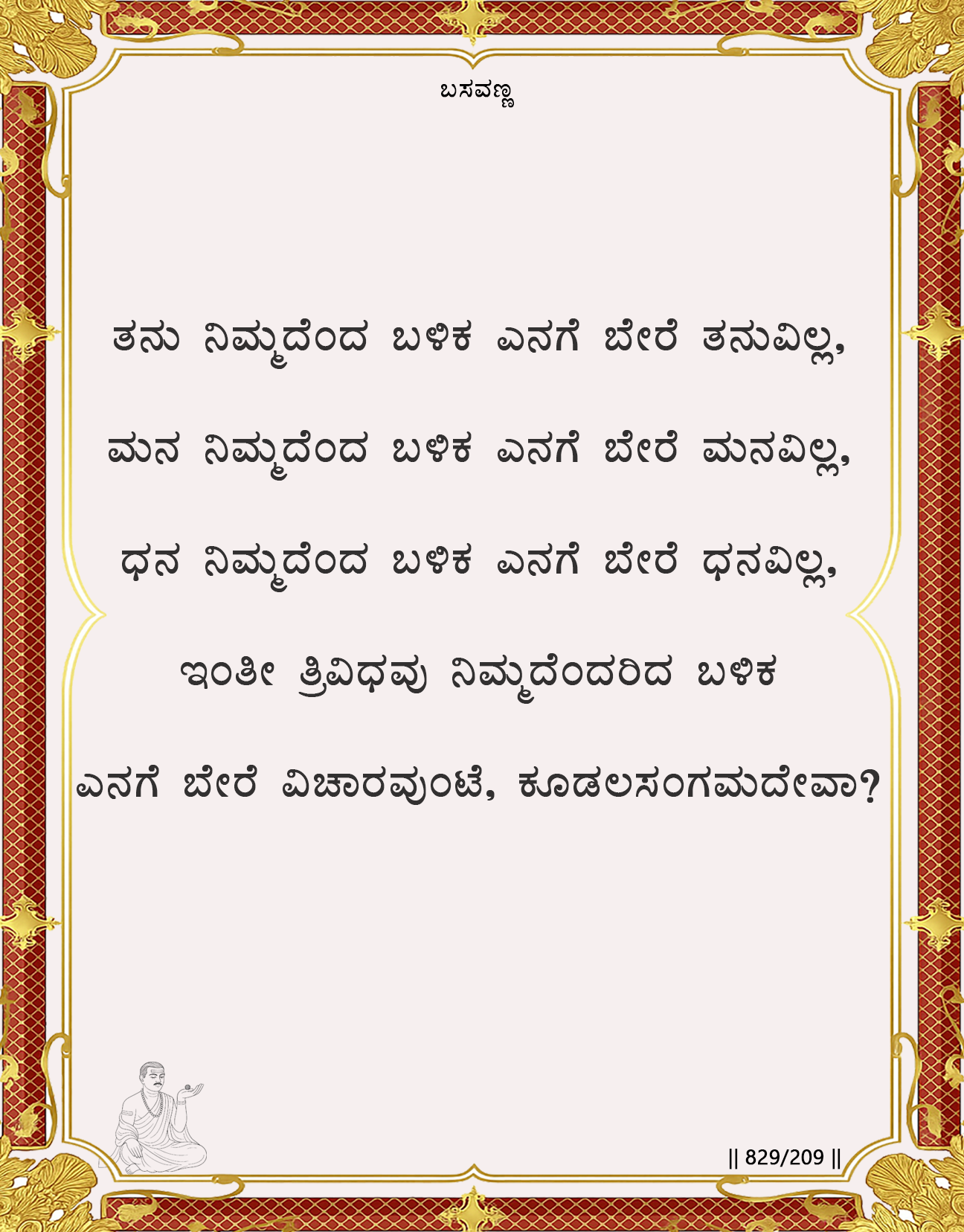
My body is Yours
then what body can I call mine?
My mind is Yours
then what thought remains to bear my name?
My wealth is Yours
then what treasure lies within my grasp?
When body, mind, and wealth
have all returned to their true master,
what space is left for the restless “I”
to wander and worry,
O Kudalasangamadeva?
In this perfect arithmetic of surrender,
when everything is handed over,
nothing remains
except You.
Basavanna presents the mathematics of surrender: the ego exists only by claiming ownership “my body,” “my mind,” “my wealth.” As each of these is offered to the Divine, the ego progressively loses its ground. When all is surrendered, the possessor the “I” has no territory left and naturally dissolves. This is not annihilation but liberation, where the illusion of separateness ends and only the Divine shines. True surrender is not giving up life but giving up the illusion of ownership that hides the Divine within.
Spiritual Context
Core Spiritual Principle: The ego (ahamkara) is not a substantive entity but a parasitic construct that arises from the mistaken appropriation of what is not-self (anatman). Liberation is achieved not by improving or fighting the ego, but by systematically withdrawing the energy of identification from its claimed territories until it starves and vanishes.
Cosmic Reality Perspective: This is the ultimate expression of non-duality. The world of names and forms (Nama-Rupa) is a manifestation of the Divine (Linga). The sense of “I” and “mine” is the primary obscuration that prevents the recognition of this truth. Surrender is the process of removing this obscuration, allowing the inherent unity to shine forth.
Historical Reality (Anubhava Mantapa Context): This vachana provides the metaphysical foundation for the socio-economic practices of the Sharanas. Their commitment to Kayaka (work as worship) and Dasoha (communal offering) was not merely altruism; it was the lived application of this “algebra of surrender,” where one works without claim to the fruits, recognizing that the worker, the work, and its results all belong to Koodalasangamadeva.
Interpretation
“My body is Yours then what body can I call mine?”: The first and most fundamental surrender is of physical identity. The body is the most tangible thing we call “I.” By offering it, the root of physical identification is severed.
“My mind is Yours then what thought remains to bear my name?”: This targets the subtle body. Thoughts, emotions, and memories are the internal narrative that sustains the “I.” Surrendering the mind dismantles the very machinery of ego.
“My wealth is Yours then what treasure lies within my grasp?”: This addresses external extensions of the self. Possessions represent security, power, and identity in the world. Letting go of “mine” removes the ego’s external scaffolding.
“what space is left for the restless ‘I’…?”: This is the final, revelatory question. With no objects to claim, the subject that claims them has no functional reality. It is a ghost in a machine that has been dismantled.
Practical Implications: The path of Lingayoga is a continuous practice of offering. Every breath, every thought, every possession is to be consciously recognized as belonging to the Linga. This is not a one-time act but a constant orientation of consciousness that gradually erodes the ego’s foundations.
The Cosmic Reality
Anga (Human Dimension): The complex of body, mind, and possessions, mistakenly identified as “self.” This is the bundle of aggregates that appears separate.
Linga (Divine Principle): The sole reality and true substance of all that is. It is the only legitimate “Owner” and the ground in which all phenomena arise and subside.
Jangama (Dynamic Interaction): The sacred process of return. It is the act of prayer, remembrance, and conscious living that facilitates the transfer of title from the illusory individual self (Anga) back to the universal Divine (Linga). This movement is liberation in action.
Shata Sthala
Primary Sthala: Aikya The vachana does not describe the struggle of surrender but its final, blissful conclusion. The series of rhetorical questions leads to the silent, self-evident answer: “Nothing remains except You.” This is the voice of one who abides in the non-dual state of Aikya, where the separation between devotee and Divine has ceased.
Supporting Sthala: Sharana The practical means to reach this end is the steadfast stance of the Sharana one who has taken refuge. The life of a Sharana is a lived enactment of this algebra, constantly offering all aspects of life at the feet of the Linga until the offering is total and the offeror is absorbed into the offering.
Practical Integration
Arivu (Awareness Practices): Throughout the day, practice the mantra: “This body is Yours. This thought is Yours. This object is Yours.” Use this not as a concept but as a felt sense of returning what was never truly owned.
Achara (Personal Discipline): Before engaging in any activity, mentally offer it to Koodalasangamadeva. Upon completion, offer the results. This severs the ego’s claim to being the “doer” (karta) and the “enjoyer” (bhokta).
Kayaka (Sacred Action): Perform your work as an offering. See your skills, time, and energy as divine instruments. The income generated is not “your” profit but a resource for Dasoha, to be managed as a divine trust.
Dasoha (Communal Offering): The community is the crucible for this surrender. By sharing resources and serving without expectation of return, members continuously practice the dissolution of “mine” and experience the joy and freedom of living in a shared, divine economy.
Modern Application
Contemporary culture is built on the cultivation and protection of ego-identity: “my career,” “my brand,” “my possessions,” “my opinions.” This hyper-individuation leads to existential anxiety, loneliness, and relentless striving, as the self is a fragile construct that requires constant defense and validation.
This vachana offers the ultimate liberation from the burden of self-management. It reveals that our deepest suffering comes from claiming ownership of a life that is inherently part of a vast, flowing whole. To surrender is to put down this exhausting burden. It allows one to engage with life passionately but without the anxiety of personal gain or loss, discovering a profound peace and connectedness that the ego could never provide.
Essence
I claimed a house, a mind, a name
and called the debt “myself.”
I returned the keys to the only Owner,
and found the debt was never real.
The ego is a standing wave pattern a seemingly stable structure formed by the interaction of various energy streams (body, mind, possessions). Surrender is the process of ceasing to reinforce this pattern. As each stream is recognized as part of the larger ocean (Linga) and its energy is no longer claimed for the localized pattern, the wave collapses back into the sea from which it arose, leaving only the ocean.
Imagine your sense of “I” is a knot in a handkerchief. The knot has no substance of its own; it is just a configuration of the cloth. The practices of surrender are like gently loosening the knot. When the cloth is completely smooth, the knot is gone, but the handkerchief remains, now in its natural, free state. You haven’t destroyed anything real; you’ve just undone a constriction.
The universal human struggle is the burden of selfhood the weight of responsibility, the fear of loss, the anxiety of not being enough. This vachana points to the astonishing truth that this self is a fiction maintained by claiming things that were never ours. The ultimate peace and freedom come from realizing we are not the anxious owner, but the boundless presence in which the entire drama of ownership and loss unfolds.

Views: 0