Poetic Rendering

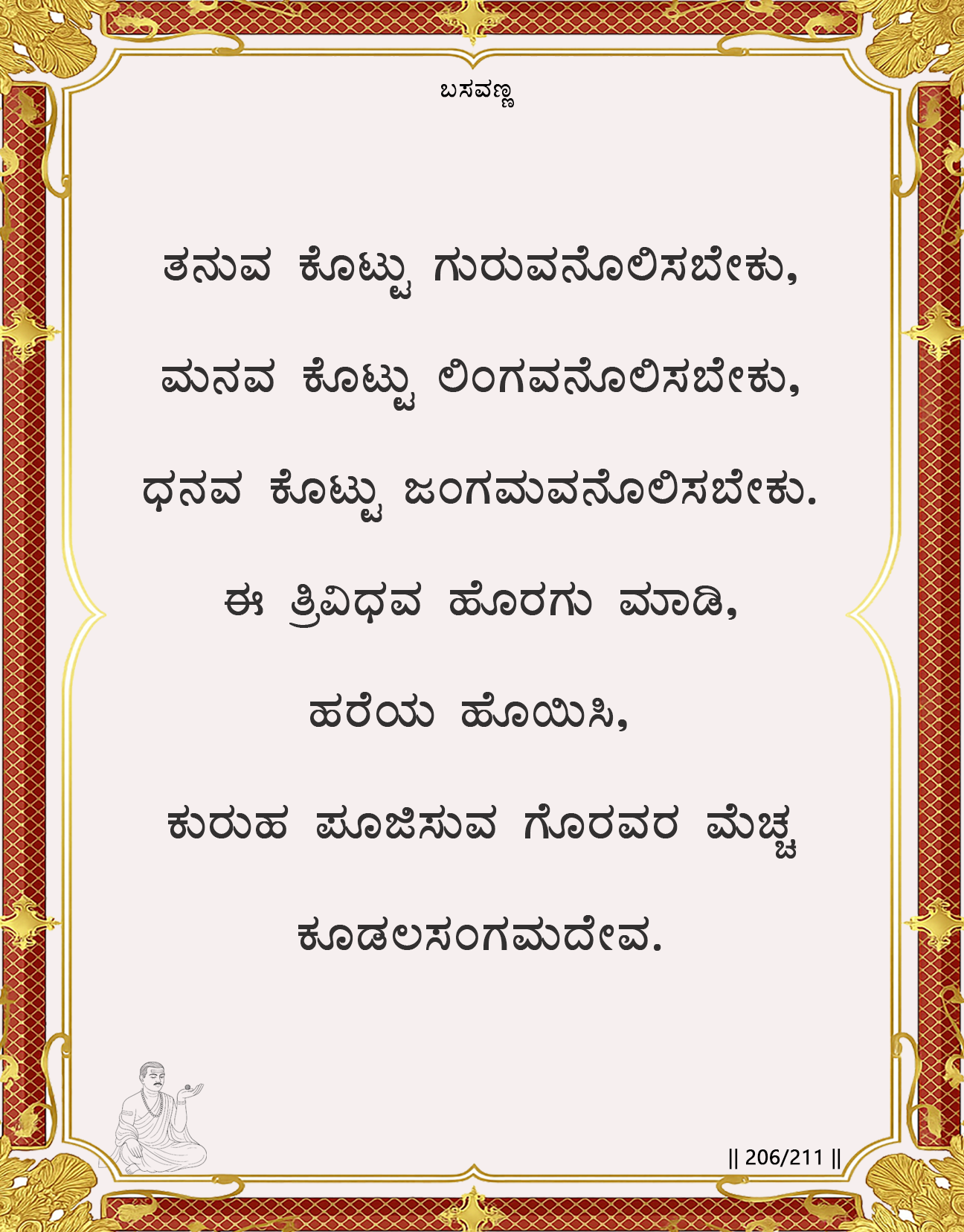
Offer your body in devoted service to the Guru,
Offer your mind in pure surrender to the Linga,
Offer your wealth in sacred sharing with the Jangama.
But if after making these three offerings
you still parade them with pride
beating the drum of your own ego
as though it were stretched from your very skin
and worship only the sign, the outer symbol,
then such offerings are hollow,
unaccepted by the true Guru,
O Kudalasangamadeva.
Basavanna teaches that true spiritual life is grounded in three authentic offerings: – serving the Guru with the body, – surrendering the mind to the Linga, – and sharing one’s wealth with the Jangama. But if these acts are done with pride, display, or ego, they lose all sanctity. The moment one boasts of service or seeks recognition, the offering becomes empty like beating a drum made from one’s own skin. Such outward show is mere worship of symbols, not of truth. Only humility and sincere inner surrender are accepted by Kudalasangamadeva.
Spiritual Context
Core Spiritual Principle: The spiritual value of an action is determined solely by the consciousness (bhavana) behind it, not by the action itself. An offering made with ego is not an offering at all, but a reinforcement of the very separation it purports to transcend. The antidote to this is humility (vinaya), which is the true mark of authenticity.
Cosmic Reality Perspective: In the non-dual reality of Shiva-Shakti, all action is already a movement of the Divine. The individual ego claiming authorship of a “holy” act is a profound contradiction it is the finite claiming ownership of an infinite process. Such pride creates a hard shell of separation that blocks the flow of grace.
Historical Reality (Anubhava Mantapa Context): As the Lingayoga movement grew, the risk of spiritual materialism using one’s piety, service, or philanthropy for social status became real. This vachana is a direct safeguard, a quality-control measure for the community. It ensures that the revolutionary social practices of Kayaka and Dasoha remain rooted in genuine inner transformation, not in a new form of egoistic competition.
Interpretation
The Tripartite Offering: This structure comprehensively covers the entirety of human existence: physical action (body), internal state (mind), and external resources (wealth). It presents a complete map for a sanctified life.
“beating the drum of your own ego as though it were stretched from your very skin”: This is a devastating metaphor. The ego (ahamkara) is the “skin” that creates a sense of separation. To boast of one’s spirituality is to beat a drum made from this very skin of separation. The sound it produces is not divine music but the empty noise of the ego celebrating itself, a closed loop of self-congratulation that reaches no one else, least of all the Divine.
“worship only the sign, the outer symbol”: This condemns ritualism without inner substance. The “sign” is the external act of service, the physical Linga, or the act of giving. When divorced from the inner state of selfless surrender, these become idols worshipped in place of the truth they are meant to point toward.
Practical Implications: The practice of Lingayoga requires constant vigilance over one’s motivation. Before any spiritual act, one must inquire: “For whom is this being done?” The goal is to perform all actions as an offering (arpana) where the sense of being the offeror has been surrendered, leaving only the offering itself.
The Cosmic Reality
Anga (Human Dimension): The individual capable of performing sacred actions (service, surrender, sharing) but also susceptible to the corruption of those actions through egoic pride and the desire for recognition.
Linga (Divine Principle): The absolute standard of purity and selflessness. It is the consciousness that receives an offering only when the offering is free from the taint of the separate self.
Jangama (Dynamic Interaction): The process of purification. It is the sincere effort to offer one’s body, mind, and wealth, coupled with the continuous self-inquiry that checks for the subtle inflation of the ego. The Jangama is the living corrective that realigns the Anga with the Linga.
Shata Sthala
Primary Sthala: Maheshwara The ability to make this distinction between authentic surrender and egoic display is the hallmark of the Maheshwara stage. It represents a “lordly” overview of the spiritual path, understanding the subtle traps that can ensnare even a diligent practitioner.
Supporting Sthala: Sharana The threefold offering is the foundational discipline of the Sharana. This vachana is an advanced teaching for Sharanas, urging them to move from the external form of the practice to its inner essence, ensuring their refuge remains pure.
Practical Integration
Arivu (Awareness Practices): Cultivate the awareness of “the silent offering.” Perform acts of service, meditation, and charity so discreetly that your left hand does not know what your right hand is doing. The highest offering is one that is forgotten the moment it is made.
Achara (Personal Discipline): Make anonymity a spiritual discipline. When you help someone or contribute to the community, do so without attaching your name or expecting gratitude. See if you can derive satisfaction from the act itself, not from the recognition it might bring.
Kayaka (Sacred Action): Perform your work with excellence, but let the credit flow to others or to the Divine. See yourself as an instrument. The greatest Kayaka is one where the worker is invisible, and only the sacred nature of the work is apparent.
Dasoha (Communial Offering): In the community, celebrate collective success over individual achievement. Create a culture where humility is valued more than prominence, and where the focus is on the shared goal of spiritual awakening, not on personal spiritual status.
Modern Application
We live in the age of the “personal brand,” where virtue signaling, performative activism, and the curated display of one’s spirituality (on social media and elsewhere) are rampant. Actions are often undertaken for likes, validation, and social capital, utterly voiding them of authentic spiritual power.
This vachana is a radical call to integrity. It liberates us from the exhausting need to manage our spiritual image. It invites us to find freedom in anonymous service and silent surrender, where the act is its own reward. It assures us that the only audience that matters the Divine is not impressed by displays, but is moved only by the genuine, humble offering of a sincere heart.
Essence
To serve, to surrender, to share
these are the three legs of the stool.
But if you carve your name on it,
you have built not a seat for the Divine,
but a monument to yourself.
An authentic spiritual offering creates a coherent, selfless waveform that resonates with the fundamental frequency of the Linga (non-dual awareness). An offering corrupted by pride creates an incoherent waveform where the signal of surrender is drowned out by the noise of the ego. The system (the cosmos/Divine) cannot receive the incoherent signal; it is like static that cannot carry information. The offering is “unaccepted” not as a punishment, but as a natural law of spiritual physics.
Imagine you are sending a gift to a king. If you send a humble, well-wrapped package (sincere offering), it is accepted. But if you tie a giant, noisy megaphone to the box that keeps shouting, “I sent this! Look how great I am!” (egoic pride), the palace guards will reject it at the gate. The problem isn’t the gift, but the disruptive noise attached to it.
We have a deep-seated need for our efforts to be seen and valued. This vachana does not deny this need but redirects it to the only audience that can provide absolute and unconditional validation: the Divine within. It teaches that the quiet, inner confirmation of having acted with purity is infinitely more satisfying than any external applause, and it is the only satisfaction that truly liberates.

Views: 0