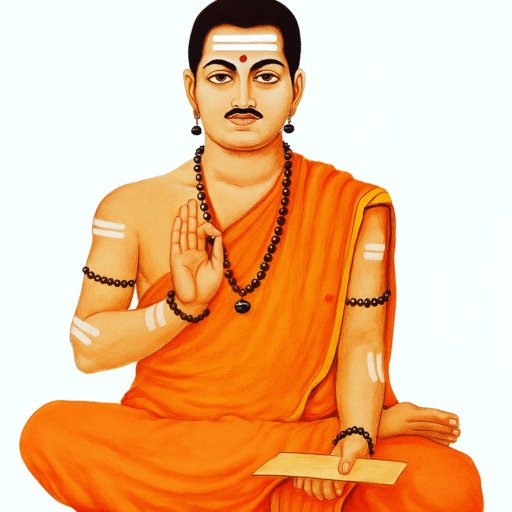

Poetic Rendering

My body feels its aches,
my mind knows its wounds
yet having placed myself at Your feet,
how can these remain mine?
If You, O Kudalasangamadeva,
pervade my breath, my bones, my very being,
then every throb of this body,
every flicker of this mind,
is but the Linga’s own feeling.
For the one who has surrendered “I,”
there is no “my pain” or “my trouble”
the body is Your temple,
the mind Your dwelling,
and all that stirs within Shiva Bhakta
belongs only to You.
Basavanna teaches that when the seeker truly surrenders the sense of “I,” the body and mind no longer belong to the individual. Their joys and pains are absorbed into the Divine who inhabits them. Since the Linga pervades the devotee completely, whatever is felt by the Shiva Bhakta is the Divine’s own experience. Thus, pain is not a personal burden but part of the living union between devotee and God.
Spiritual Context
Core Spiritual Principle: The root of suffering is identification with the body-mind as “self.” Liberation is the recontextualization of this same body-mind as a vessel for the Divine. In this state, experiences are not owned by a personal ego but are witnessed as movements within the divine consciousness, thereby losing their power to cause existential suffering.
Cosmic Reality Perspective: This is the practical culmination of Shiva-Shakti non-duality. The individual soul (Shakti) has fully recognized itself as a manifestation of the Absolute (Shiva). Therefore, all of its manifestations including pain, aging, and death are seen as divine processes. The waves (individual experiences) are not separate from the ocean (Divine Consciousness).
Historical Reality (Anubhava Mantapa Context): This teaching provides immense psychological and spiritual resilience. It empowers the devotee to face the inevitable hardships of life and the physical challenges of a disciplined spiritual path without being broken by them. It transforms the very basis of experience from a personal problem to a participatory sacred event.
Interpretation
“My body feels its aches, my mind knows its wounds yet having placed myself at Your feet, how can these remain mine?”: This is the logical argument of surrender. The act of placing oneself at the divine feet is a transfer of title. If the “I” has been given away, then all its attributes and experiences are included in the transfer. To claim “my pain” after this is a contradiction.
“every throb of this body… is but the Linga’s own feeling”: This is the radical re-framing of experience. Sensation is stripped of its personal narrative. A pain in the leg is not “my suffering” but “the Linga’s sensation in this leg.” This creates a profound detachment that allows the sensation to be experienced purely, without the added layer of psychological distress.
“the body is Your temple, the mind Your dwelling”: This is the foundational metaphor. One does not complain about the weathering of the temple walls or the settling of its foundations; one maintains the temple as an offering to the deity within. Similarly, the devotee cares for the body-mind not for personal comfort but as an act of service to the divine resident.
Practical Implications: The practice of Lingayoga involves this constant re-perception. When pain or difficulty arises, the practice is to inwardly say, “This is Your temple, this is Your experience,” thereby offering the sensation to the Linga. This transforms suffering into a form of intimate communion.
The Cosmic Reality
Anga (Human Dimension): The physical and mental apparatus that registers sensory and emotional data. It is the instrument of experience, now consecrated.
Linga (Divine Principle): The conscious, witnessing presence that is the true “I” within the temple. It is the ultimate subject, for whom all experiences within the temple are occurring.
Jangama (Dynamic Interaction): The continuous act of consecration. It is the flow of awareness that labels every sensation as “Yours, not mine,” and the loving maintenance of the temple (through Achara and Kayaka) for the pleasure of its Divine Inhabitant.
Shata Sthala
Primary Sthala: Aikya The voice in this vachana is not that of a seeker striving for union, but of one abiding in its fulfillment. The dissolution of personal ownership over experience is the hallmark of the non-dual state of Aikya.
Supporting Sthala: Pranalingi This stage describes the total dedication of one’s life force to the Linga. The Pranalingi’s every breath and heartbeat are for the Linga; this vachana takes it a step further, stating that every sensation within that life force is also the Linga’s.
Practical Integration
Arivu (Awareness Practices): When physical or emotional pain arises, practice this shift in identification. Instead of “I am in pain,” practice perceiving “There is pain in this body that belongs to Shiva.” Observe the sensation with the detached curiosity of a caretaker tending to a sacred shrine.
Achara (Personal Discipline): Care for your body (diet, rest, hygiene) as an act of temple maintenance. Engage in practices that purify the mind (meditation, japa) as a way of cleaning the inner sanctum for the deity.
Kayaka (Sacred Action): Use your body’s strength and your mind’s focus in work as an offering. When the body tires, offer that fatigue to the Linga as the natural result of the temple being used for sacred labor.
Dasoha (Communal Offering): Extend this understanding to others. See each person as a walking temple of the Divine. Respond to their pain with the reverence of one tending to a sacred site, offering comfort as an act of service to the indwelling Linga.
Modern Application
Contemporary culture is intensely focused on the body and mind as sites of personal identity and optimization. We are consumed by the pursuit of perfect health, agelessness, and happiness, leading to a deep fear of pain, decline, and mortality. This creates immense anxiety and a sense of personal failure when the body-mind inevitably suffers.
This vachana offers profound liberation from the tyranny of the perfectible self. It allows one to face chronic illness, aging, and emotional wounds with grace and dignity. It reframes the human journey not as a personal battle against suffering, but as a divine drama unfolding within a sacred vessel. This brings a deep, unshakeable peace that is independent of physical or mental states.
Essence
This pain is not a breach in my walls,
but a note in Your song.
This temple feels the rain and sun,
and every weathering is Your touch.
The individual consciousness is a localized field of awareness within the universal field (Linga). Normally, sensations are tagged with a “self” metadata, creating a proprietary claim that generates suffering. In the state described, the “self” metadata is replaced with “Linga” metadata. The sensory data (pain) remains the same, but because it is now recognized as data within the universal field rather than data owned by a local node, it no longer generates system-level distress (suffering). The local node (the individual) continues to process the data, but as a function of the whole.
Imagine you are a character in a video game. Normally, if your character gets hurt, you feel stressed and identify with the damage. But if you realize you are the player, not the character, you can watch the character take damage with concern for the game’s outcome, but without the visceral, personal fear. Basavanna is saying, “You are the Player (Shiva) experiencing the game through the character (the body). The character’s pains are part of the game’s reality, not yours.”
The universal human experience is the fear of pain and the vulnerability of the body. This vachana addresses this deepest fear by revealing that our true identity is the boundless consciousness that witnesses the body, not the body itself. It is an invitation to find safety not in the fragile vessel, but in the immortal Captain who sails it.

Views: 0