Poetic Rendering

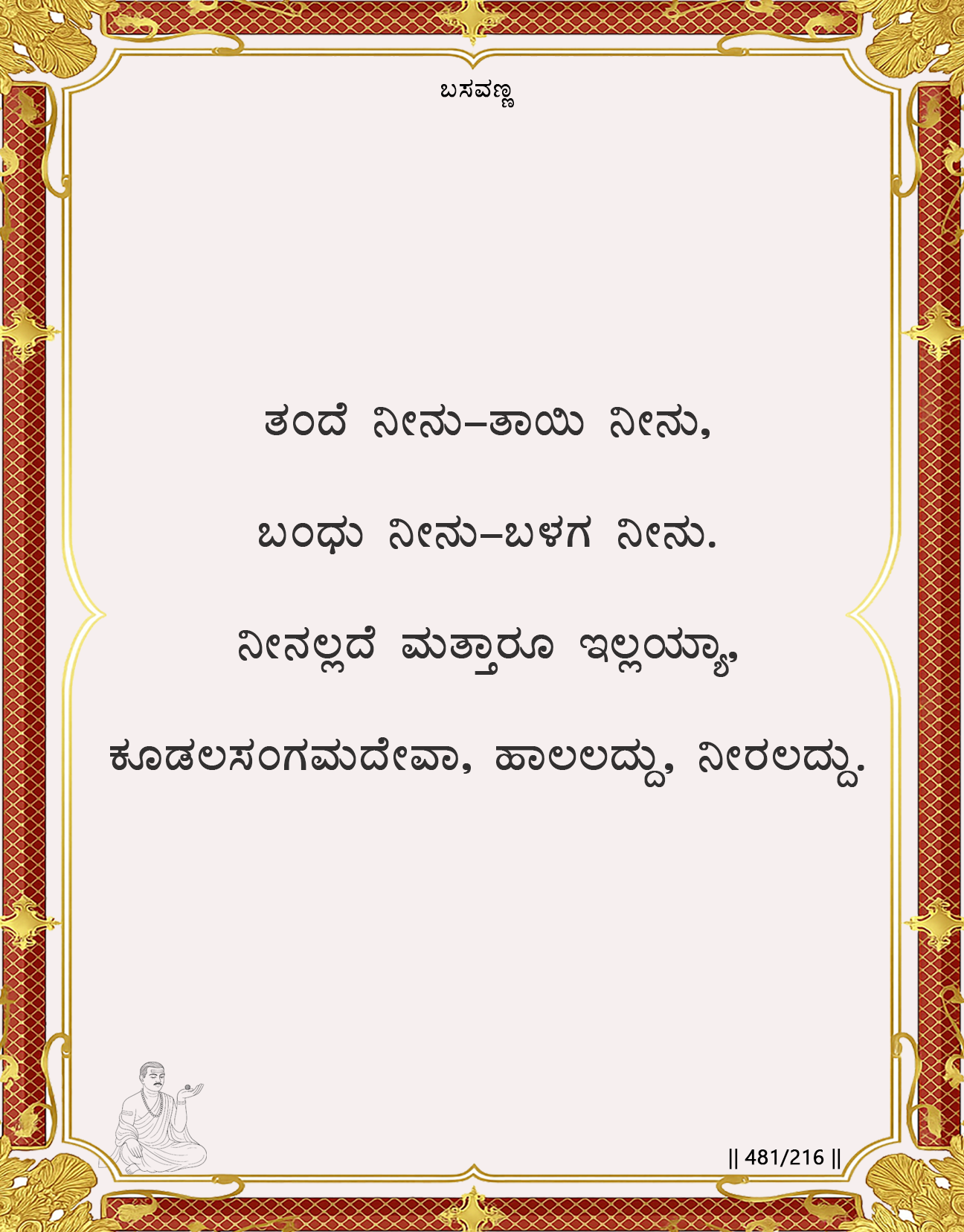
You are my father,
You are my mother.
You are my kin,
You are my clan.
Beyond You,
there is no other.
O Kudalasangamadeva
before You,
all distinctions vanish:
there is neither milk nor water,
only the One without a second.
Basavanna proclaims that the Divine alone is the true source of all relationships and identities father, mother, family, and lineage. Everything that seems separate or divided returns to this single origin. When he says “neither milk nor water,” he points to the dissolving of all social distinctions and classifications whether sacred or mundane, pure or impure, superior or inferior. Just as milk and water become inseparable when mixed, so too all forms and identities merge in the Divine. For Basavanna, every caste, creed, and category is an illusion; only Kudalasangamadeva remains real and all-pervading.
Note: Kudalasnagamadeva – Kudala this very moment – sangama the merger – deva you are divine unto yourself.
Spiritual Context
Core Spiritual Principle: All relative identities and distinctions are provisional and ultimately unreal. The only absolute, non-contingent reality is the Divine. Liberation (moksha) is the direct realization that one’s true identity is this Divine source, before and beyond all familial, social, and ritual classifications.
Cosmic Reality Perspective: This is the pure expression of Shiva-Advaita (non-dualism). The world of name and form (Nama-Rupa), including the most intimate human relationships, is a manifestation of the one consciousness. To see “father” and “mother” as separate from the Divine is to see the wave as separate from the ocean. The statement “neither milk nor water” signifies the transcendence of all gunas (qualities) and dvandvas (dualities).
Historical Reality (Anubhava Mantapa Context): This vachana is the theological death-blow to the caste system. If the Divine is the only true father, mother, and clan, then the pride of lineage and the stigma of low birth are equally illusory. It provides the metaphysical basis for the radical social equality practiced in the Anubhava Mantapa, where all were considered children of one God.
Interpretation
“You are my father, You are my mother…”: This is not merely poetic devotion but a statement of ontological fact. It traces the source of one’s being beyond the biological parents to the ultimate creative principle. It severs the root of identity-from-birth (jati) that caste is built upon.
“Beyond You, there is no other.”: This is the core non-dual declaration (ekameva advitiyam). It leaves no room for any other ultimate reality not a separate soul, not a separate world, and certainly not a separate social hierarchy.
“neither milk nor water… only the One without a second.”: The “milk and water” metaphor is profound. In society, milk symbolizes purity, nobility, and high caste, while water is common and mundane. Basavanna declares that from the perspective of the Absolute, these distinctions do not exist. They are mixed and unified in the one reality. The seeker who realizes this becomes free from all concepts of purity and impurity, high and low.
Practical Implications: The realization of this truth demands a lived expression. It means relating to all beings as manifestations of the same Divine Source, thereby eradicating prejudice, favoritism, and discrimination from one’s heart and actions.
The Cosmic Reality
Anga (Human Dimension): The consciousness that has shed all limited identities and now knows itself solely as a child of the Divine, a manifestation of the One.
Linga (Divine Principle): The absolute, non-dual source and substratum. It is the “Father-Mother” of all manifestation, the sole “Kin” in the family of existence.
Jangama (Dynamic Interaction): The process of seeing through the illusion of separation. It is the constant remembrance that turns every encounter with “another” into a recognition of the one Linga, thereby dissolving the boundaries of “milk” and “water” in the crucible of daily life.
Shata Sthala
Primary Sthala: Aikya The voice in this vachana is that of one established in union. The dissolution of all duality, even the most fundamental biological and social dualities, is the hallmark of the Aikya stage.
Supporting Sthala: Sharana This realization is the ultimate fulfillment of taking refuge. The Sharana finds that in surrendering to the Divine, they have not lost a family but gained the entire universe as their kin, all contained within the one Beloved.
Practical Integration
Arivu (Awareness Practices): In meditation, contemplate the source of your “I.” Trace it back beyond your name, your job, your family role, until only the pure sense of “Am-ness” remains. Recognize this as Koodalasangamadeva.
Achara (Personal Discipline): Consciously practice seeing the Divine in everyone you meet your biological parents, your friends, and strangers alike. Let your respect and compassion be unconditional, based on this shared divine kinship.
Kayaka (Sacred Action): Perform your work for the sake of the one Divine family. Let your labor be an offering that sustains the community of manifestations of God, without discrimination.
Dasoha (Communal Offering): The community (Sangha) must be a living embodiment of this truth. It should be a space where no one is “other,” where all distinctions of background are irrelevant, and where the only identity that matters is that of a Sharana, a child of God.
Modern Application
Our world is fractured by intense identity politics, nationalism, religious sectarianism, and socio-economic tribalism. We are hyper-aware of what separates us: our race, our gender, our political party, our nationality. This creates endless conflict and a deep sense of alienation.
This vachana offers a healing vision that transcends yet includes all identities. It does not ask us to abandon our cultural heritage, but to see it as a beautiful, temporary wave on the ocean of a shared Divine consciousness. It provides the ultimate foundation for universal brotherhood and sisterhood, allowing us to honor diversity while resting in the profound truth of our essential unity. It liberates us from the prison of “us vs. them.”
Essence
All the rivers have one thirst:
for the sea.
All the names have one silence:
for the Nameless.
Individual identities are like unique waveforms a “father” waveform, a “mother” waveform, a “high caste” waveform, a “low caste” waveform. They appear distinct but are all perturbations of the same underlying quantum field (the Linga). The realized state is the collapse of these specific waveforms back into the ground state of the field, where all differentiating information is lost, and only pure, undifferentiated potentiality remains. The statement “neither milk nor water” describes this ground state where all qualities are in superposition and unity.
Imagine a vast, dark room. You light a candle (a father), a lamp (a mother), a neon sign (a king), and a matchstick (a servant). Each has a distinct color, brightness, and identity. Now, imagine turning on the main, blazing white light of the sun. All the smaller lights are swallowed up in that one, all-pervading radiance. You can no longer point to the candle or the matchstick; there is only light. Basavanna is speaking from the perspective of that sun-like awareness.
We have a deep, primal need to belong, to have a source, and to be part of a tribe. This vachana fulfills this need at the highest level. It reveals that our truest, most secure belonging is not to a fragile human family or a temporary social group, but to the very source of the cosmos itself. This is the ultimate homecoming, where one finds themselves to be a beloved child of the Universe.

Views: 0