
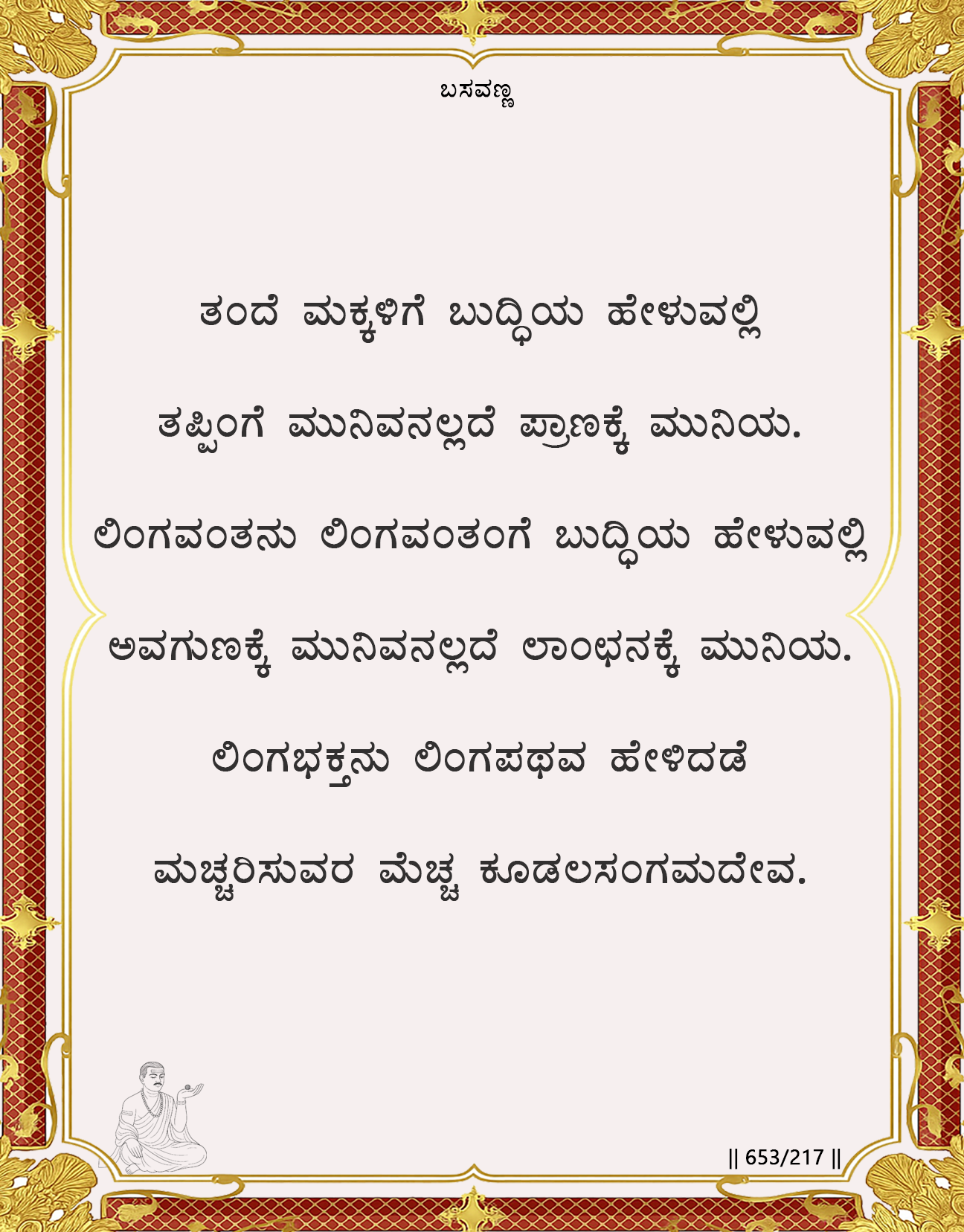
Poetic Rendering

When a father scolds his child,
his anger is never for the child’s life
only for the misstep.
When a Shivayogi corrects
a fellow seeker on the path of the Linga,
his reproach is not for the soul
only for the fault that veils it.
So when one points out
the way of truth and right conduct,
let not envy rise nor pride rebel.
Let the heart bow in recognition,
for such correction is grace itself,
O Kudalasangamadeva.
Basavanna teaches that genuine correction within the spiritual path is an act of compassion, not condemnation. Just as a loving father disciplines only to protect his child, a true Lingayogi corrects a fellow seeker not out of disdain but out of care for the soul’s progress. The fault not the person is what is addressed. Therefore, when guidance or correction comes, one must not fall into jealousy or ego but recognize it as divine grace pointing the way back to truth.
Spiritual Context
Core Spiritual Principle: On the spiritual path, ego is the primary obstacle. A necessary antidote to ego is humble acceptance of constructive feedback. True spiritual friendship (satsangha) involves the mutual duty to guide each other away from error and back to the truth, always differentiating the fallible action from the infallible divine essence within the individual.
Cosmic Reality Perspective: From the non-dual view, correction is a manifestation of divine grace (Shakti) working to remove the obscurations (malas) that prevent the recognition of the inherent unity (Linga) within all. It is not a personal conflict but a cosmic process of purification.
Historical Reality (Anubhava Mantapa Context): The Anubhava Mantapa was a living laboratory for spiritual democracy. For such a diverse community to function, a robust culture of constructive feedback was essential. This vachana provides the ethical framework for that culture, preventing conflicts and ensuring that criticism served a unifying, rather than divisive, purpose.
Interpretation
“his anger is never for the child’s life only for the misstep.”: This establishes the fundamental principle of separating the actor from the action. The soul (the child’s life) is inherently pure and divine; the error (the misstep) is a temporary clouding that can be corrected.
“his reproach is not for the soul only for the fault that veils it.”: This applies the paternal analogy directly to the spiritual context. The Lingayogi’s goal is to remove the veil (the fault) to reveal the ever-shining Linga (the soul) within the fellow seeker.
“let not envy rise nor pride rebel… for such correction is grace itself.”: This addresses the primary pitfalls of the ego when faced with correction: envy of the corrector’s insight, and prideful rebellion against their authority. The vachana re-frames the entire event, revealing it not as a personal attack but as a gift of grace (prasada) from the Divine, channeled through the Jangama.
Practical Implications: For a Lingayogi, both giving and receiving correction become spiritual practices. Giving requires pure intention and compassion. Receiving requires the humility to see one’s own blind spots and the wisdom to recognize the divine hand in the process.
The Cosmic Reality
Anga (Human Dimension): The individual who, in ignorance, commits a fault and whose ego is prone to defensiveness. Also, the individual who, with compassion, offers correction.
Linga (Divine Principle): The perfect standard of truth and conduct. It is the unwavering reference point that makes the concept of a “fault” or “misstep” meaningful.
Jangama (Dynamic Interaction): The entire ecosystem of mutual upliftment. It is the loving correction, the humble acceptance, and the resulting purification that brings the Anga closer to its true nature as the Linga.
Shata Sthala
Primary Sthala: Sharana The behavior described is the practical ethics of the Sharana community. Taking refuge means trusting that the community acts for your highest good, even when its feedback is difficult to hear.
Supporting Sthala: Maheshwara The capacity to give and receive correction in this spirit requires the “great” (maha) discernment of the Maheshwara, which can perceive the eternal amidst the temporal and act without personal motive.
Practical Integration
Arivu (Awareness Practices): When you feel criticized, practice self-inquiry: “Is my reaction coming from a hurt ego, or is there a truth here I need to see?” Use the emotional charge as a signal to look deeper, not to retaliate.
Achara (Personal Discipline): Cultivate the discipline of accepting feedback gracefully. Practice saying, “Thank you for pointing that out. I will reflect on it.” This breaks the cycle of defensive ego.
Kayaka (Sacred Action): In your work, be open to feedback on how to improve your service. See it as a way to refine your Kayaka, making it a more perfect offering.
Dasoha (Communal Offering): Offer the gift of loving, truthful feedback to your spiritual siblings. Do so with care and only for the purpose of upliftment. Also, offer the gift of a receptive heart when others do the same for you.
Modern Application
We live in a culture of extreme sensitivity and defensiveness, where any critique is often perceived as a “micro-aggression” or a personal attack. This has led to a breakdown of constructive dialogue and a stunting of personal and professional growth, as people become afraid to give or receive honest feedback.
This vachana offers a timeless framework for healthy conflict and profound growth. It liberates us from the fragility of the ego by teaching us to value truth over comfort. It allows us to build relationships in workplaces, families, and spiritual communities where honest communication fosters trust and accelerates collective and individual evolution, all rooted in mutual respect and a shared commitment to the highest good.
Essence
The sculptor does not hate the stone
when he chips away what hides the god.
The wound is in the excess,
not in the form awaiting release.
The ego is a coherent but limited pattern of information. Correction is an external input of new information designed to disrupt that limited pattern and allow it to re-cohere into a more expansive, accurate, and functional state (closer to the Linga). The ego’s defensive reaction is the system’s resistance to this necessary perturbation. Humility is the system’s lowering of its defensive thresholds, allowing the corrective information to be integrated, leading to a phase transition in consciousness.
Imagine your mind is a garden. A fault is a weed. A friend who points out the weed is not attacking your garden; they are helping you tend to it. Your pride is like refusing to pull the weed because you don’t want to admit it’s there. The vachana teaches us to be grateful for the gardener who helps us see the weeds, because they care for the beauty of the garden itself.
We have a deep-seated need to be right and to be seen as good. This makes us vulnerable to criticism. This vachana addresses that vulnerability by redefining the very meaning of correction. It is not an indictment of our worth, but an affirmation of our potential. It is the love of the community saying, “We see the divine in you, and we are helping you remove what obscures it.”

Views: 0