Poetic Rendering

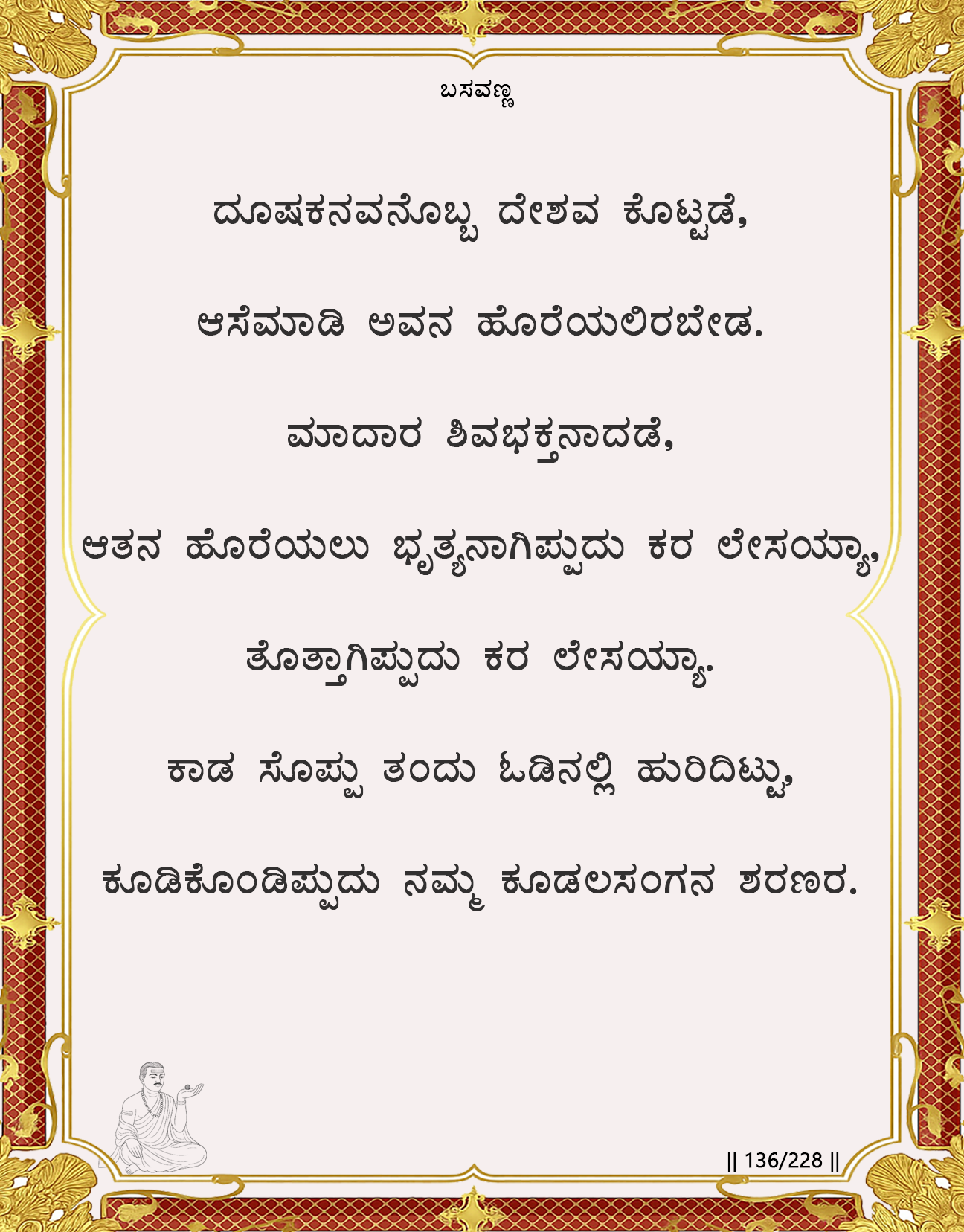
If a wicked man were to offer you
a whole country and all its lands,
do not accept even the shade of his doorway.
But if a true Shiva-bhakta such as Madara Chennayya
offers you only his humble hut,
then serve him as a servant,
stand before him as his shield.
Even if it means gathering wild leaves from the forest
and carrying them upon your head to share with him
know this, O Kudalasangama
this alone is the blessed company
of Your sharanas.
In this vachana Basavanna constructs a radical spiritual economy in which the moral quality of the giver outweighs the material value of the gift. Wealth acquired through adharma is seen as energetically toxic, while even the poorest offering from a sincere bhakta becomes spiritually priceless. Choosing the hut of a devotee over the kingdom of the corrupt is not sentimental preference but metaphysical discernment: one aligns oneself not with external prosperity but with inner luminosity. For Basavanna, proximity to those moving toward sharana-hood is the highest investment of one’s life-force, because service to such beings accelerates one’s own ascent toward the divine presence of Kudalasangama.
Spiritual Context
Core Spiritual Principle: All matter is congealed consciousness. Wealth or food obtained through unrighteous means carries the imprint of that corrupt consciousness and will bind and poison the receiver. An offering from a pure heart, regardless of its material scale, carries the imprint of divine consciousness and liberates. Therefore, the source of one’s sustenance is a primary determinant of one’s spiritual state.
Cosmic Reality Perspective: The Linga is pure, undifferentiated consciousness. To accept anything that originates in duality, exploitation, and ignorance (the “wicked man’s” wealth) is to introduce a foreign, dissonant element into one’s system, moving it away from coherence with the Linga. To accept from a bhakta is to receive a substance already aligned with the divine frequency.
Historical Reality (Anubhava Mantapa Context): This was a crucial economic and social doctrine for the Sharanas. It empowered them to reject patronage from corrupt kings and landlords, ensuring the community’s economic and spiritual independence. It valorized the simple, honest labor of the lowly as the only truly clean wealth, and made service to the saintly poor a greater honor than service to the powerful.
Interpretation
“do not accept even the shade of his doorway.”: This is an absolute prohibition. The “shade” symbolizes the most minimal, passive form of benefit. Basavanna argues that even the most incidental association with energy derived from adharma is spiritually damaging. It is a directive for total energetic hygiene.
“serve him as a servant, stand before him as his shield.”: The response to the true bhakta is one of active, even extreme, service and protection. This is not servitude to a person, but service to the divine principle (the Linga) manifesting through that person. To be their “shield” is to protect the fragile, sacred light of bhakti in the world.
“gathering wild leaves from the forest and carrying them upon your head to share with him…”: This hyperbolic image drives home the point. The most menial labor, performed in service to a true devotee, is of infinitely greater spiritual value and dignity than lounging in the palace of the wicked. The act of sharing, of Dasoha, is what sanctifies the offering.
“this alone is the blessed company of Your sharanas.”: This defines the essence of the Lingayoga community. It is not a gathering of the wealthy or powerful, but a fellowship of mutual service centered around the recognition of divine presence in the humble and devoted.
Practical Implications: A Lingayog a must be fiercely discerning about their sources of income, their partnerships, and their associations. The primary question is not “What can I get?” but “From what consciousness does this originate?” The community must be built on an economy of righteous livelihood (Dharma-Kayaka) and selfless sharing (Dasoha).
The Cosmic Reality
Anga (Human Dimension): The individual making conscious choices about what energies to let into their life-system, actively choosing sattvic sources over tamasic or rajasic ones, even at great material cost.
Linga (Divine Principle): The pure source of all abundance and the standard of righteousness that defines what is truly “wealth.”
Jangama (Dynamic Interaction): The economy of grace. It is the flow of sustenance from the righteous devotee, the act of service in receiving it, and the shared offering that completes the circuit, enriching all involved with divine energy.
Shata Sthala
Primary Sthala: Maheshwara The “great” discernment to choose the hut over the kingdom, to see the invisible spiritual currency, is the operational intelligence of the Maheshwara stage.
Supporting Sthala: Sharana The action that results from this discernment serving the bhakta, joining their company is the very definition of taking refuge (Sharana). It is the practical implementation of the Maheshwara’s discernment.
Practical Integration
Arivu (Awareness Practices): Consciously evaluate the sources of things in your life your food, your income, your entertainment. Ask: “Does this come from a place of harm, exploitation, or greed? Or does it come from a place of honesty, kindness, and service?”
Achara (Personal Discipline): Make a personal commitment to ethical consumption and livelihood. Support businesses and individuals known for their integrity. Sever ties, where possible, with sources of income or support that are clearly unrighteous.
Kayaka (Sacred Action): Dedicate your work to serving the “good of all beings” (loka sangraha). See your labor as contributing to a clean, righteous economy that supports the spiritual awakening of society.
Dasoha (Communal Offering): The community should prioritize creating its own righteous economy.
Support the Kayaka of fellow Sharanas. Share resources so that no one is forced to accept “tainted” wealth out of desperation. Make the community a self-sustaining ecosystem of purity and grace.
Modern Application
We live in a global economy largely built on exploitation, environmental degradation, and addictive consumerism. We are enmeshed in systems where our money, food, and products often have ethically murky or outright harmful origins. We feel powerless to change this and often ignore the spiritual consequences of our participation.
This vachana is a powerful call for conscious, ethical disengagement. It liberates us from the illusion that material abundance is the highest good. It empowers us to make choices, however small, that align our personal economy with our spiritual values. It teaches that true wealth is freedom from complicity in a dharma, and that the most fulfilling life is one of simple means in the righteous company of those who seek the light.
Essence
A crust of bread from a saint’s hand
is a kingdom.
A kingdom from a tyrant’s hand
is a prison.
I choose the crust.
This vachana describes the principle of “energetic coherence” in spiritual systems. The “wicked man’s” wealth is a high-entropy, incoherent energy signature, a product of systems of exploitation and separation. Introducing it into your personal energy field creates internal dissonance. The “bhakta’s hut” is a low-entropy, coherent energy signature, a product of unity and devotion. Aligning with it increases your own coherence, making you resonant with the fundamental frequency of the Linga. The choice is between downloading a virus or an upgrade for your consciousness.
Imagine you have two cups of water. One is from a pristine mountain spring (the bhakta’s offering). The other is from a polluted industrial river, though it has been filtered to look clean (the wicked man’s kingdom). The first water will nourish and purify you. The second, despite its appearance, contains invisible toxins that will slowly sicken you. Basavanna commands us to drink only from the pure spring, even if it means we have to walk farther and carry the water on our heads.
We are tempted by the easy path, the quick reward, the glitter of worldly success. This vachana speaks to our deeper yearning for integrity and purity. It reveals that our soul’s health depends not on what we possess, but on the purity of what we allow to possess us. It affirms that the greatest security is found not in vast, corrupt holdings, but in the sacred economy of a shared crust of bread among friends of God.

Views: 0