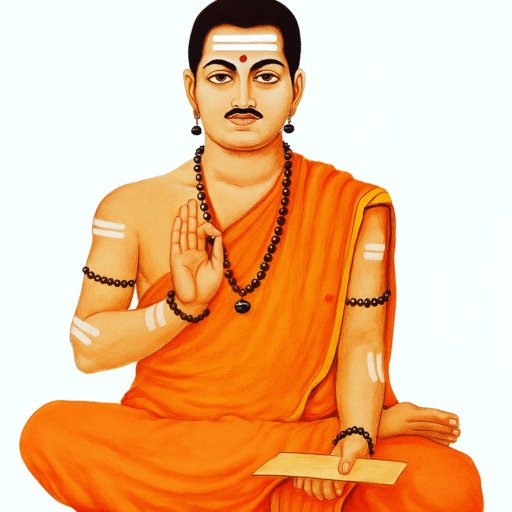

Poetic Rendering

Is heaven somewhere above,
and hell somewhere far below?
Is there another world beyond this world?
No where the heart is filled with Shiva’s presence,
there is the true Paradise.
Where a Sharana breathes,
there itself is Kashi;
his courtyard is Varanasi,
his very body, Kailasa.
Why wander outward, O Kudalasangama,
In this vachana, Basavanna dissolves the imagined distance between the seeker and the sacred, declaring that no heaven, pilgrimage site, or divine realm exists apart from the awakened heart. Paradise and hell are not cosmic locations but modes of consciousness, and the Sharana becomes the living axis of sanctity his breath a holy river, his body a mountain of God, his dwelling a pilgrimage center. Basavanna overturns external religiosity by asserting that all sacred geography is internal; the search for holy places ends when one discovers that the truest Kashi, Kailasa, and Shiva-loka arise only where divine awareness is realized within.
Spiritual Context
Core Spiritual Principle: The ultimate pilgrimage is the journey inward. All external holy places (tirthas) are symbolic projections of internal states of consciousness. When consciousness is purified and united with the Divine, the individual becomes the living embodiment of all holiness. The seeker does not need to go to a sacred place; they become the sacred place.
Cosmic Reality Perspective: In the non-dual reality, there is no “here” and “there,” no “sacred” and “profane” as separate categories. All is the manifestation of the one Linga. The realized being is one who perceives this unity directly, experiencing their own being as a perfect expression of the cosmic order. Kailasa (the abode of Shiva) is not a mountain but the state of still, elevated consciousness; Kashi (the holy city) is not a city but the state of enlightened awareness where liberation occurs.
Historical Reality (Anubhava Mantapa Context): This vachana is a profound democratization of spiritual authority and access. It empowers the common person, declaring that the highest spiritual states are not dependent on the ability to undertake long, expensive pilgrimages, a privilege often reserved for the wealthy and high-born. It establishes that the Anubhava Mantapa itself, and every Sharana within it, is as holy as any traditional site.
Interpretation
“Is heaven somewhere above…? No where the heart is filled with Shiva’s presence, there is the true Paradise.”: This directly internalizes the concepts of heaven and hell. Paradise is redefined as a quality of consciousness (the heart filled with Shiva), not a location. This shifts the entire spiritual endeavor from an external search to an internal transformation.
“Where a Sharana breathes, there itself is Kashi; his courtyard is Varanasi, his very body, Kailasa.”: This is the radical, ontological claim. A Sharana is not like Kashi; their presence is Kashi. The breath is the Ganges, the body is the mountain of God. This is not poetry but a statement of metaphysical fact from the realized state. It confers ultimate dignity and responsibility upon the human form.
“Why wander outward…?”: This rhetorical question is the culmination of the teaching. It renders all external seeking redundant for one who has realized the truth within. The frantic search for God “out there” ceases when God is recognized “in here.”
Practical Implications: The path of Lingayoga is one of profound interiorization. The purpose of spiritual practice is to consecrate one’s own being to make one’s body a temple (Kailasa), one’s mind a holy city (Kashi), and one’s life a continuous pilgrimage. The Ishtalinga is the focal point for this internal consecration.
The Cosmic Reality
Anga (Human Dimension): The physical and psychological complex that is transformed from a limited, profane entity into the entirety of the sacred cosmos.
Linga (Divine Principle): The all-pervading reality whose presence, when fully acknowledged, sanctifies and transfigures the Anga.
Jangama (Dynamic Interaction): The process of this transfiguration. It is the life of sadhana that turns the breath into prayer, the body into a shrine, and daily life into a sacred journey, fully integrating the Anga with the Linga.
Shata Sthala
Primary Sthala: Aikya The perspective of this vachana is that of one who abides in non-dual union. The collapse of the distinction between the inner and the outer, the self and the cosmos, is the definitive characteristic of Aikya.
Supporting Sthala: Pranalingi The manifestation of this union in the details of embodied life breath, body, home is the expression of the Pranalingi, for whom the Linga has become the very substance of life itself.
Practical Integration
Arivu (Awareness Practices): In meditation, consciously contemplate: “This body is Kailasa, the abode of Shiva. This breath is the sacred Ganges, flowing through the city of Kashi that is my awareness.” Use this as a powerful visualization to internalize and embody the sacred.
Achara (Personal Discipline): Treat your body with the reverence due to a temple. Maintain cleanliness, health, and mindfulness as acts of worship. Treat your home as a sacred space (Varanasi), keeping it orderly and filled with positive, spiritual vibrations.
Kayaka (Sacred Action): See your work as the ritual activity (puja) performed within the temple of the world. Let every action be an offering that maintains the sanctity of your internal Kashi.
Dasoha (Communal Offering): Honor the presence of fellow seekers as you would honor a sacred pilgrimage site. See the divine in their being. The community becomes a network of living, breathing “Kashis,” supporting each other’s inner pilgrimage.
Modern Application
We are perpetual wanderers, seeking fulfillment, peace, and meaning through external means travel, consumption, experiences. We embark on literal pilgrimages to far-off lands, often missing the profound journey that is always available within. This leads to a sense of rootlessness and existential discontent.
This vachana offers the ultimate homecoming. It liberates us from the exhausting and expensive pursuit of external salvation. It reveals that everything we seek peace, holiness, liberation is already present as our own conscious being. It empowers us to find the divine not on a map, but in the mirror; to find heaven not in the sky, but in the stillness of a heart anchored in the present moment. This is the end of spiritual seeking and the beginning of spiritual being.
Essence
Why circle the earth
searching for a holy stone,
when your own chest
is the mountain where God sits?
The river of liberation
flows from your own breath.
Sacred geography is a holographic projection of consciousness. Traditional holy sites are like stable, culturally agreed-upon “pixels” in this projection, representing specific states of consciousness (e.g., Kailasa = transcendent stillness; Kashi = liberating awareness). The realized Sharana is a being in whom the entire hologram has been fully integrated and collapsed back into the source their own unified consciousness. For them, the projection ceases, and they recognize themselves as the light source from which all holy images are cast. The external pilgrimage is navigating the projection; the internal realization is becoming the projector.
Imagine a movie projector casting an image of a beautiful, sacred landscape onto a screen. Most people are trying to find fulfillment by walking around on the screen, searching for the perfect spot in the image. The enlightened being is the one who has turned around, discovered the projector within themselves, and realized that the entire magnificent landscape is emanating from their own light. Basavanna is telling us to stop looking at the screen and to become the projector.
We have an innate longing for the sacred, for a place of perfect peace and meaning. We project this longing onto the external world. This vachana reveals that the sacred place we yearn for is not a location to be found, but a dimension of our own consciousness to be awakened. It addresses our deepest homesickness by showing us that we are, and always have been, home.

Views: 1