Poetic Rendering

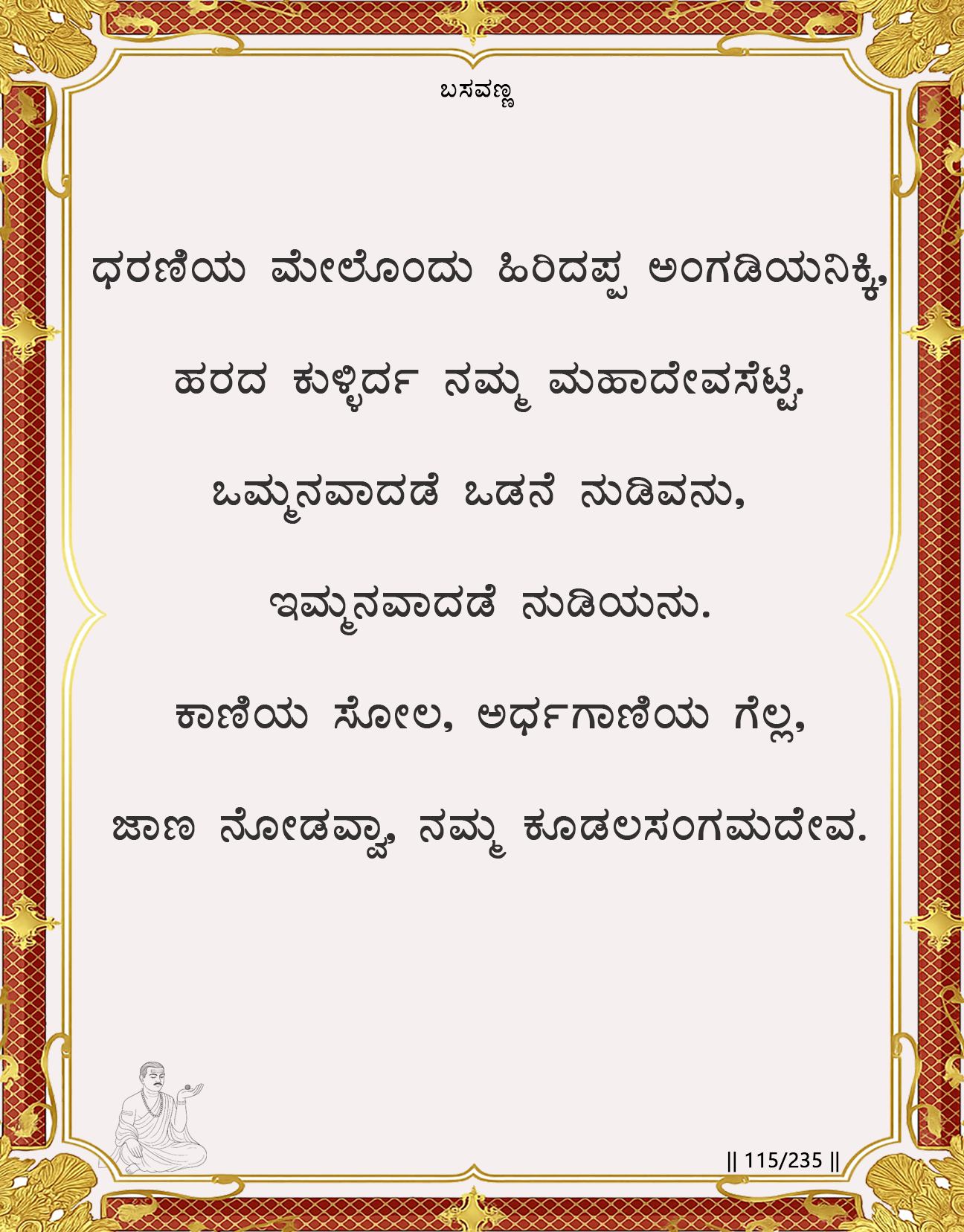
Across this wide earth,
the marketplace hums without rest
buying and selling,
desire and profit weaving its endless noise.
But above every
bargain and beneath every gain
sits the Supreme Merchant, Mahadeva-Setti,
whose scales measure truth alone.
If we trade with honesty,
awareness, and devotion,
He responds in grace;
but when we cheat
boasting of full profit though we have not earned even half
His silence exposes our self-deception.
The glitter we chase slips through our fingers;
the treasure
He holds remains untouched by fraud.
Know this, O seeker:
only the commerce of
the awakened heart yields true wealth
the eternal credit of Kudalasangama’s grace.
In this vachana, Basavanna portrays the cosmos as a grand marketplace governed not by human cunning but by the infallible accounting of the Divine Merchant, Mahadeva-Setti. While worldly transactions thrive on desire, deceit, and the illusion of profit, the divine ledger weighs only truth, clarity, and wholehearted devotion. False gains may soothe human pride, but they carry no value in the spiritual economy where every action is measured with uncompromising precision. Basavanna teaches that only those who trade in integrity earn the true wealth of existence the grace of Kudalasangama while all other profits dissolve as illusions in the ultimate balance of the awakened soul.
Spiritual Context
Core Spiritual Principle: The universe operates on a principle of exact, non-linear accountability. Every action is a transaction that yields a precise karmic result. Deceit in one’s spiritual “business” (life) leads to bankruptcy of the soul, while integrity and devotion generate the true profit of inner peace and divine grace. The “profit” is not external but is the quality of one’s consciousness.
Cosmic Reality Perspective: The Linga is the fundamental law of Dharma the cosmic order that ensures perfect justice. As Mahadeva-Setti, it is not a personified God keeping books, but the inherent, self-regulating nature of reality where every cause has an effect. Trying to cheat this system is as futile as trying to cheat the law of gravity.
Historical Reality (Anubhava Mantapa Context): This vachana provided an ethical framework for the merchant class and all working people within the Lingayoga community. It elevated business from a mere means of survival to a spiritual practice (Kayaka). It taught that honest dealing was not just social ethics but cosmic law, and that the true profit was not wealth, but the grace earned through integrity.
Interpretation
“the marketplace hums without rest…”: This describes Samsara the world of perpetual transaction, desire, and activity where most people are engrossed in the superficial noise of profit and loss.
“But above every bargain… sits the Supreme Merchant, Mahadeva-Setti, whose scales measure truth alone.”: This reveals the hidden reality behind the appearances. The “scales” are the law of Karma. They do not measure money or social success, but “truth” the alignment of one’s actions with Dharma.
“If we trade with honesty, awareness, and devotion, He responds in grace…”: This outlines the profitable transaction. The capital invested is “honesty, awareness, and devotion.” The dividend paid is “grace” (Prasada), which is the divine empowerment for further spiritual growth.
“when we cheat boasting of full profit though we have not earned even half His silence exposes our self-deception.”: The “cheating” is spiritual hypocrisy claiming virtues, insights, or status one does not truly possess. The “silence” of God is not indifference but the inherent consequence: such a person remains stuck in their delusion, receiving no genuine spiritual nourishment. The punishment is the state of self-deception itself.
“the treasure He holds remains untouched by fraud.”: The ultimate treasure liberation (Moksha) cannot be stolen, faked, or bought with counterfeit currency. It can only be earned through the hard, honest capital of sincere practice.
Practical Implications: A Lingayoga must see their entire life as a business dealing with the Divine. Every action should be an honest transaction. The balance sheet must be checked daily through self-reflection (Arivu) to ensure one is not accumulating karmic debt through deceitful living.
The Cosmic Reality
Anga (Human Dimension): The merchant-soul who must choose to trade either in the counterfeit currency of ego and deceit or the genuine currency of truth and devotion.
Linga (Divine Principle): The cosmic bank, the source of all real value, and the inviolable law of exchange that governs all transactions.
Jangama (Dynamic Interaction): The flow of honest labor (Kayaka) and selfless sharing (Dasoha). This is the legitimate commerce that circulates genuine spiritual wealth between the individual and the cosmos, generating the profit of grace.
Shata Sthala
Primary Sthala: Maheshwara The understanding of this cosmic commerce and the discipline to live as an honest merchant in the sight of God is the mature wisdom and self-governance of the Maheshwara.
Supporting Sthala: Sharana The goal of this honest commerce is to accumulate enough “credit of grace” to be able to take full refuge, merging one’s individual business with the divine corporation, so to speak.
Practical Integration
Arivu (Awareness Practices): Keep a mental “karmic ledger.” At the end of each day, review your actions, words, and thoughts. Were they truthful transactions, or were they deceptive? Did they generate the “profit” of peace and clarity or the “loss” of agitation and guilt?
Achara (Personal Discipline): Make integrity your highest policy. Be scrupulously honest in all your dealings, both big and small. Avoid exaggeration, false promises, and taking credit for what is not yours.
Kayaka (Sacred Action): Perform your work with the consciousness that you are transacting with the Divine. Offer your labor honestly and receive your wages as Prasada. See your work as your primary field for accumulating spiritual merit.
Dasoha (Communal Offering): The community should function as an ethical marketplace. Support businesses and individuals known for their integrity. Share resources freely, understanding that hoarding is a form of spiritual bankruptcy. Make the community a showcase of divine commerce.
Modern Application
We live in a world of “spin,” financial fraud, inflated resumes, and a culture that often rewards cunning over character. The line between clever marketing and deception is blurred. This creates a deep-seated collective anxiety and a crisis of trust.
This vachana is a profound call to spiritual capitalism. It liberates us from the stress of maintaining a false image and competing in a corrupt marketplace. It assures us that the most sustainable and profitable long-term strategy is radical integrity. It teaches that the real bottom line is not our net worth, but the quality of our consciousness and the grace we have earned. This leads to a life of profound inner security and trust.
Essence
The world is a shop,
and God is the Shopkeeper.
You can pay with the counterfeit coin of deceit,
and receive nothing but hollow goods.
Or you can pay with the pure gold of truth,
and purchase the one thing that lasts:
His grace.
The cosmos operates as a perfect blockchain ledger. Every thought, word, and deed is a transaction that is immutably recorded in the distributed ledger of consciousness (the Linga-network). Deceitful transactions are like trying to introduce corrupted data into the blockchain; they are rejected by the network’s consensus protocol (the law of Dharma) and do not generate valid “blocks” (spiritual growth). Only valid, truthful transactions are confirmed and added to the chain, earning the transaction fee of “grace” and increasing the net worth of the soul’s wallet. The “silence” of God is the system’s refusal to validate a fraudulent transaction.
Imagine life is a game where you earn points. You can try to cheat by secretly giving yourself points (boasting, being hypocritical). But the game is designed so that only points earned through genuine, honest play actually count towards winning. The cheat points appear on your personal screen (your ego), but they are not registered on the official server (the cosmic ledger). When the game ends, only the officially registered points matter. Basavanna is telling us to stop cheating and start playing the game properly, because the ultimate prize union with God is only awarded for a legitimately won game.
We are tempted to take shortcuts, to appear better than we are, to gain an unearned advantage. This vachana speaks to our deep desire for authentic success and lasting achievement. It reveals that the only success that truly satisfies the soul is the one earned through integrity. It affirms that the universe is ultimately just, and that we are the ones who profit or suffer from the honesty of our own dealings.

Views: 0