Poetic Rendering

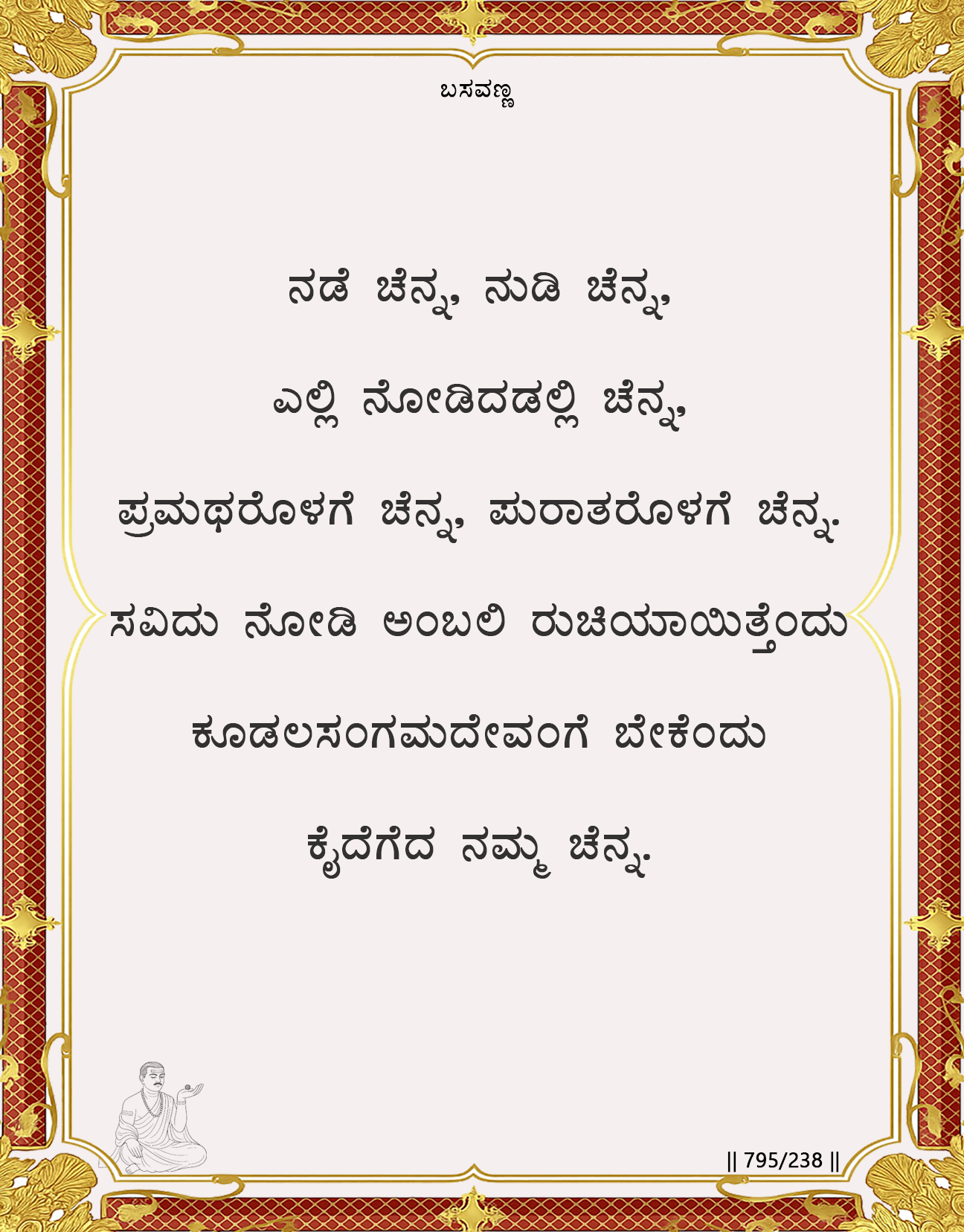
Graceful in gait,
graceful in speech,
graceful wherever he moves
graceful among the companions of Shiva,
graceful even among the ancients of old.
Like ambali, the humble millet broth
simple, fermented, revealing hidden sweetness
so is the beauty ripened within my very palm.
Here rests the tender, living Linga,
O Kudalasangamadeva
the Infinite cupped in the hands
of Madara Chennayya.
In this profound vachana, Basavanna reaches the pinnacle of his vision of radical spiritual equality. By comparing Madara Chennayya the tanner and outcaste to ambali, the fermented millet broth whose humble simplicity reveals hidden depths, Basavanna shows that spiritual radiance often emerges from the most unexpected places. The “beauty in the palm” is not external ornamentation but the awakened consciousness symbolized by the ishtalinga resting in the devotee’s hand. This transforms the body from a mere vessel into a living shrine and collapses the distance between seeker and sought. The Infinite, once imagined as remote and transcendent, now abides intimately in the hand of a so-called low-born devotee. Through this, Basavanna declares that spiritual worth is not inherited by birth or status but is awakened through inner ripening. The cosmos rests wherever devotion ripens even, and especially, in the hands of those society deems least significant.
Spiritual Context
Core Spiritual Principle: The ultimate spiritual realization is the non-dual state where the distinction between the worshipper and the worshipped dissolves. The Divine is not in a remote heaven but intimately present, cradled in the hands of the realized devotee, irrespective of their social standing.
Cosmic Reality Perspective: This Vachana is the consummation of Shivayoga’s non-dual vision. The entire cosmos (Brahmanda) is contained within the individual (Pindanda). The “Infinite” (Linga) and the “hand” (Anga) are not two. Chennayya’s realization demonstrates that when consciousness is purified, the body itself becomes the temple, and the entire universe is experienced as residing within the palm of one’s hand.
Historical Reality (Anubhava Mantapa Context): This is perhaps the most radical statement of the Lingayat revolution. By celebrating Madara Chennayya, a member of the supposedly “untouchable” Madiga caste, as the very cradle of the Infinite, Basavanna systematically annihilates the theological foundation of the caste system. It declares that enlightenment is the only true nobility and that God resides with those whom society has thrown away.
Interpretation
“Graceful in gait, graceful in speech…”: This describes the state of a realized being (Sthitaprajna). Their every action, born of a unified consciousness, is naturally graceful , as it is a perfect expression of the Divine Will, without the friction of ego.
“Like ambali… so is the beauty ripened within my very palm.”: The metaphor of ambali is devastatingly powerful. It is the food of the poor simple, fermented, and unassuming. Yet, its “hidden sweetness” emerges through a process of transformation. Similarly, Chennayya’s “beauty” is not external but an inner, ripened sweetness of consciousness, forged through the “fermentation” of spiritual practice amidst a life of hardship.
“Here rests the tender, living Linga… the Infinite cupped in the hands…”: This is the climax. The Linga is “tender” and “living” not a cold, stone symbol but a dynamic, conscious presence. The act of “cupping” is one of ultimate tenderness, care, and intimacy. It signifies that the devotee does not possess God, but cradles the Divine with the reverence of a parent holding a newborn, or a vessel holding its sacred content. The macrocosm is fully contained in the microcosm.
Practical Implications: The seeker is taught that the goal is not to reach God, but to become the sacred space where God resides. The practice is to cultivate such inner purity and humility that one’s entire being one’s “hands” becomes a fit cradle for the Divine to manifest.
The Cosmic Reality
Anga (Human Dimension): The physical body of the enlightened devotee. In this state, the Anga is not a limitation but the perfect, manifest form of the Linga. It is the temple, the altar, and the priest simultaneously.
Linga (Divine Principle): Koodalasangamadeva as the “Infinite,” the “tender, living Linga.” It is the essential, formless reality that has taken residence in the form of the devotee.
Jangama (Dynamic Interaction): The state of being Madara Chennayya. His very existence is the Jangama the dynamic, living proof of the union between the human and the Divine. His graceful movement through the world is the Linga in motion.
Shata Sthala
Primary Sthala: Aikya. This Vachana is a pure expression of Aikya (Union). The image of the Infinite being cupped in the hands of the devotee leaves no room for any separation between the soul and God.
Supporting Sthala: Pranalingi. The Linga is so intimately united with the devotee that it is his very life (Prana). Chennayya doesn’t just wear the Linga; he is the living Linga, breathing and moving in the world.
Practical Integration
Arivu (Awareness Practices): Meditate on the feeling of cradling the universe in your hands. Feel the Ishtalinga not as an external object, but as the very core of your awareness, tenderly held within your own consciousness.
Achara (Personal Discipline): Cultivate the “hidden sweetness” of ambali. Practice humility, simplicity, and integrity. Let your spiritual worth be an inner ripening, not an external display.
Kayaka (Sacred Action): See your hands at work as the “cradle of the cosmos.” Whatever task you perform tanning leather, typing, cooking do it with the awareness that these very hands are the shrine of the Infinite.
Dasoha (Communal Offering): Honor the “Madara Chennayya” in everyone. Actively dismantle internal hierarchies and see the potential for the divine cradle in every human being, regardless of their social role or appearance.
Modern Application
Spiritual elitism; the commodification of enlightenment; the deep-seated biases of class, race, and education that create invisible hierarchies even within spiritual circles; the disconnect between spiritual ideals and embodied, humble living.
This Vachana is the ultimate social and spiritual leveler. It liberates spirituality from the domains of the elite, the educated, and the affluent. It empowers every individual by stating that the cosmos rests in your hands when your heart is pure. It calls for a society where we bow to consciousness, not to credentials, and where we recognize that the most profound wisdom often wears the garb of simplicity.
Essence
In gait, in speech, a grace profound,
Like ambali, on humble ground.
The Infinite, in hands held low,
Is all the universe we need to know.
This Vachana describes the Holographic Principle realized in a single human being. In a hologram, every fragment contains the complete information of the whole. Madara Chennayya, through the alchemy of devotion, has become such a perfect holographic fragment. The “Infinite” (the whole) is completely encoded and fully present within the finite “palm of his hands” (the fragment). His realization is the collapse of the scale between the cosmic and the human, revealing that the universe is not outside, but is the very substance of the realized self.
A single dew drop on a leaf can reflect the entire sky the vast sun, the sweeping clouds. The drop is small and transient, yet it contains the whole. Madara Chennayya is that dew drop. His humble existence, his “hand,” is the droplet that perfectly contains and reflects the infinite sky of the Divine. Basavanna points to him and says: “Behold! The entire universe is right here.”
You are not a seeker on a path to a distant God. You are the potential home for the Divine. The entire cosmos is longing to be born within you. Your task is not to build a ladder to heaven, but to clean the house of your own heart and body so thoroughly that heaven has no choice but to take up residence. The greatest miracle is not levitation, but the realization that the sacred is already resting in the palm of your hand.

Views: 0