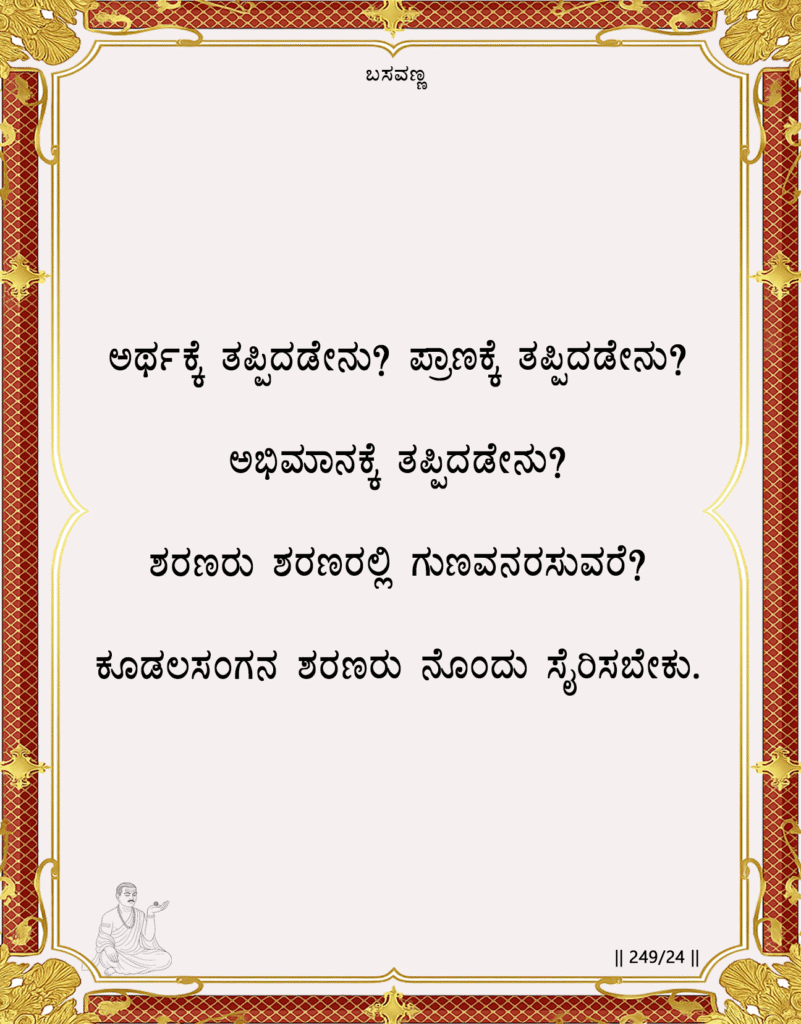
Poetic Rendering

Is strength in the body’s vigor?
Is strength in wealth or fame?
Is strength in the cleverness of speech?
When all these fail,
shall we cast him aside, O seeker?
The strength of Kudalasangamadeva’s devotee
is not in judging, but in lifting
to stand by the fallen with silent grace,
and to see the divine still shining within.
This vachana transforms the idea of strength from dominance to compassionate endurance. Basavanna questions the conventional measures of worth power, wealth, and intellect reminding us that all these fade. When a fellow seeker falters in worldly life, the true Śharaṇa does not mock or reject him. Instead, Basavanna calls for a higher strength the strength of acceptance, forbearance, and support. The community of devotees (Śharaṇas) must not be built on judgment but on solidarity; not on worldly success but on shared surrender to Kudalasangamadeva.This silent strength is not loud in defense nor swift in blame. It is the unspoken patience that upholds the fallen, believing that divine grace works even through failure.True strength, says Basavanna, is the quiet act of seeing God’s light in one who has stumbled and helping him rise again on the path.
Spiritual Context
Core Spiritual Principle: The highest spiritual strength is not the power to conquer or accumulate, but the compassionate capacity to uplift others without judgment. A true spiritual community is defined by its solidarity with the fallen, not its celebration of the successful.
Cosmic Reality Perspective: The Linga, as all-pervading consciousness, does not abandon any part of itself. It is the very ground of being that supports all, regardless of their apparent success or failure. To judge and cast aside a fallen seeker is to act against this fundamental, supportive nature of reality.
Historical Reality (Anubhava Mantapa context): This vachana outlines the ethical core of the Sangha. It ensures that the community remains a refuge for the imperfect and the struggling, embodying the revolutionary principle that a person’s worth is inherent and divine, not contingent on their worldly standing or momentary failures.
Interpretation
1. Rhetorical Questions on Strength: By questioning physical, financial, and intellectual strength, Basavanna systematically deconstructs the worldly ego’s foundations. He implies that these are transient and unreliable, and thus cannot be the basis for judging a person’s spiritual worth.
2. “When all these fail, shall we cast him aside…?” : This is the critical ethical challenge. It confronts the reader with the common, yet unspiritual, impulse to value people for their utility and to discard them when they are no longer “useful” or “successful.”
3. “The strength… is not in judging, but in lifting…” : This is the positive definition of spiritual power. “Judging” is the act of the ego, which separates. “Lifting” is the act of the soul, which unites and heals. This is the applied non-duality of seeing oneself in the other.
4. “…to stand by the fallen with silent grace, and to see the divine still shining within.” : This describes the quality of this strength. It is “silent” (without condescension or self-congratulation) and rooted in “grace” (an unconditional offering). The key is the perceptual shift: to see not the fallen ego, but the unfallen Linga that continues to shine within the person.
Practical Implications: The seeker must actively cultivate this compassionate strength. When encountering someone who has failed whether materially, morally, or spiritually the response should be one of supportive inquiry and practical help, not judgment or exclusion. The community’s health is measured by how it treats its most vulnerable members.
The Cosmic Reality
Anga (Human Dimension): The human in two aspects: as the one who has fallen (needing support) and as the one who has the capacity to lift (offering support). Both are roles every seeker will play.
Linga (Divine Principle): Kudalasangama Deva as the principle of unconditional support and the inner light that never fades, even in apparent failure. It is the divine “spark” within the fallen.
Jangama (Dynamic Interaction): The Jangama is the active, compassionate engagement between devotees. It is the dynamic flow of support from one Anga to another, a flow that is energized by the shared recognition of the Linga within each other. This is spirituality in motion.
Shata Sthala
Primary Sthala: Sharana. This vachana describes the conduct of a true Sharana, whose identity is so merged with the community that another’s fall is felt as one’s own, compelling a compassionate response.
Practical Integration
Arivu (Awareness): Practice seeing the unchanging Linga-consciousness in everyone, especially those who are struggling, failing, or are socially marginalized. Look past their transient state to their eternal core.
Achara (Personal Discipline): Make it a personal vow never to abandon or speak ill of someone because of their failures. Let your discipline be one of loyalty and compassionate support.
Kayaka (Sacred Action): Use your skills and resources to actively help those who have stumbled to get back on their feet. Offer employment, mentorship, or simple practical help.
Dasoha (Communal Offering): Build a community safety net. Ensure that the Sangha has systems of support emotional, practical, and spiritual for members going through difficult times. Foster a culture where asking for help is seen as strength.
Modern Application
We live in a “cancel culture” and a society obsessed with success, where people are quickly judged, shamed, and discarded for their mistakes, failures, or unpopular opinions. This creates an environment of fear, perfectionism, and profound loneliness, where no one feels safe to be vulnerable.
This vachana offers the liberative antidote: a culture of compassionate restoration. It calls us to replace judgment with curiosity, condemnation with support, and cancellation with the offer of a helping hand. It teaches that our collective strength is not in weeding out the weak, but in empowering everyone to heal and grow. It is the foundation for building truly resilient and humane communities, families, and organizations.
Essence
The arm grows weak, the wealth takes flight,
The clever mind loses its light.
But strength that sees God in the fall,
Is the greatest power of all.
Metaphysically, this vachana deals with the concept of Dukha (suffering) and its remedy. Worldly strengths are within the domain of Prakriti (ever-changing nature) and are thus subject to decay. The “fallen” state is an experience of Dukha. The “strength to lift” arises from the Sattvic Guna, informed by the knowledge of the eternal Atman (Linga). This compassionate action burns the karma (Samskaras) of both the helper and the helped, as it is performed without egoic judgment. It is a practical application of the vision of Advaita (non-duality), where serving the other is serving the Self.
The ultimate measure of a person’s or a community’s character is not how they treat their stars, but how they treat those who have stumbled. Real strength is not demonstrated in victory, but in the grace with which we handle failure both our own and that of others. A life dedicated to lifting others is a life of true and enduring power.

Views: 2