Poetic Rendering

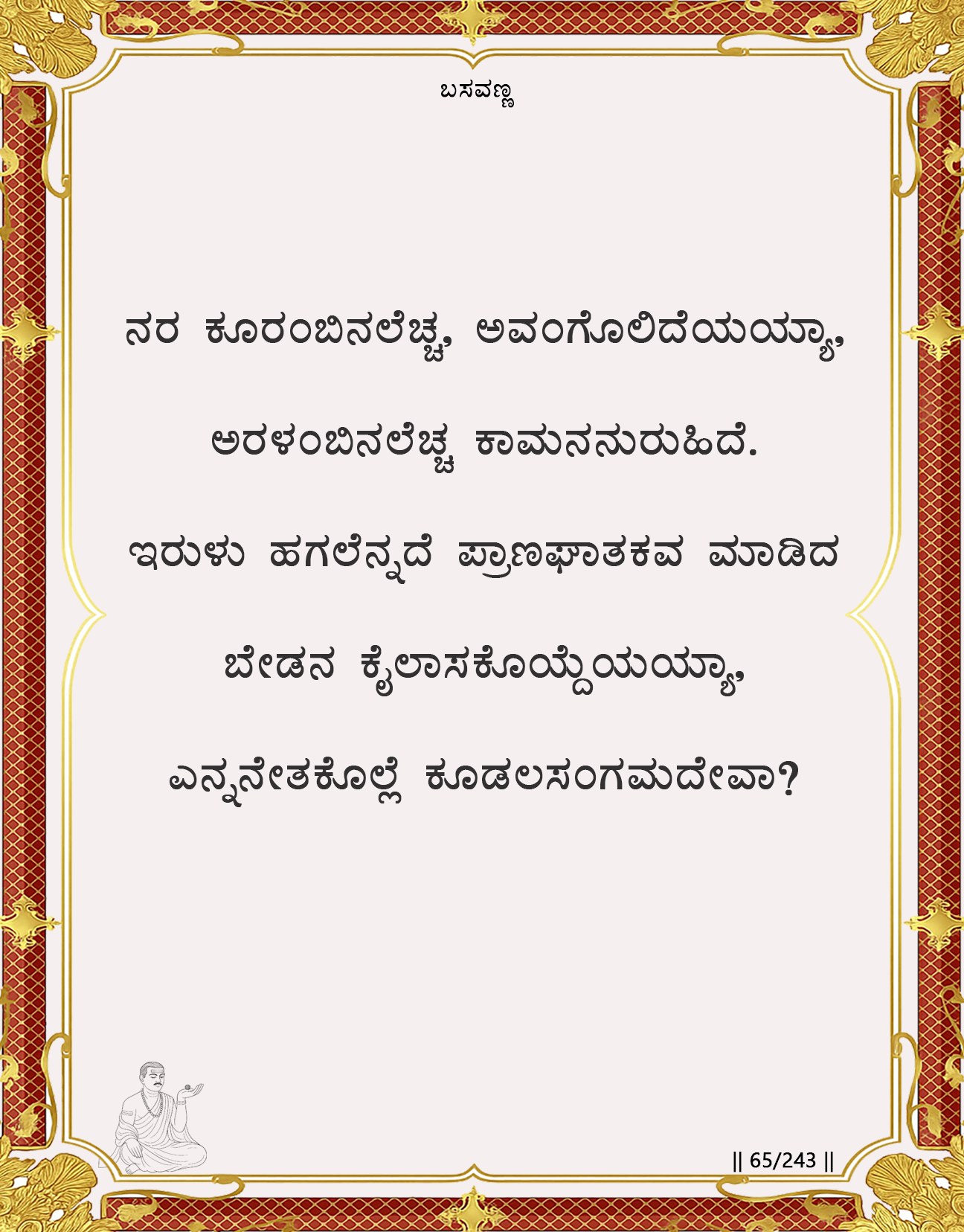
You blessed the hunter who bound the bird,
You listened to Arjuna’s word.
You turned to ash the god of desire’s flame,
Yet crowned Kannappa’s savage
love with Your name.
Their worship was wild unmeasured, free;
Mine walks the path of the
Shatsthalas, taught by Thee.
Then why,
O Kudalasangama, do You pass me by?
Why does Your door stay closed,
while I weep and try?
Have I lost the soul in seeking the way,
Clinging to the form, and forgotten to pray?
O Lord, if even the untamed find Your embrace,
What use my learning, if I’ve forgotten grace?
This vachana captures the most critical and painful crisis in a sincere seeker’s journey: the feeling of divine abandonment despite rigorous adherence to the spiritual path. The devotee has correctly followed the external map the Shatsthalas but has arrived at an inner desert of silence. The vachana is not a complaint against God, but a profound mirror held up to the soul, revealing the final and most subtle barrier: the ego of being a seeker. It exposes the paradox where the very practice designed to annihilate the ego has instead become its fortress, leading to the poignant realization: “What use my learning, if I’ve forgotten grace?”
Spiritual Context
Core Spiritual Principle: The most dangerous obstacle on the path is the spiritual ego the sense of identity built upon one’s own seeking, discipline, and knowledge. Grace flows not to the one who has perfected the method, but to the one who has relinquished the ‘perfector.
Cosmic Reality Perspective: In Lingayoga, the Linga is absolute freedom (Swatantra). It cannot be bound or summoned by any methodology, not even the sacred Shatsthala. The ego, in its effort to ‘control’ the spiritual process through correct practice, is the antithesis of this freedom. Grace descends in the space created by the utter collapse of this controlling entity, not as a reward for its efforts.
Historical Reality (Anubhava Mantapa Context): This Vachana serves as a critical warning within the Lingayat community. It prevents the path from devolving into a new orthodoxy where practitioners might look down upon ‘simple’ devotees. It ensures that the revolutionary spirit remains one of inner humility, where the goal of union (Aikya) is never confused with the pride of the journey.
Interpretation
“You blessed the hunter… Arjuna… Kannappa…”: The seeker lists figures who were blessed despite, or because of, their ‘flawed’ or unconventional devotion. This litany is the ego’s attempt to understand God through a ledger of merit and demerit, a system of cosmic justice. The underlying cry is: “My balance sheet is better than theirs!”
“Mine walks the path of the Shatsthalas, taught by Thee.”: Here lies the crux of the problem. The seeker is not just practicing; they are identifying with their correct practice. The Shatsthala, meant to be a map for losing the self, has become a badge of the self. This is the pinnacle of the ‘doer-ship’ (kartritva bhava) that spirituality aims to dissolve.
“Why does Your door stay closed, while I weep and try?”: The ‘weeping and trying’ is the final, frantic effort of the ego to achieve what can only be received through its cessation. The ‘closed door’ is not a barrier erected by God, but the seeker’s own back, turned towards grace while facing their own spiritual resume.
“What use my learning, if I’ve forgotten grace?”: This is the moment of profound insight and the true beginning of the prayer. The seeker realizes that the goal was never learning, but grace; not achievement, but surrender. The question itself signals the ego’s impending dissolution.
Practical Implications: The seeker is guided to the most subtle stage of practice: self-vigilance against spiritual pride. The practice becomes one of ‘offering the practice itself.’ One must continually ask, “Am I using my sadhana to build a better ‘me,’ or to dismantle the ‘me’ entirely?”
The Cosmic Reality
Anga (Human Dimension): The seeker trapped in the identity of ‘the seeker.’ This Anga is a well-polished vessel that is still full of itself.
Linga (Divine Principle): Koodalasangamadeva as unconditioned Grace, which cannot be contained by any vessel that is not utterly empty.
Jangama (Dynamic Interaction): The dynamic is the painful crisis of abandonment itself. This suffering is the final, fierce act of the Jangama the Guru-principle operating as life to shatter the seeker’s last and most cherished identity, creating the vacuum that grace can fill.
Shata Sthala
Primary Sthala: Maheshwara. This intense, purificatory crisis is the fire of the Maheshwara stage burning its most refined fuel: the ego of virtue and knowledge.
Supporting Sthala: Prasadi. The heartfelt cry, “What use my learning?” is the pivotal moment that makes the seeker a true receptacle for the grace that defines the Prasadi stage.
Practical Integration
Arivu (Awareness Practices): Practice observing the ‘spiritual I.’ In meditation, watch for thoughts of comparison, pride in practice, or frustration at ‘lack of progress.’ See them as the final clouds to be dispersed.
Achara (Personal Discipline): Introduce acts of ‘holy folly.’ Deliberately break a minor rule of your own spiritual routine. Give away a prized spiritual book. Practice being a beginner, unknowing, and humble.
Kayaka (Sacred Action): Perform your spiritual duties anonymously, or in a way that brings no recognition. Let the left hand not know what the right is doing. The goal is to sever the link between action and the actor’s spiritual identity.
Dasoha (Communal Offering): Seek out and serve those whose devotion is simple and heart-based, whom your mind might have previously judged as ‘uninformed.’ Learn from them the quality of surrender you have lost.
Modern Application
The ‘spiritual achiever’ complex; obsession with certifications, teacher status, and perfect adherence to a system; judging others’ paths; burnout and despair when enlightenment does not arrive on schedule despite ‘perfect’ practice.
This Vachana is a lifeline for the modern, disciplined seeker. It liberates them from the prison of their own spiritual ambition. It validates the ‘dark night of the soul’ not as a failure, but as the final exam. It teaches that the goal is not to become a perfect seeker, but to cease seeking altogether in a glorious failure that is, in fact, the ultimate success.
Essence
I built the altar, lit the flame,
And called upon Your sacred name.
Yet You blessed the wild, the raw, the true
Shatter this seeker, and come through.
This Vachana describes the final stage of Psychic Metabolism. The spiritual path is a process of consuming and transforming identifications. The seeker has successfully metabolized gross identities (wealth, fame, family) but is now struggling to digest the most subtle nutrient: the identity as a ‘spiritual being.’ The feeling of abandonment is the ‘indigestion’ the system’s inability to process this final, robust identity. Grace is the enzyme that can only be secreted when the system admits its own failure to digest. The cry of the Vachana is that admission, which triggers the release of the grace-enzyme, allowing for the final assimilation of the self into the Self.
A student who has mastered every textbook and can recite every theory perfectly is stuck, because the final exam is to burn all the textbooks and forget they were ever a student. Basavanna is that star student, holding his diploma, standing outside the gate, finally realizing that the key to the gate is to drop the diploma. The diploma is his knowledge of the Shatsthala. The act of dropping it is the surrender that is the true fulfillment of the path.
The most profound surrender is to surrender your surrender. The final letting go is the release of your identity as the one who is letting go. When you stop trying to reach God and simply admit your absolute inability to do so, you have, at that moment of perfect, helpless sincerity, arrived. The door was never locked; you were just leaning on it from the outside.

Views: 0