Poetic Rendering

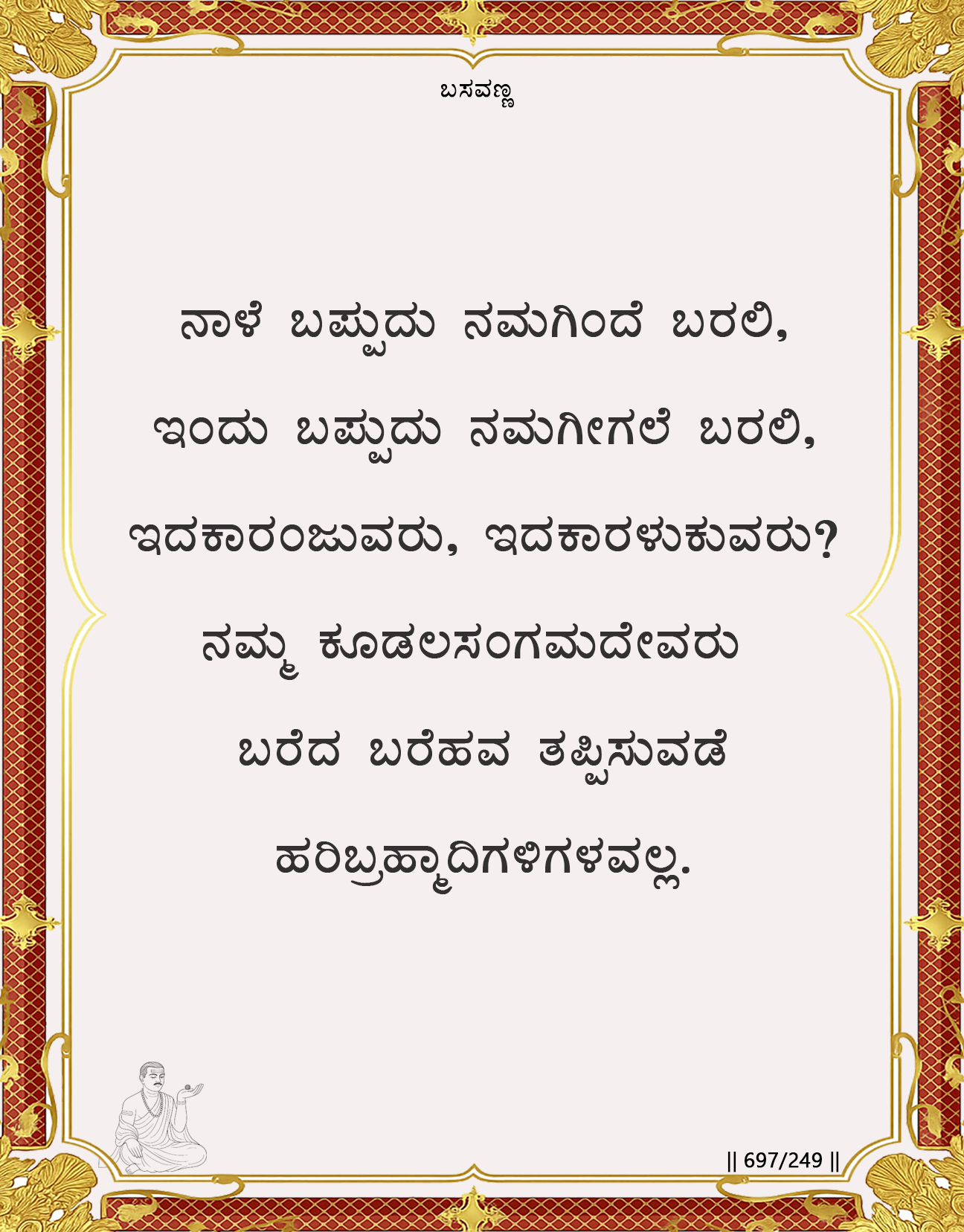
Whatever is meant for tomorrow
let it come today.
If it is to come today
let it arrive this very moment.
Why fear it?
Who is there to weep before the appointed hour?
For our companion,
Koodalasangamadeva,
has already inscribed our path
a destiny untouched, unaltered,
even by Hari or by Brahma.
To know this
is to stand unshaken:
death cannot disturb
the one held wholly
in His refuge.
Basavanna teaches that whatever is destined is certain to arrive, whether sooner or later, and thus there is no reason for fear or sorrow. For the seeker who walks as a true companion of Koodalasangamadeva, destiny is already written by the Divine and cannot be altered even by other gods. Realizing this brings complete fearlessness especially before death. Death is not an end but a natural passage within the Lord’s order, and one who rests in His refuge meets it without trembling. This freedom from fear allows the seeker to live with clarity, courage, and unwavering trust in the Divine.
Spiritual Context
Core Spiritual Principle: Sovereign Surrender. Fear arises from the illusion of control (ahamkara). Liberation from fear comes not from controlling destiny, but from surrendering to the divine will that orchestrates it, recognizing it as the ultimate refuge.
Cosmic Reality Perspective: This is a non-dual perspective on time and karma. The unfolding of events in time is the play (Lila) of Shiva-Shakti. The Linga is not just a static presence but the active, intelligent principle that writes and enacts the cosmic script. To resist this is to suffer; to align with it is to be free.
Historical Reality (Anubhava Mantapa Context): This vachana provides the psychological foundation for the social courage displayed by the Sharanas. Facing persecution from orthodox structures, their fearlessness was rooted in this theological conviction. Their destiny was in the hands of their Ishta Linga, not the Brahminical gods (Hari, Brahma) or the social authorities who served them.
Interpretation
“Let it come today… this very moment.” This is not a plea but a bold invocation. It demonstrates the complete dissolution of resistance and the welcoming of reality as it is, in the eternal now.
“A destiny untouched, unaltered, even by Hari or by Brahma.” This is a radical assertion of the Linga’s supreme sovereignty. It establishes a direct, personal covenant with the Divine that bypasses all intermediary celestial bureaucracies.
“Death cannot disturb the one held wholly in His refuge.” Death is the ultimate test of fear. By conquering the fear of death, one becomes invincible to all lesser fears, as they are all derivatives of the primal fear of annihilation.
Practical Implications: Spiritual practice becomes the continuous cultivation of sharanagati (surrender). It involves watching the play of fear and desire in the mind and consciously offering them up to the Linga, trusting in its benevolent orchestration.
The Cosmic Reality
Anga (Human Dimension): The human is the experiencer of a pre-ordained script (prarabdha karma). The unenlightened Anga identifies as the author and resists the plot. The enlightened Anga understands it is an actor playing a divine role.
Linga (Divine Principle): The Linga is the Supreme Author and Director. It is the non-dual consciousness that has chosen to experience itself through the specific, limited narrative of an individual life. It is both the source of the destiny and the refuge within it.
Jangama (Dynamic Interaction): This is the lived state of fearless alignment. It is the dynamic flow of life lived in conscious partnership with the Divine Director. Every event, welcome or unwelcome, is met not with resistance but with the question, “What is the Linga revealing through this now?”
Shata Sthala
Primary Sthala: Sharana. This vachana is a perfect manifesto for the Sharana stage. The hallmark of a Sharana is nirbhaya (fearlessness) and nirahankara (egolessness), both born from the total surrender encapsulated in the phrase “held wholly in His refuge.”
Supporting Sthala: Prasadi. The state of the Sharana is itself the highest grace. The understanding that brings fearlessness is not an intellectual conclusion but a transformative realization bestowed upon the sincere seeker, marking them as a Prasadi, one who has received the ultimate gift of peace.
Practical Integration
Arivu (Awareness Practices): Practice witnessing thoughts of anxiety about the future or regret about the past. Label them as “fear” or “desire for control” and consciously offer them to the Linga, reaffirming “Koodalasangamadeva’s will is my will.”
Achara (Personal Discipline): The discipline is to refrain from pre-emptive grieving or worrying. When fear arises, use the vachana’s mantra: “Why fear it? Who is there to weep before the appointed hour?”
Kayaka (Sacred Action): Perform your duty without attachment to the outcome. Work as an instrument of the Divine, accepting success and failure with equanimity, knowing both are part of the inscribed path.
Dasoha (Communal Offering): Be a pillar of fearlessness for the community. Your calm acceptance of life’s vicissitudes becomes a living testimony that strengthens others in their times of fear and uncertainty.
Modern Application
The “anxiety of uncertainty.” Modern life is defined by a desperate need to secure the future through insurance, investments, career plans, and social media curation. This creates a pervasive, low-grade terror of anything that threatens our carefully constructed illusions of control.
This vachana is an antidote to existential anxiety. It invites a shift from being a frantic controller to a trusting participant in a benevolent cosmos. It is the key to resilience, allowing one to navigate economic instability, health crises, and personal loss with a profound, unshakable core of peace.
Essence
Why barter the present for a phantom future’s dread?
What is written, will be read.
The Hand that scripts the soul’s design
holds it through every turning.
In that embrace, all fear is dead.
The story’s end is just beginning.
This vachana presents a spiritual resolution to the philosophical problem of determinism and free will. It posits that while the events of a life may be predetermined (the script), the individual’s qualitative experience of those events as suffering or freedom is a matter of conscious alignment (the surrender). Freedom is not in choosing what happens, but in how one relates to what happens.
Imagine you are a character in a movie written and directed by a loving, all-knowing filmmaker. You have two choices: you can struggle against the script, trying to rewrite your lines and change the plot, which is exhausting and futile. Or, you can trust the director, play your part with full commitment, and experience the story as a profound and liberating masterpiece. Basavanna advises the latter.
This speaks to the universal human desire for security and our terror in the face of powerlessness. It offers a profound solution: true security is found not in trying to control the uncontrollable, but in yielding to a Power that is both the source of the chaos and the sanctuary within it. It transforms fatalism into faithful, fearless participation.

Views: 1