Poetic Rendering

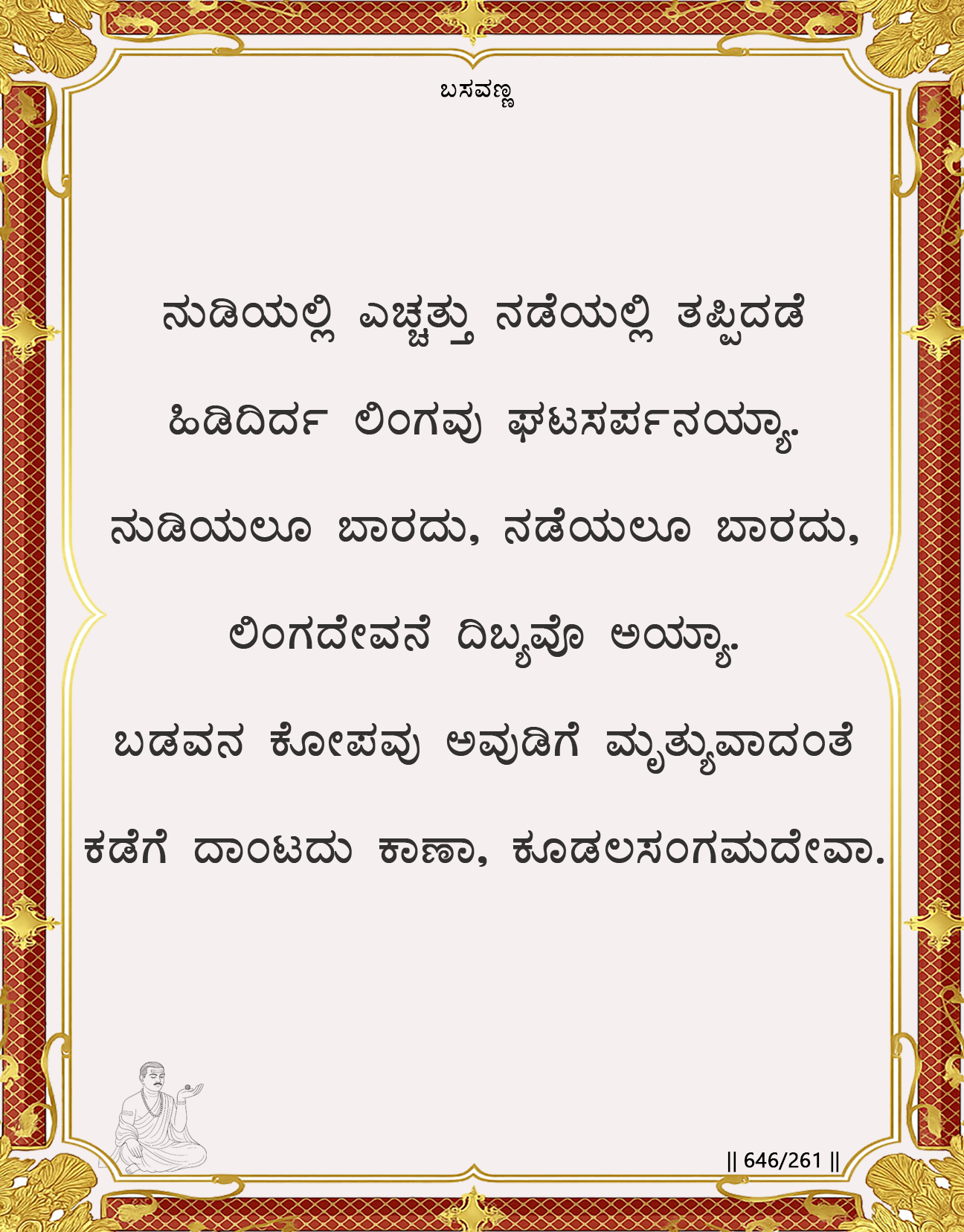
Words may pour like honey
sweet on the tongue, pleasing to the ear
but if the walk falters, beware!
For the very Linga you wear with pride
becomes a serpent coiled in the pot,
its hidden venom turning inward
upon your own life.
If speech shines bright
while conduct lies in shadow,
what sanctity can remain in that Linga?
The Linga is no ornament
it is a mirror.
And when the heart drifts from truth,
that mirror cracks upon your face.
The seeker’s cry,
unheard like the poor man’s plea,
falls into the vast silence
for the Lord listens not to words alone,
but to the steady cadence of deeds.
To speak devotion yet live in deceit
is to weave your own downfall.
Know this, O wearer of the Linga:
your actions are the serpent within you.
Walk upright, and it sleeps;
walk crooked, and it strikes.
Such is the quiet justice
of Koodalasangamadeva.
Basavanna exposes the grave danger of spiritual hypocrisy the split between speech and conduct. Honeyed words cannot conceal a wavering life. When actions contradict devotion, the very Linga one bears turns from a source of grace into a source of inner turmoil. The powerful image of the Linga becoming a “serpent in the pot” shows how duplicity harms the seeker from within. For Basavanna, the Linga is a living mirror that reflects the wearer’s true state. Words have no power unless supported by righteous deeds. A divided seeker’s prayers remain unheard, not because God withholds mercy, but because integrity is the channel through which grace flows. True devotion requires complete alignment of heart, speech, and action. When these are unified, the path is luminous; when divided, the seeker becomes the cause of their own suffering. Basavanna’s message is clear and uncompromising: the spiritual life begins with integrity.
Spiritual Context
Core Spiritual Principle: The Non-Duality of Being and Doing (Karma-Sannyasa). In Lingayoga, there is no renunciation of action, only renunciation of the ego in action. The Linga is not an escape from the world but the conscious center from which one acts. When action is divorced from this center, it becomes mundane and binding. When aligned, it is liberating kayaka. The serpent is the coiled karma generated by unaligned action.
Cosmic Reality Perspective: This vachana presents the Shiva-Shakti dynamic as an inviolable law. Shakti is the power of action. When this power is directed by the ignorant ego (separate from Shiva-consciousness), it becomes a destructive, self-consuming force (the serpent). When directed by the ego dissolved in Shiva, it becomes a creative, harmonious force. The “quiet justice” is the inherent intelligence of this energy system rebalancing itself.
Historical Reality (Anubhava Mantapa Context): This was a crucial disciplinary teaching for the nascent Lingayoga community. As the movement grew, the risk of hypocrisy of people wearing the Linga for social prestige or power while clinging to old, deceitful behaviors was real. This vachana served as a purifying fire, ensuring the revolution was one of authentic character, not just outward symbolism. It held leaders and followers alike to an uncompromising standard.
Interpretation
“Serpent coiled in the pot…” The “pot” is the human body/vessel. The Linga, meant to be the sanctifying presence, becomes the very agent of suffering when misused. This inverts the biblical imagery; the serpent is not an external tempter but the internalized consequence of one’s own duplicity.
“The Linga is no ornament it is a mirror.” This dismantles magical or superstitious views of the Linga. Its power is not talismanic but revelatory. It reflects your state of being back to you, and if that state is split, the reflection is fractured, causing spiritual dissonance and suffering.
“The steady cadence of deeds.” Grace flows through the channel of integrity. Deeds are not just moral actions; they are the rhythmic expression (cadence) of an integrated consciousness. Disconnected words are static; aligned action is a resonant frequency that the Divine “hears.”
Practical Implications: Spiritual practice must include constant vigilance (sadhana chatushtaya) over one’s actions. It is more important to do a small right action consistently than to perform grand rituals while living dishonestly.
The Cosmic Reality
Anga (Human Dimension): The Anga is the stage where the drama of integrity is played out. It is the “walk,” the lived expression. It is also the “pot” that houses either the nectar of union or the venom of hypocrisy.
Linga (Divine Principle): The Linga is the immutable standard of Truth (Sat). It is the mirror that shows the Anga exactly as it is. It is also the cosmic law that the serpent represents the principle that energy returns to its source; deceitful energy returns as self-inflicted suffering.
Jangama (Dynamic Interaction): Jangama is the state of being where the Anga’s walk is a perfect, unbroken reflection of the Linga’s truth. When this fails, Jangama becomes the painful process of the “serpent striking” the karmic feedback that forces realignment through suffering.
Shata Sthala
Primary Sthala: Sharana. This vachana defines the acid test of a genuine Sharana. The mark of refuge is not the external Linga but the internalized state where action spontaneously reflects divine principles. Failure here means one has not truly taken refuge; they are still acting from the ego.
Supporting Sthala: Maheshwara. The understanding that the Linga embodies a fierce, inviolable justice aligns with the Maheshwara consciousness. The realized being doesn’t just enjoy bliss; they embody and enact this cosmic law, becoming a living example of its truth.
Practical Integration
Arivu (Awareness Practices): Practice a daily review of actions with the Linga as the mirror. At day’s end, ask: “Where did my walk falter behind my word? Where was the serpent of deceit or laziness active?” Do not judge, but see clearly.
Achara (Personal Discipline): The supreme discipline is to simplify your life so that your inner truth and outer actions can be congruent. Make promises sparingly and keep them absolutely. Align your lifestyle with your professed values.
Kayaka (Sacred Action): Let your primary kayaka be the alignment itself. In your job, relationships, and community roles, prioritize integrity over profit, convenience, or praise. Let each deed be a stitch that weaves your inner and outer worlds together.
Dasoha (Communal Offering): Foster a community culture of gentle, truthful accountability. Help brothers and sisters see their own divides with compassion, not judgment. Protect the community from the poison of collective hypocrisy.
Modern Application
“The Performance of Identity.” In the age of social media and personal branding, we are experts at crafting a “word” (an online persona, a resume, a set of proclaimed values) that is often radically disconnected from our private “walk.” This leads to existential emptiness, anxiety, and a culture of pervasive distrust.
This vachana is a call to radical authenticity and trustworthiness. It argues that the deepest psychological and spiritual suffering comes from this self-betrayal. Healing and power come from the arduous work of unification of ensuring your public and private selves, your speech and your actions, are one. It is the foundation for true leadership and self-respect.
Essence
You polished the stone you wear,
but left the heart-room dark.
You fed the tongue with honeyed prayer,
while deeds left a venomous mark.
The stone, a mirror, cold and clear,
shows the split you would not see.
And in that crack, a silent fear:
the serpent you set free.
To wear the Linga is to dare
to make your life its perfect prayer.
This vachana describes the Spiritual Principle of Entropy in Consciousness. A system (the individual) is in a state of low entropy (order, integrity) when thought, speech, and action are aligned. This state allows for the free flow of energy (grace). Hypocrisy introduces a high-entropy statedis order, noise, and internal conflict. The system then consumes itself to sustain this disordered state (the serpent’s venom). The “quiet justice” is the second law of thermodynamics applied to consciousness: disordered states are inherently unstable and cause dissipation of energy as suffering until order is restored.
Imagine your life is a song. Your heart holds the true melody (your deepest values). Your words are the lyrics you sing. Your actions are the music that accompanies it. If you sing beautiful lyrics of love while playing music of hate and selfishness, the result is not a song but a painful, jarring noise that hurts the player most of all. Basavanna says: Tune your instrument. Let your life be a single, harmonious song where the lyrics, melody, and music are one.
This addresses the universal human capacity for self-deception and the profound peace that comes from integrity. We all know the shame of the lie discovered and the quiet pride of doing the right thing when no one is watching. The vachana elevates this moral intuition to a cosmic law: integrity is not just social virtue but the fundamental architecture of a soul in communion with the Divine. The split mind is hell; the unified mind is its own heaven.

Views: 0