Poetic Rendering

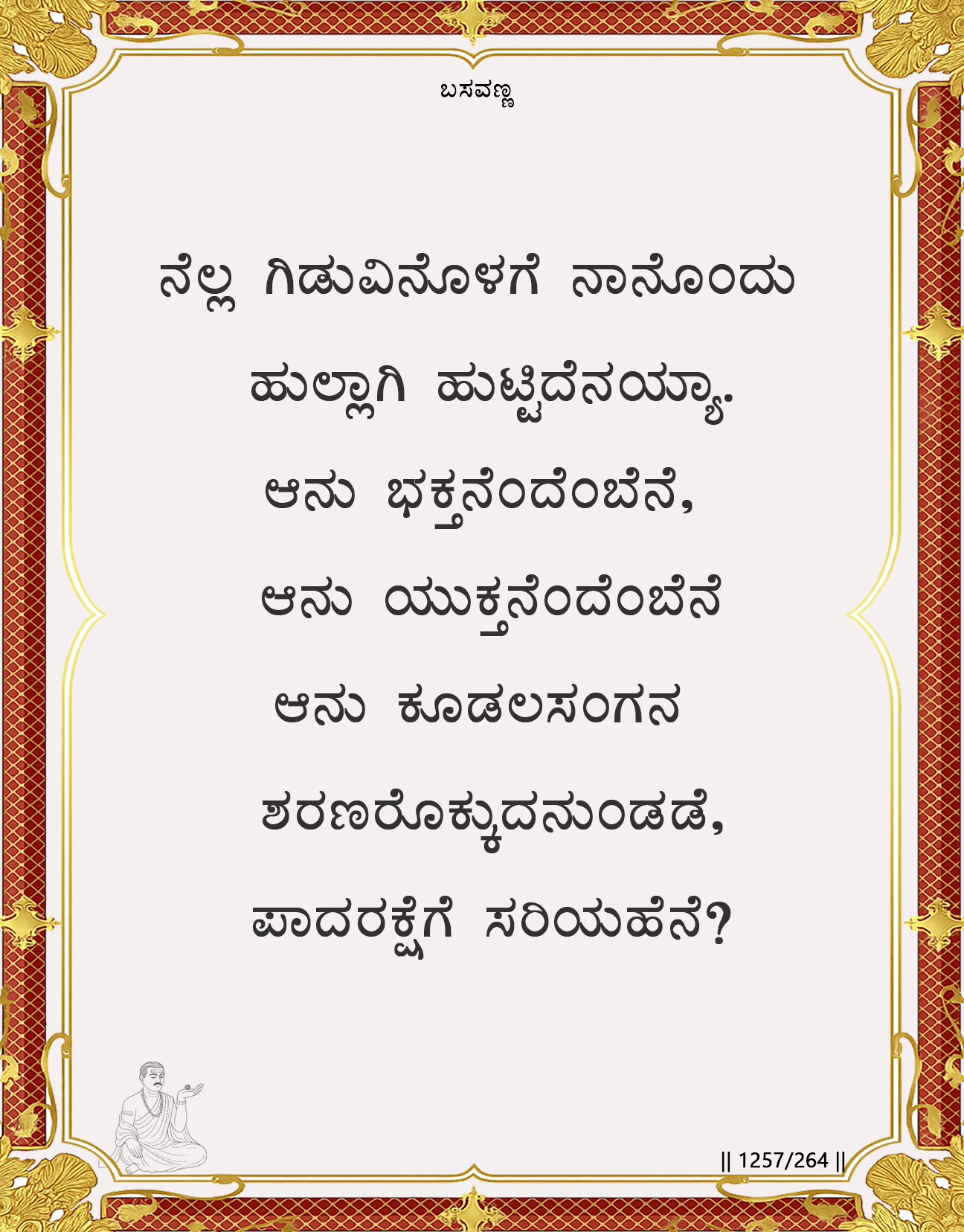
Before the golden grain stands tall,
it is but a blade of grass
soft, fragile, unnoticed.
How then shall I dare
call myself a bhakta?
What skill, what purity,
what depth have I truly earned?
By the grace of Koodalasangamadeva,
I have been allowed to stand
in the company of His sharanas
but do I even deserve
to touch the dust
of their worn sandals?
Basavanna expresses deep humility, comparing himself to the early grass that precedes mature grain. Just as grass cannot claim the stature of ripened paddy, he feels unworthy of calling himself a devotee. The vachana highlights that true spiritual maturity cannot be self-claimed; it arises only through grace. Although he is allowed to remain among the great sharanas of Koodalasangamadeva, Basavanna questions whether he is even worthy of the dust beneath their feet. This is the humility of a realized being one who sees grace, not personal merit, as the source of all spiritual advancement.
Spiritual Context
Core Spiritual Principle: Grace as the Ground of Being (Prasada-Adhishthana). Any spiritual quality or position is a gift, not an achievement. The moment one claims “I am a devotee,” the ego reasserts itself and obscures the very divine source it claims to serve. True spirituality begins with the dissolution of spiritual pride and the continuous acknowledgment that one is a vessel, not a source.
Cosmic Reality Perspective: From the non-dual view, the separate “I” that could claim attainment is an illusion (ahamkara). The grass and the golden grain are both temporary formations of the same earth and sunlight (Shiva-Shakti). The humility expressed is the clear seeing that there is no separate “Basavanna” to claim the status of “grain”; there is only the divine process unfolding. To claim otherwise would be for the wave to claim authorship of the ocean.
Historical Reality (Anubhava Mantapa Context): As the leading figure of the movement, Basavanna models essential leadership ethics for the Lingayoga community. This vachana prevents the cult of personality and spiritual hierarchy based on titles. It establishes that even the most revered teacher must see themselves as the first servant and the foremost recipient of grace, ensuring leadership remains grounded in service (dasoha) and humility, not ego.
Interpretation
“Blade of grass… golden grain.” This is a metaphor for the Shatsthala journey itself. The grass is the initial, tender seeking of the Bhakta. The golden grain is the fulfilled state of Aikya. Basavanna positions himself in the vulnerable, early stage, focusing on the process, not the product.
“What skill, what purity, what depth have I truly earned?” This deconstructs the very notion of spiritual “earning.” It challenges the transactional mindset of karma. In the economy of grace, nothing is “earned” by the ego; all is “given” to the soul.
“The dust of their worn sandals.” The dust is sacred because it is imbued with the tapas (austerity) and kayaka (sacred action) of the realized ones. To feel unworthy of even this dust is the highest form of reverenceit sees the Divine in the other so completely that one’s own self-importance vanishes.
Practical Implications: Spiritual practice must include the active cultivation of humility (vinaya). This involves constantly reflecting on one’s motives, acknowledging the role of help and grace in every small advancement, and holding one’s own spiritual identity lightly.
The Cosmic Reality
Anga (Human Dimension): The Anga, in this purified state, is conscious of its role as the receptive field. It is the “blade of grass” that knows its growth depends entirely on elements beyond itself.
Linga (Divine Principle): The Linga is the grace-giver, the sole cause of transformation. It is the generative power that turns potential (grass) into fulfillment (grain).
Jangama (Dynamic Interaction): Jangama is the humility itselfthe dynamic relationship where the Anga continuously bows to the Linga’s grace as manifest in the world (the sharanas, the community). This bowing is not weakness but the most powerful alignment with reality.
Shata Sthala
Primary Sthala: Prasadi. This vachana is a masterclass in the Prasadi stage. The hallmark of a Prasadi is the recognition that every breath, every step on the path, is a form of grace received. The speaker doesn’t claim a high state; they marvel at being allowed to be near those who embody it.
Supporting Sthala: Bhakta. The intense longing and devotion expressed here are the very fires of the Bhakta stage. However, they are now purified of any sense of ownership. This shows how Bhakti, when matured by the grace of Prasada, becomes the selfless love that characterizes the highest devotion.
Practical Integration
Arivu (Awareness Practices): Practice “grass meditation.” Contemplate your own life and see the countless causes people, circumstances, unseen grace that have brought you to this moment. Cultivate the feeling of being a grateful recipient, not a solitary achiever.
Achara (Personal Discipline): The discipline is to relinquish the pronoun “my” in spiritual matters. Replace “my meditation,” “my practice,” “my understanding” with “the meditation that grace allows,” “the practice sustained by the Guru-Linga-Jangama,” “the understanding that dawns.”
Kayaka (Sacred Action): Perform your duty as an offering of gratitude for the grace of having a duty to perform. See your work as the “dust” you are allowed to contribute to the great journey of the sangha.
Dasoha (Communal Offering): Honor the community and its elders with genuine reverence. See the most humble member as a vessel of grace. This attitude creates a culture of mutual respect and dissolves competitive spirituality.
Modern Application
“The Culture of Self-Promotion and Spiritual Branding.” In an age of influencers and personal brands, even spirituality becomes a curated identity. We are encouraged to market our “awakening,” our “journey,” and our “expertise,” leading to comparison, envy, and subtle arrogance.
This vachana is an antidote to spiritual narcissism. It teaches that true authority comes from humility, not self-assertion. It invites a shift from building a spiritual resume to becoming a transparent conduit for grace. In a noisy world of self-proclaimed gurus, the one who says “I am only grass” may be the only one standing in the nourishing sunlight of truth.
Essence
The ripe field bows its heavy head.
The empty stalk stands stiff with pride.
I am the green shoot, not the bread,
and in this truth, I safely hide.
For if I claim the harvester’s name,
I freeze in fear of my own claim.
But as a blade, I feel the Sun,
and know the Harvest has begun
This vachana demonstrates The Paradox of Authentic Attainment: The Law of Inverse Claim. In the realm of ego, stature increases with self-assertion. In the realm of spirit, true stature increases in direct proportion to the dissolution of self-claim. The most advanced practitioner is the one who genuinely perceives themselves as the least. This isn’t a strategy but an ontological fact: as the separate self (grass) diminishes, the awareness of the divine source (the grain, the field, the sun) expands. The vachana records the subjective experience of this expansion, which feels like humble smallness.
Imagine a door that opens inward to a vast palace. The bigger you try to make yourself to enter (puffing up with pride, achievement, identity), the more you block the doorway. The smaller you make yourself (through humility, surrender, gratitude), the more easily you pass through into the infinite space within. Basavanna stands at the threshold, making himself as small as a blade of grass, and in doing so, experiences the boundless grace of the palace he is about to enter.
This speaks to our deep fear of insignificance and our compensatory desire for recognition. Basavanna offers a shocking resolution: embrace your insignificance not as a defeat, but as the key to union with the Significant. The peace we seek is found not in building a bigger self, but in the profound relief and gratitude of letting the small self be cradled by a grace larger than we can ever claim.

Views: 0