Poetic Rendering

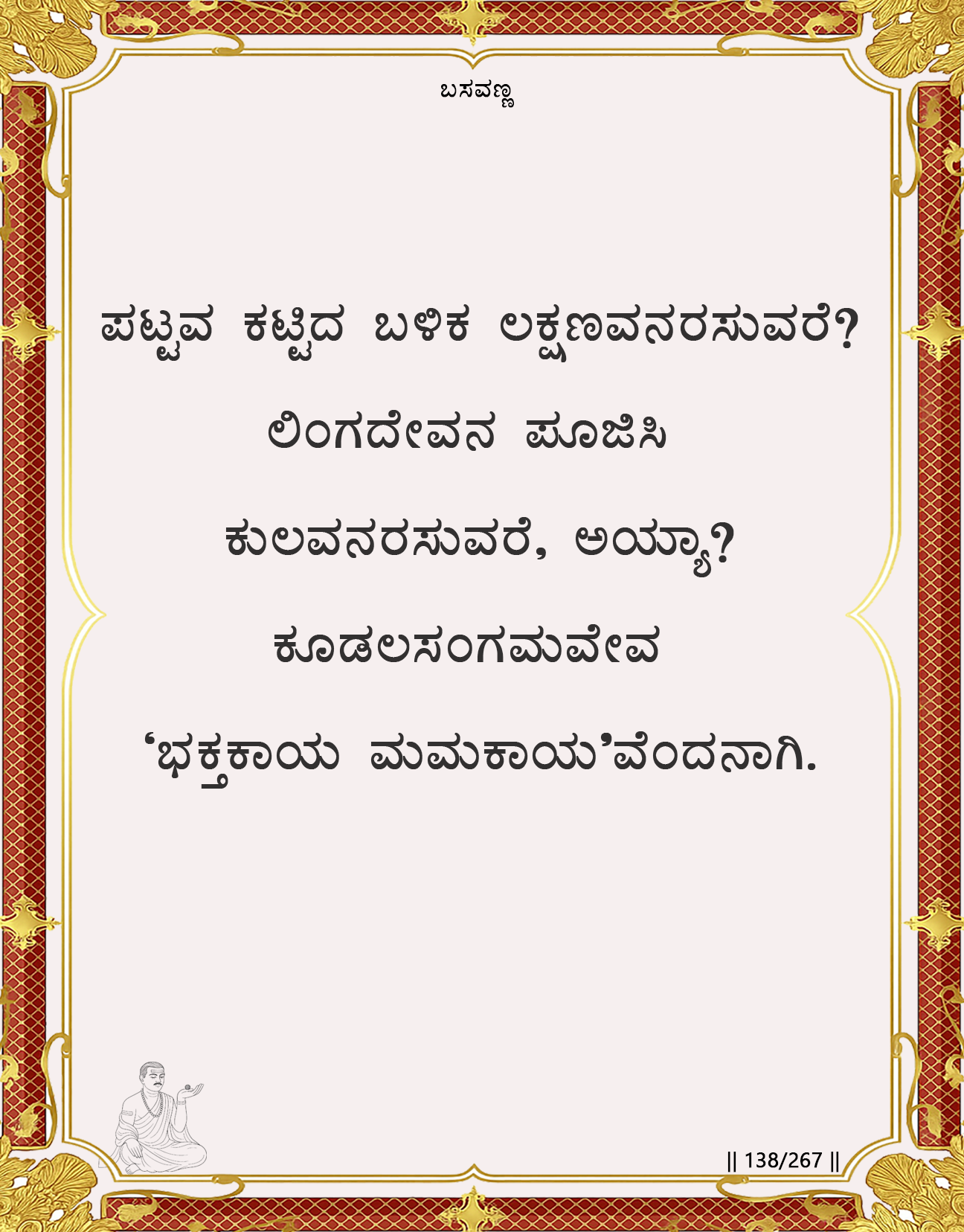
When the Linga is tied upon one’s body does anyone still ask of birth or clan?
When the flame of worship is lit within who speaks of high or low, of rich or poor?
The moment of initiation,
when the Guru places the Linga in the palm,
is the true coronation of the soul beyond place, title, or family name.
For in the eyes of Koodalasangama, the body of the Sharana and the body of Shiva
are not two, but one breathing, radiant truth.
This vachana is Basavanna’s revolutionary declaration of spiritual democracy and the annihilation of social hierarchy. It centers on the transformative power of Linga Diksha (initiation), which is not merely a ritual but a metaphysical event that redefines the individual’s identity. Basavanna asserts that upon receiving the Linga, all worldly labels caste, clan, and social status become irrelevant. The initiate enters a new, universal “caste” of consciousness, where the only identity that matters is the non-dual union with the Divine. This is not a social reform but a spiritual truth: when one’s core identity shifts to the Atman (soul), the superficial distinctions of the body and birth lose all meaning.
Spiritual Context
Core Spiritual Principle: Ontological Rebirth (Dvija). Linga Diksha is not an addition to one’s identity but a complete rebirth. The old identity, based on karma and jati (caste), is symbolically and energetically severed. The new identity is atmaja (born of the Self) or lingaja (born of the Linga). This is the true meaning of being “twice-born”not by Brahminical rite, but by the awakening of divine consciousness.
Cosmic Reality Perspective: From the non-dual view, there is only Shiva. Social distinctions are superimpositions (adhyasa) on this unity. The initiation is the ceremonial removal of these superimpositions. The Guru, representing the lineage of awakened consciousness (jagadguru), “remembers” for the disciple their true nature as Shiva and bestows the Linga as the tangible, daily reminder of that truth. The “flame of worship lit within” is the ignition of jnana agni (fire of knowledge) that burns away the dross of false identity.
Historical Reality (Anubhava Mantapa Context): This was the legal and spiritual basis for the Lingayoga social revolution. In a society where identity, occupation, and dignity were fixed by birth, this initiation provided an opt-out and a rebirth. It allowed individuals from “lower” castes and women to shed their stigmatized social bodies and claim a divine body. It was an act of radical empowerment and the formal mechanism for building a casteless community (sangha) based on shared spiritual commitment.
Interpretation
“Does anyone still ask of birth or clan?” This is a rhetorical command, not a question. It instructs the community to cease recognizing old identities. To ask after initiation is to deny the metaphysical reality of the ceremony.
“The true coronation of the soul.” This inverts worldly power. Kings are crowned over territories; the soul is crowned over illusion (maya). The Guru is the officiant of a higher sovereignty, granting authority over one’s own inner kingdom.
“The body of the Sharana and the body of Shiva are not two…” This is the theological core. The initiated body is not a sinful vessel but a manifestation (vibhuti) of the Divine. The Linga on the body signifies the Shiva-nature of the body. This erases the duality of sacred/profane, pure/impure at the level of the physical self.
Practical Implications: Post-initiation, all social interactions within the sangha must reflect this new reality. Relationships are re-founded on spiritual brother/sisterhood (sharana/sharaneshwari), not hereditary roles. The Linga becomes the primary identity badge, superseding all others.
The Cosmic Reality
Anga (Human Dimension): The Anga is transfigured from a social entity into a consecrated pinda (microcosm). It is no longer a “Shudra body” or “Brahmin body” but a Lingangaa body whose defining feature is its union with the Linga.
Linga (Divine Principle): The Linga is the bestowed sovereign, the seed of divine identity planted within the individual cosmos. It is both the symbol and the substance of the new self.
Jangama (Dynamic Interaction): Jangama is the living tradition of initiation the Guru-Shishya lineage that transmits the awakening. It is also the lifelong process of the Anga learning to live out the truth of its “coronation,” aligning every action with its Shiva-nature.
Shata Sthala
Primary Sthala: Sharana. Linga Diksha is the formal entry into the Sharana stage. The seeker now has a concrete, daily practice (worship of the personal Ishtalinga) and a reformed identity that supports the path of surrender and ethical living required of a Sharana.
Supporting Sthala: Aikya. The initiation ceremony is a ritual foreshadowing of Aikya. The phrase “not two, but one” is the experiential truth of Aikya, presented here as the doctrinal promise and purpose of the initiation. The entire Shatsthala journey is the process of making this ritual truth an everyday reality.
Practical Integration
Arivu (Awareness Practices): The daily worship (panchachara) of the Ishta linga is the core awareness practice. It is a daily re-initiation, a tactile reaffirmation of one’s true identity beyond the masks assumed during the day.
Achara (Personal Discipline): The primary discipline is to uphold the dignity of this new identity. This means acting with the integrity, compassion, and fearlessness befitting one who wears the form of Shiva. It involves consciously rejecting old caste-based behaviors and self-concepts.
Kayaka (Sacred Action): One’s work becomes kayakanot a caste-duty (jati-dharma) but a form of worship offered by the Shiva-body. The nature of the work is sanctified by the consciousness of the worker.
Dasoha (Communal Offering): The community’s duty is to honor and protect this new identity in every member. It must provide a space where the “mark beyond all marks” is the only mark that matters, offering solidarity and spiritual fellowship that replaces old kinship networks based on birth.
Modern Application
“The Tyranny of Manufactured Identity.” We live in a world of rigid identity politics, brand affiliations, social media profiles, and professional titles that often feel constricting and conflict-prone. We are judged and judge others based on a curated set of labels, leading to alienation and tribalism.
This vachana offers a profound way out of identity-based suffering. It proposes that our deepest self is not constructed from social, racial, or professional pieces, but is conferred by a connection to the Sacred. It suggests we can choose a primary identity rooted in consciousness and compassion, one that renders other divisive labels secondary and ultimately irrelevant. In a fragmented world, it points to a unifying identity available to all who seek it.
Essence
They stamped your hand with ink of clan,
a number in a vast, old plan.
But we have washed that mark away
and on the heart’s fresh palm we lay
a seed of light, a stone of grace
the only line upon your face.
Now wear this, and know your name:
the undivided, holy flame.
This vachana presents Initiation as Ontological Revolution. In the framework of Lingayoga, Linga Diksha is a performative act of supreme magnitude that does not symbolize but instantiates a new reality. The Guru’s ritual action and mantra (“I bestow the Linga”) effect a metaphysical change in the recipient’s beinga shift from a socially constructed identity (jati) to a divinely conferred identity (lingin). The community’s covenant to “not ask of birth or clan” is the necessary social ratification of this new ontology. Together, they create an entirely new “form of life,” a Sangha, where the old semiotics of caste are rendered void and the Ishtalinga becomes the sole, meaningful signifier of one’s true, universal self.
Imagine society is a play where everyone is assigned a rigid role and costume at birth, determining their entire life’s script. Linga Diksha is not about getting a better role in the same play. It is the moment the director (Guru) steps onto the stage, stops the performance, and hands you a mirror, saying, “This script is not you. This costume is a disguise. Look you are the light that illuminates the entire stage.” From that moment, the play of social hierarchy continues around you, but you are no longer an actor in it. You are the awareness watching it, and your community are those who have also awakened and now recognize only the light in each other.
This speaks to the profound human ache to be valued for our essential being, beyond all inherited or earned labels. We instinctively rebel against the limitations of caste, class, and pedigree. Basavanna validates this rebellion not as a social protest but as a spiritual imperative. He provides the tangible means the ritual, the insignia, and the community to enact our deepest intuition: “I am not this limited name and form.” He offers a radical rebirth into a life where dignity is innate, conferred by the Divine itself, and recognized by all who walk the same path toward the liberating truth of non-dual union.

Views: 0