Poetic Rendering

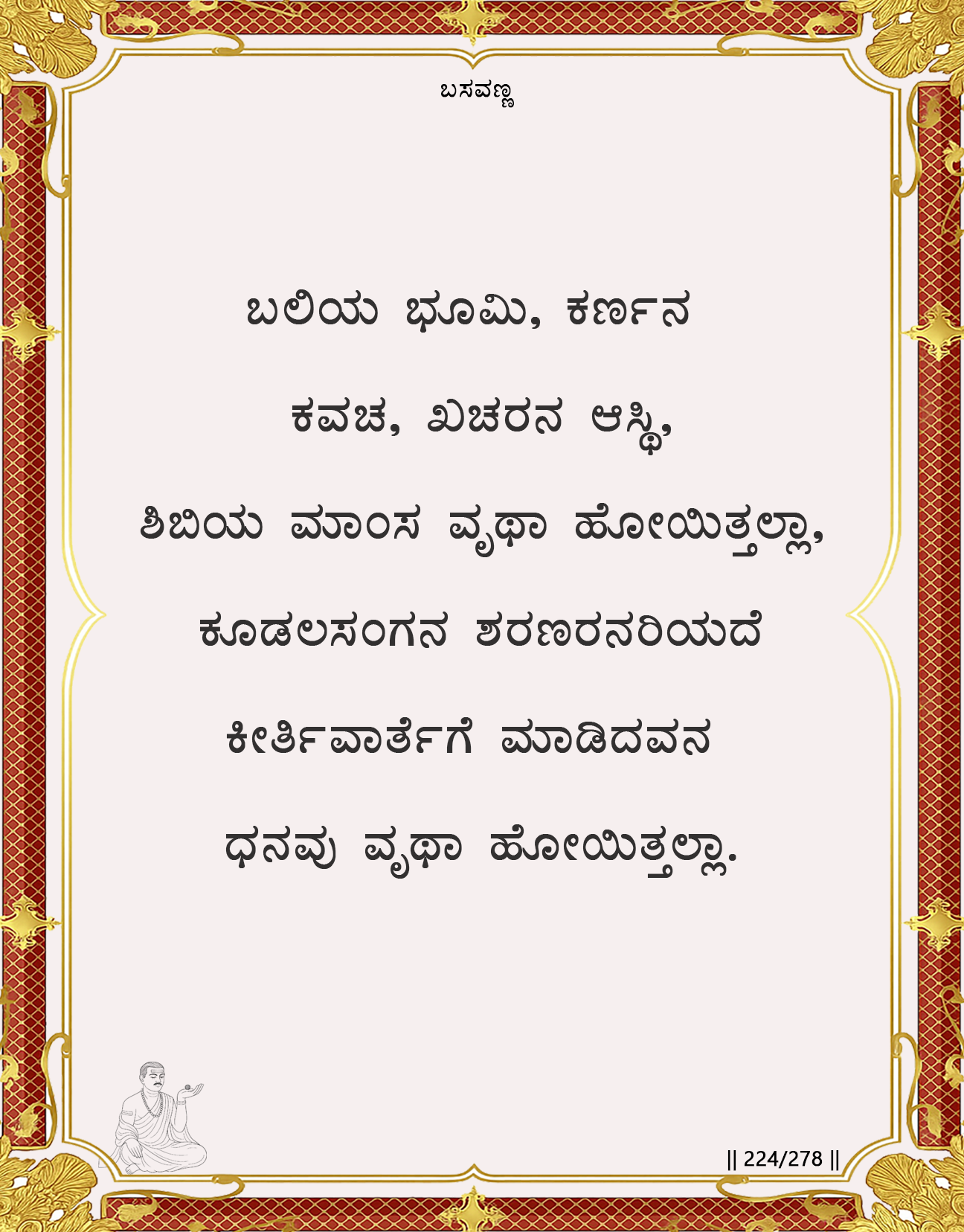
Bali, who gave the three worlds in alms,
Karna, who tore off his golden armor,
Kacha, who offered himself to the gods,
Shibi, who carved his flesh for a pleading bird
their gifts blaze through legend,
yet fade to nothing.
For what is charity without the Linga?
What is sacrifice without the inward flame
of Shiva-awareness?
Gifts offered for praise or renown
cast no light;
they are shadows without substance.
Wealth given without love
for the Sharanas of Koodalasangamadeva
is wealth scattered on barren dust.
Legendary Acts of Generosity
King Bali (Mahabali) : A benevolent Asura king celebrated for his righteousness and devotion to Lord Vishnu. When Vamana (an incarnation of Vishnu) asked for three paces of land, Bali humbly offered all he had even the three worlds. His act of surrender is remembered as the ultimate gift of humility and generosity
Karna (Mahabharata) Known as Daanveer Karna (“the great giver”), he never refused anyone who sought alms. His most famous act was giving away his divine armor (kavach) and earrings (kundal) to Lord Indra, even though he knew it would cost him his life in battle. This sacrifice made him the epitome of charity
Kacha (Puranic tales) Son of Brihaspati, sent to learn the secret of immortality from Shukracharya, the guru of the Asuras. Kacha offered himself in service to the gods, enduring repeated deaths and resurrections during his training. His willingness to sacrifice his life for divine knowledge is seen as an act of devotion and generosity toward the gods.
King Shibi (Mahabharata & Buddhist Jataka tales) Famous for the story where a dove sought refuge from a hawk. To protect the dove, Shibi offered his own flesh equal to the bird’s weight, ultimately placing himself on the scale. His self-sacrifice for the sake of compassion is one of the most celebrated examples of generosity in Indian lore.
These stories are not just myths but moral exemplars in Indian tradition. They highlight that true generosity often involves personal sacrifice, compassion, and humility, values deeply woven into the cultural fabric.
Basavanna challenges the celebrated ideals of generosity represented by figures like Bali, Karna, Kacha, and Shibi. Even their extraordinary acts of giving, he says, lack true spiritual worth if they are not grounded in devotion to Shiva and free from ego. Real charity (Dasoha) is not measured by the size of the gift but by the purity of the giver’s awareness. Giving done for fame, honor, or merit only strengthens karmic bondage. True giving arises from surrender, humility, and recognition of the Divine in all where the giver, gift, and recipient are one in the presence of the Linga.
Spiritual Context
Core Spiritual Principle: Non-Dual Offering (Advaita Dasoha). The substance of charity is not the object given but the consciousness from which it springs. Any giving that reinforces the triad of giver, gift, and receiver as separate entities is a transaction within Maya, binding karma. True giving is an expression of the already-existing unity.
Cosmic Reality Perspective: From the non-dual Shiva-Shakti view, all manifestation (the three worlds, the body, wealth) is already Shaktithe energy of Shiva. To “give” it while acknowledging separation is a contradiction. Authentic Dasoha is the conscious recognition that one is merely redirecting a fragment of Shakti back toward its Source (Linga), often through the conduit of the awakened community (Jangama).
Historical Reality (Anubhava Mantapa Context): This was a radical critique of both Brahminical ritual sacrifice (Yajna) and kingly patronage done for merit (Punya) and fame. In the Basavayoga economy, Dasoha was the social engine. Basavanna here establishes its metaphysical foundation: community sharing is spiritual practice only when it is an outward expression of inner, Linga-centric awareness.
Interpretation
Legendary Gifts “Fade to Nothing”: Bali, Karna, etc., acted within the drama of duality as heroes, devotees, or moral agents. Their gifts were monumental transactions, expecting cosmic rewards, honor, or moral victory. Hence, they belonged to the realm of cause and effect (Karma), which is finite and ultimately perishable.
“For what is charity without the Linga?”: The Linga is the centering axis that transforms action. Without this anchor, action spins off into the relative world of names and forms. Charity becomes a social or ethical act, not a spiritual one.
“Gifts offered for praise or renown… shadows without substance”: This defines “Prakrita Dasoha” (material giving). The substance (light) comes only from the giver’s awareness; the shadow is the empty form of the act, casting no spiritual reality.
“Wealth given without love for the Sharanas… is wealth scattered on barren dust”: The Sharanas represent the Jangama the living, conscious embodiment of the Linga. Giving to them with love is giving directly to the Divine flow. Without that love (awareness of unity), the gift falls on the “barren dust” of separatist perception, where nothing spiritual can grow.
Practical Implications: One must perform a “motive scan” before any act of giving. Is there a hidden desire for recognition, gratitude, or spiritual merit? The ideal is to give as naturally as a tree gives fruit without ceremony, without memory of the act.
The Cosmic Reality
Anga (Human Dimension): The realm of the individual ego (Ahamkara) and its possessions. It is naturally prone to using generosity as a currency for enhancing self-image, securing future rewards, or alleviating guilt. Its gifts are always measured and finite.
Linga (Divine Principle): The infinite, non-transactional source from which all abundance arises. It does not “give” but perpetually emanates. To give with Linga-awareness is to align one’s finite action with this infinite, gratuitous outflow.
Jangama (Dynamic Interaction): The sacred circuit of grace. When giving is an offering of love to the Sharanas (the conscious community), it completes the circuit: Shakti (wealth/energy) flows from the individual, is sanctified by the collective awareness, and returns to Shiva, purifying the giver in the process. This is the living mechanics of Lingayoga.
Shata Sthala
Primary Sthala: Sharana. This is the practical stage of lived Dasoha. The Sharana has taken refuge, and thus their giving is an extension of that surrender. They give not as a lord, but as a conduit, with humility and love for the Divine in the other.
Supporting Sthala: Aikya. The perfection of Dasoha. At this stage, the very concept of “giving” evaporates. One simply sees one’s own wealth, body, and action as already belonging to, and being part of, the singular divine body (Shiva-Sharana-Sangha). There is no “other” to give to.
Practical Integration
Arivu (Awareness Practices): Before giving, pause and internally dedicate the offering: “To the Linga present in you, I offer this.” Practice anonymous giving where possible, eliminating any feedback loop for the ego. Witness the mental resistance or pride that arises as part of the purification.
Achara (Personal Discipline): Establish a fixed, regular proportion of your income for Dasoha. Give it first, without deliberation, as an act of precedence, not from surplus. This ritualizes non-attachment. When receiving thanks, mentally redirect that gratitude to the Linga within the giver.
Kayaka (Sacred Action): View your labor itself as the primary “gift.” Offer the skill, attention, and integrity of your work as a daily Dasoha to the world. Your paycheck then becomes a secondary symbol of that already-completed offering.
Dasoha (Communal Offering): In community gatherings, participate in collective giving where contributions are pooled anonymously. Serve food or resources without distinguishing between “servers” and “recipients,” embodying the non-dual reality that all are partakers in the one offering.
Modern Application
“Philanthropic Ego & Virtue Signaling.” The age of public charity, donor plaques, and social media activism has turned giving into a performance of identity. It is often a transaction: wealth exchanged for social capital, reputation, or moral superiority, leaving the giver’s separatist ego intact and even strengthened.
This vachana calls for Stealth Grace. Give anonymously. Donate without telling anyone. Perform acts of kindness with no possibility of credit. Support causes without attaching your name. The practice liberates the act from the ego’s marketplace and transforms it into a genuine spiritual discipline, dismantling the inner tyrant who uses goodness for self-aggrandizement.
Essence
Gold and flesh, offered to the sky of story,
Echo and fade in time’s forgetful glory.
But a crumb laid down with a seeing heart,
Where giver and receiver never part,
Is a star that burns in the unmoving center
A flash of the Linga, the only True Enter
This vachana outlines the quantum field of charity. In a separatist (collapsed) state, giving is a localized transaction between two isolated particles (giver and receiver), exchanging finite energy. In a non-dual (superposition) state, giving is a recalibration within a unified field; energy simply flows to areas of need within the one body of consciousness, with no loss or gain, no giver or receiver. The legendary gifts were massive but localized transactions; the smallest gift offered in unity is a reconfiguration of the whole field.
Imagine a family dinner. If a child grandly “donates” a pea to their sibling to win parental praise, it’s a transaction. If the parent silently serves food to everyone, knowing all are fed from the same pot and belong to the same family, it’s Dasoha. The action may look similar, but the underlying reality separation vs. unity is entirely different.
Our deepest yearning is not just to be generous, but to be seamlessly generous to give without the wound of separation, without the calculus of self, and thus to experience our boundless nature. The ego’s charitable achievements are ultimately haunted by the unspoken question, “Did it make me good?” True giving ends that question by ending the “me” that asks it.

Views: 2