Poetic Rendering

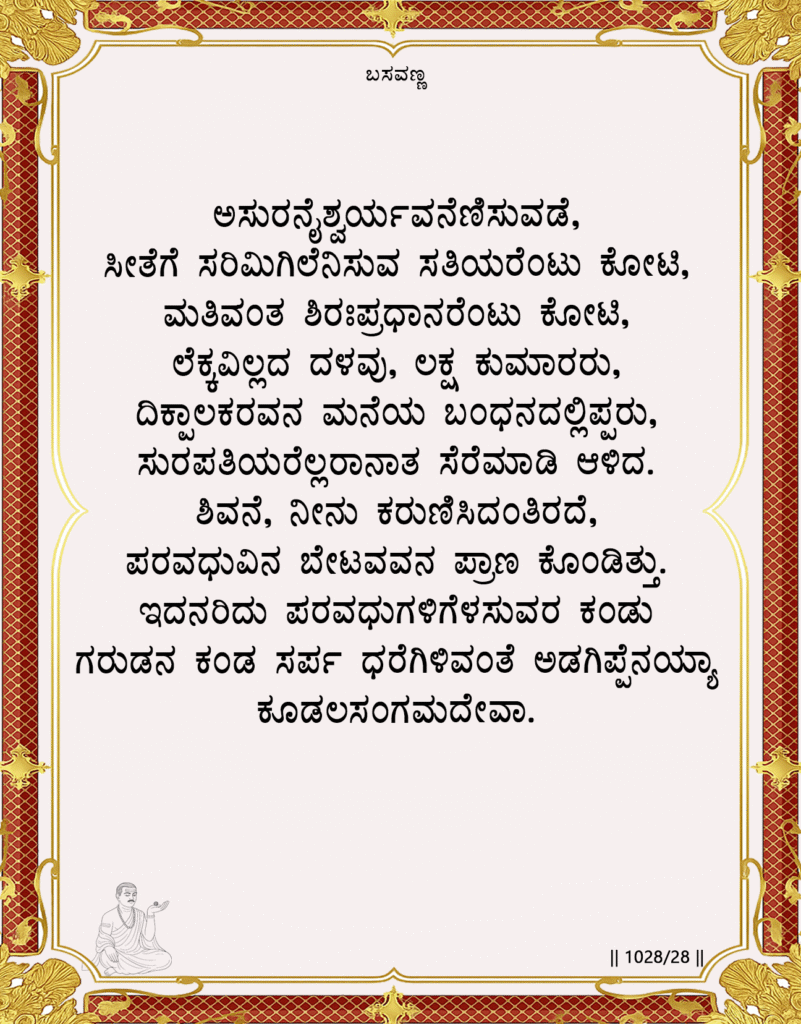
He who had treasures beyond measure,
consorts in countless numbers,
counselors filling halls like forests,
sons and soldiers beyond the sands of the sea,
guardians of heaven’s gates bound in his house,
even the lords of gods subdued
yet all of it perished,
for one moment of unbridled desire.
Seeing this, when I behold men chasing after what belongs to another,
my heart recoils, shrinking back
as a snake before the eagle’s wings.
O Koodalasangama,
without Your grace,
the empire of power collapses into dust.
This vachana is a profound meditation on the nature of power and its inherent fragility when divorced from inner purity. Basavanna paints a vivid portrait of a figure of unimaginable wealth and influence a king with vast treasures, armies, celestial connections, and even divine beings in his service. Yet, this entire empire of power was annihilated by a single, unguarded moment of illicit desire. The vachana is not merely a moral tale but a stark exposition of a cosmic law: external structures, no matter how magnificent, are built on the foundation of the individual’s inner state. When that foundation of self-restraint and integrity cracks, the entire edifice collapses. The seeker’s visceral recoil from such temptation is a prayer of gratitude for the grace that grants such discernment.
Spiritual Context
Core Spiritual Principle: Worldly power and attainment are inherently unstable and fragile. They are not a foundation for the soul. The only true stability comes from inner purity, self-restraint, and alignment with Divine Law (Dharma). A single moment of succumbing to base desire can unravel a lifetime of accumulation.
Cosmic Reality Perspective: The cosmos operates on Dharma, the principle of righteous order. The king’s “unbridled desire” was an act of Adharma (unrighteousness), a violation of cosmic law. The collapse of his empire was not a moral punishment but the natural, inevitable consequence of this misalignment, just as a building collapses if its foundation is removed.
Historical Reality (Anubhava Mantapa context): As a former minister, Basavanna had intimate knowledge of the corrupting nature of political power. This vachana is a profound political and spiritual critique, warning that no amount of temporal authority can protect one from the consequences of their own inner failings. It establishes inner integrity as the only real power.
Interpretation
1. The Catalogue of Power: The detailed list of the king’s assets treasure, women, advisors, armies, even celestial beings serves to emphasize the sheer scale and seeming invincibility of his power. This makes its eventual collapse all the more dramatic and instructive.
2. The Fatal Flaw: “one moment of unbridled desire” : The cause of the fall is not an external army, but an internal weakness. This highlights that the greatest threat to any structure, whether a kingdom or a soul, is not outside, but within the untamed senses and ego.
3. The Seekers’s Response: “my heart recoils…” : This is the lesson internalized. The poet doesn’t just understand intellectually; he has developed a visceral, instinctual aversion to unethical acquisition. The simile of the snake and the eagle conveys a deep, self-protective fear born of wisdom.
4. The Culminating Realization: “without Your grace… collapses into dust.” : This is the ultimate insight. The capacity for such discernment and self-restraint is not a personal achievement but a gift of divine grace (Prasada). Without this grace sustaining one’s inner foundation, any external “empire” is doomed to eventual ruin.
Practical Implications: The seeker must understand that spiritual practice is the process of building an unshakable inner foundation. This involves constant vigilance over one’s desires and motivations. Success is measured not by external acquisitions, but by the strength of one’s integrity and the depth of one reliance on grace.
The Cosmic Reality
Anga (Human Dimension): The human as a repository of power (political, social, personal) and desire. The untransformed Anga is a kingdom built on sand, vulnerable to being swept away by the tides of its own passions.
Linga (Divine Principle): Kudalasangama Deva as the embodiment of Dharma and the source of the grace that stabilizes the soul. The Linga is the eternal, unchanging foundation upon which a true life can be built.
Jangama (Dynamic Interaction): The Jangama is the flow of grace that actively instills discernment (Viveka) and dispassion (Vairagya) in the seeker. It is the dynamic force that allows the Anga to learn from the falls of others and build its life on the foundation of the Linga, rather than on the fleeting sand of worldly power.
Shata Sthala
Primary Sthala: Maheshwara. This vachana exemplifies the Maheshwara’s role: to develop immense inner strength and discipline, to learn from the mistakes of the world, and to wield power (over oneself and one’s environment) with utter integrity.
Supporting Sthala: Prasadi. The final acknowledgment reveals that the Maheshwara’s strength itself is sustained by grace. The ability to recoil from temptation is a blessing, positioning the seeker to receive even greater grace.
Practical Integration
Arivu (Awareness): Practice observing the consequences of desire and unethical action in the world around you in politics, business, and personal lives. Let these observations serve as living lessons to strengthen your own resolve for integrity.
Achara (Personal Discipline): Cultivate discipline in small things. Practice restraint in speech, consumption, and entertainment. This builds the “muscle” of self-control needed to resist larger temptations.
Kayaka (Sacred Action): Use any power or influence you have in your work to uphold Dharma fairness, honesty, and compassion. See your position as a trusteeship, not a possession.
Dasoha (Communal Offering): Share these lessons with the community. A strong Sangha is one that collectively values integrity over acquisition and supports its members in living a principled life.
Modern Application
We live in a culture that idolizes power, wealth, and fame. The falls of celebrities, executives, and politicians are constant tabloid fodder, yet we continue to chase the same hollow dreams, ignoring the lesson that external success without inner integrity is a ticking time bomb.
This vachana liberates by redefining success. It frees us from the exhausting pursuit of external validation and power. It teaches that true, lasting security is built not on a resume or a bank account, but on the quality of our character and our conscious reliance on a higher grace. It is the path to a life of authentic peace, immune to the inevitable rise and fall of worldly fortunes.
Essence
A crown of gold, a throne’s command,
A single lust, a fallen land.
This lesson seen, my heart grows wise,
And on Your grace, my soul relies.
Metaphysically, this vachana illustrates the interplay between the three Gunas. The king’s empire, built on Rajasic (active, passionate) energy, is spectacular but unstable. The “unbridled desire” is a surge of Tamas (ignorant, destructive) energy that collapses the Rajasic structure. The seeker’s “recoil” is the emergence of Sattva (purity, harmony), which creates stability and clarity. This Sattvic state is not a personal achievement but is made possible by the grace (Prasada) of the Linga, which transcends the Gunas. The vachana maps the journey from being a slave to the Gunas to being established in the grace that masters them.
All structures of egoic power whether personal, corporate, or national are inherently fragile because they are built on the shifting sands of desire. The only enduring legacy is one built on the rock of ethical integrity and spiritual wisdom. The wise learn from the falls of others and understand that the greatest power is the self-mastery granted by a conscious connection to a higher principle.

Views: 4