Poetic Rendering

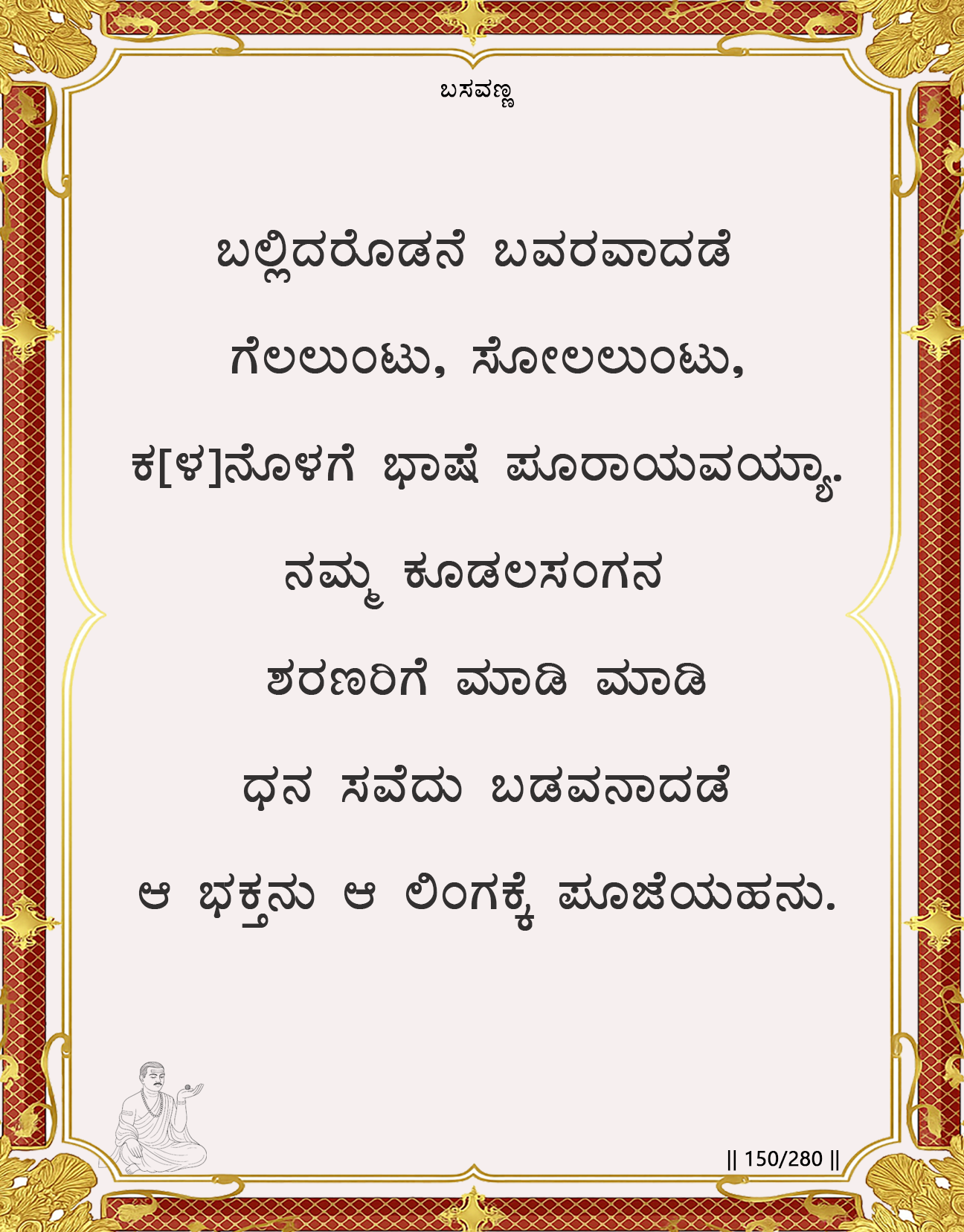
Among men, the learned and the valiant
lock horns in endless quarrel
words leaping like sparks,
scorching pride into ash.
One wins and boasts,
another loses and broods;
yet both remain caught
in the same dusty wheel of desire,
their victories hollow,
their losses the same old chains.
But the one who spends his wealth
for the Sharanas of Kudalasangamadeva
who gives with hands emptied of self
and a heart lit with service
such a one, though stripped of gold,
stands before the Linga radiant.
For what is poured out in devotion
returns as grace.
And the poverty born of love
is a treasure the world
cannot measure.
Basavanna contrasts the ego-bound world with the liberating path of sacred offering. Intellectuals and warriors may argue, win, or lose, but their disputes only reinforce the ego’s grip, keeping them trapped in the cycle of pride, gain, and loss. True transformation begins not through victory or accumulation, but through Daasoha selfless offering to the Sharanas. When wealth and effort are given without ego, they undergo a spiritual alchemy: what is materially diminished becomes spiritually multiplied. Such giving is not charity but inner purification, where the act dissolves the self and reveals a wealth far greater than possessions the grace of Kudalasangamadeva.
Spiritual Context
Core Spiritual Principle: Transmutation through Sacrifice (Yajna). In Lingayoga, the true sacrificial fire is Dasoha. The ego and its attachments (wealth, pride) are the fuel. When offered with the right intention (to the Sharanas), the flame of consciousness burns away the dross of “mine-ness” (Mamakara), leaving only the gold of grace (Prasada).
Cosmic Reality Perspective: Non-dual reality perceives no loss or gain, only transformation of energy. The quarrels of the learned and valiant represent Shakti (the energy of intellect and action) spinning in conflict with itself, creating entropy. Offering to the Sharanas is Shakti consciously directed back toward its source (Shiva), a process that increases the system’s spiritual coherence and luminosity.
Historical Reality (Anubhava Mantapa Context): This vachana directly addressed the composition of the Anubhava Mantapa, which included scholars, warriors, and wealthy householders. Basavanna reframes their core competencies: true learning and valor are shown not in defeating others, but in conquering one’s own greed. This redefined the community’s economy as one of competitive giving, where the “victory” was in who could be most selflessly generous.
Interpretation
“Words leaping like sparks, scorching pride into ash”: Intellectual and martial victories only incinerate the gross ego, but the subtle ash of “I-am-the-doer” (Kartritva Bhava) remains. The wheel of desire (Samsara Chakra) is coated with this ash, making it spin on unseen.
“Their victories hollow, their losses the same old chains”: Both winning and losing are two sides of the same coin of attachment (Raga-Dvesha). The winner is bound by pride of achievement; the loser is bound by resentment. Both are enslaved to outcome.
“Gives with hands emptied of self”: This is the key. The hands perform the action, but the internal sense of ownership (Ahankara) has been relinquished. The Anga becomes a transparent instrument.
“Stands before the Linga radiant… poverty born of love is a treasure”: This is the alchemical result. Material poverty (Daridrya) becomes spiritual abundance (Aishwarya). The “radiance” is the light of the innate Self (Prakasha), no longer obscured by the clutter of possession and ego. What returns as “grace” is the direct experience of this innate fullness.
Practical Implications: The test of any actiondebate, work, or charityis this: does it leave the “I” feeling larger (proud) or smaller (resentful), or does it dissolve the “I” entirely? Only the latter is true Dasoha and leads to radiance.
The Cosmic Reality
Anga (Human Dimension): The domain of measurable quantities: knowledge, strength, wealth, victory, loss. It operates on a balance sheet of credit and debit, which always nets to zero in spiritual terms. Its pursuits are inherently dualistic and binding.
Linga (Divine Principle): The immeasurable source of all abundance. It is not a quantity but a quality pure radiance. It cannot be received by one full of ego; it can only reflect itself in a vessel emptied of self.
Jangama (Dynamic Interaction): Dasoha is the Jangama that bridges the two. It is the process of taking a quantity from the Anga’s world and offering it in such a way that the very act vaporizes the vessel’s walls, allowing the quality of the Linga to shine through. The “Sharanas” are the living medium, the catalytic field, for this reaction.
Shata Sthala
Primary Sthala: Sharana. The entire discipline described giving wealth for the Sharanas is the core practice of a Sharana. It is the active, willful practice of surrendering attachments to solidify one’s state of refuge.
Supporting Sthala: Pranalingi. The radiant result points to the Pranalingi stage, where the Linga is not just an external object of worship but a vibrantly perceived presence within one’s own life-force. The grace received is the enlivening of this inner connection.
Practical Integration
Arivu (Awareness Practices): Before any significant expenditure, pause. Ask: “Is this for my ego’s comfort or prestige, or is this a genuine offering to the Divine flow in my community?” Use the feeling of reluctance to give as the most potent fuel for the offering.
Achara (Personal Discipline): Practice “strategic impoverishment.” Voluntarily forgo a comfort or sell a possession and dedicate the resources saved to a communal or charitable cause related to the Sharanas. Observe the inner state before, during, and after.
Kayaka (Sacred Action): Apply the principle to non-material “wealth.” Offer your skills, time, and attention to colleagues or community projects without seeking credit. Let your labor be a “silent offering,” transforming workplace dynamics from a field of competition to a field of service.
Dasoha (Communal Offering): Establish a community fund where all contribute anonymously and decisions on disbursement are made collectively for the benefit of all, especially those in need. This embodies the “hands emptied of self” on a group level.
Modern Application
The Hollow Victory of Meritocracy. Our society is built on the quarrels of the learned and valiant endless competition for grades, jobs, status, and net worth. We are taught to keep score, and whether we are winning or losing, we remain anxious and empty, chained to the “dusty wheel” of comparison and endless striving.
This vachana prescribes Generosity as a Subversive Act. It instructs us to use our resources money, time, praise not to climb the ladder, but to deliberately strengthen the collective well-being of a conscious community. This breaks the spell of competition. The resulting “radiance” is the authentic confidence and peace that comes from being sourced in grace, not in precarious personal achievement.
Essence
The scholars spar, the warriors vie,
Their triumphs brief, their shadows long.
A coin passed from an open hand
To where the heart’s true kinsmen stand,
Is a key that turns a subtler lock.
The emptied purse outshines the rock.
This vachana describes the entropy reversal of conscious systems. The quarrels of ego represent a closed system where energy (intellect, effort) degrades into heat (scorched pride) and disorder (chains). Dasoha is an open system: by channeling energy (wealth) outward to the Sharanas (a coherent field of consciousness), it creates a negentropic pull, drawing higher-order grace (radiance) back into the individual, increasing internal order and light.
Imagine two closed jars of murky water (the egos). Shaking them (quarreling) just stirs up the mud. Now, pour the water from one jar through a pure filter (the Sharanas/selfless intention) into a clean basin (the Linga). The jar is empty, but the water is now clear and reflects the sky. The emptiness of the jar is not a loss; it was the necessary condition for purification.
We are terrified of emptiness of loss, poverty, insignificance. Yet, we sense that our accumulations are hollow. This vachana reveals that the only emptiness to fear is that of the heart closed in on itself. The voluntary, loving emptiness of the open hand is not an end but the beginning of being filled with a light that no possession can ever provide.

Views: 0