Poetic Rendering

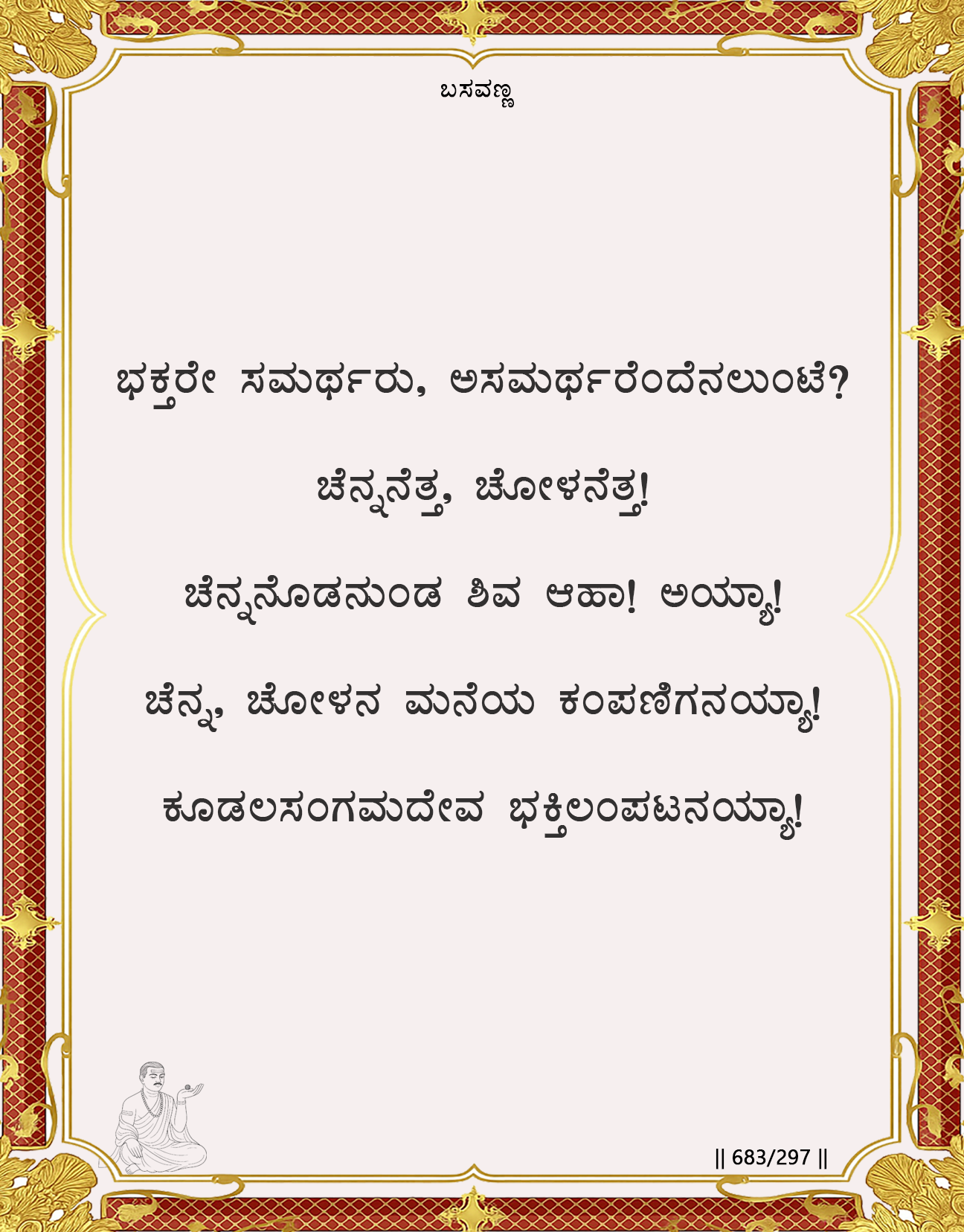
The Bhaktas are the Samartharu
whole, fulfilled, lacking nothing.
How then can anyone dare call them incomplete?
Tell me
what measure can compare
Madara Chennayya, the saintly cobbler,
with Chola, lord of a mighty empire?
Yet look
it was in Chennayya’s humble company
that Shiva’s heart overflowed with joy!
It was he,
the quiet Sharana of unbroken devotion,
who brought the true harvest
the green wealth of inner abundance
that even kings cannot command.
O Kudalasangama Deva,
You revel in such purity of heart;
You whirl in delight
in the simple, steadfast souls
whose love outshines
all royal pomp and pride.
Basavanna proclaims that Bhaktas and Sharanas are spiritually complete sovereign within themselves and cannot be judged by caste, livelihood, or social rank. Their inner wholeness surpasses all worldly measures. To make this clear, Basavanna contrasts Madara Chennayya, the humble cobbler-saint, with the powerful Chola king. Though the king possessed wealth, grandeur, and royal rituals, Shiva found greater delight in the sincere, unadorned devotion of Chennayya.
Madara Chennayya and the Tamil Nadu Connection
Madara Chennayya (11th century CE), revered as the ancestor of the untouchable community, was an elder contemporary of Basaveshwara and an early contributor to the Vachana tradition.
Some historical traditions suggest that Chennayya may have originated in Tamil Nadu and later migrated to Kalyana to join the egalitarian spiritual discussions of the Anubhava Mantapa. Harihara’s Madara Chennayyana Mahatme narrates that Chennayya once supplied fodder to the stables of a Chola king. In a famous incident, Shiva accepted Chennayya’s simple gruel over the king’s lavish offeringsrevealing that divine grace responds to purity of devotion, not to royal splendor.
Core Message
- True spiritual stature is independent of caste, profession, or power.
- Humble, sincere devotion carries a richness greater than any king’s treasure.
- God dwells most intimately in the simple, earnest heart
and it is there that the Divine dances in joy.
Basavanna thus reaffirms the heart of the Sharana movement:
Even the lowliest in society may stand tallest in the eyes of the Divine.
Spiritual Context
Core Spiritual Principle: The Economy of Divine Joy (Ananda-Vyavastha). In Lingayoga, the ultimate currency is not piety, power, or ritual correctness, but the capacity to host the divine delight. A simple, integrated heart of devotion (Sharana) generates this joy, which Shiva experiences as His own. Social and ritual status are irrelevant in this economy.
Cosmic Reality Perspective: From the non-dual view, the Chola king represents Shakti in its expansive, manifest, and outwardly powerful mode. The cobbler Chennayya represents Shakti in its concentrated, inwardly focused, and surrendered mode. Shiva’s joy “overflowing” in Chennayya signifies that consciousness finds its fullest expression not in the grandeur of manifestation, but in the intensity and purity of its own recognition within a conscious vessel.
Historical Reality (Anubhava Mantapa Context): This vachana was a direct theological rebuttal to the caste-based ritual hierarchy. By citing the widely known story of Chennayya and the Chola king, Basavanna provided scriptural proof for the Basavayoga revolution. It demonstrated that the community’s inclusion of “low-caste” saints was not social reform alone but a restoration of divine order, where God’s own preference validated their spiritual authority over kings and priests.
Interpretation
1. “The Bhaktas are the Samartharuwhole, fulfilled, lacking nothing”: This is a declaration of spiritual sovereignty. “Samartharu” means the capable, the powerful, the complete. Their completeness is internal, deriving from connection to the infinite source (Linga), making them impervious to external measures of lack.
2. “How then can anyone dare call them incomplete?”: This is a challenge to the entire social and religious system that labeled Shudras and outcastes as incomplete or impure. Basavanna asserts that their spiritual wholeness nullifies all such labels.
3. “What measure can compare… the cobbler with the lord of a mighty empire?”: He highlights the absurdity of using worldly measures (wealth, army size) to gauge spiritual reality. The two operate in different dimensions of value.
4. “It was in Chennayya’s humble company that Shiva’s heart overflowed with joy!”: This is the core inversion. The site of supreme divine emotion is not the palace but the cobbler’s hut. “Company” (Sangha) implies relationship; Shiva finds joy in relational intimacy with the humble, not in transactional worship from the powerful.
5. “The green wealth of inner abundance that even kings cannot command”: “Green wealth” symbolizes alive, growing, organic spiritualitythe harvest of a heart cultivated in devotion. This contrasts with the “dry” or inert wealth of royal treasuries.
6. “You whirl in delight in the simple, steadfast souls”: The image of Shiva whirling (like Nataraja) within the devotee signifies the dynamic, creative dance of consciousness that awakens in a purified, steady heart.
Practical Implications: One must actively decouple self-worth and the worth of others from social, professional, or economic status. The primary question to ask of oneself and others is: “Is there a simplicity and steadfastness here that could host divine joy?” This becomes the new metric for reverence.
The Cosmic Reality
Anga (Human Dimension): The realm of comparison, hierarchy, and tangible power. The king is its pinnacle. Yet, in the spiritual calculus, this realm is a superficial show. The cobbler, though at its bottom socially, is free from its delusions.
Linga (Divine Principle): The source of all value and the essence of joy. It is not impressed by manifestations of its own power (the kingdom) but is drawn to conscious recognition of its presence (the devotee’s heart).
Jangama (Dynamic Interaction): The joyful overflow and the divine whirl. This is the active, loving relationship between the Linga and the Sharana. This relationship is the true “kingdom,” the real seat of power and abundance.
Shata Sthala
Primary Sthala: Sharana. Madara Chennayya is the archetypal Sharanaa householder engaged in humble labor (Kayaka) whose inner life is a state of surrendered refuge, making him a vessel for divine joy.
Supporting Sthala: Aikya. The description of Shiva’s heart overflowing with joy in Chennayya’s company indicates a union so intimate that the distinction between the deity’s experience and the devotee’s state dissolves, reflecting the Aikya principle.
Practical Integration
Arivu (Awareness Practices): Practice seeing “Green Wealth.” In daily life, consciously look for signs of inner integrity, gentle strength, and sincere dedication in people, regardless of their role. Mentally honor that as the true wealth. In your own meditation, nurture the “green,” growing quality of your devotion, not its size or impressiveness.
Achara (Personal Discipline): Deliberately seek out and learn from individuals whose wisdom or kindness is coupled with social humility. Let their counsel hold more weight than that of titled authorities. In your own conduct, perform even menial tasks with the dignity of a Chennayya, knowing they can be an offering that delights the Divine.
Kayaka (Sacred Action): Re-evaluate your profession. Does it help you cultivate the “green wealth” of inner abundance, or does it merely accrue external status? Strive to make your work an expression of steadfast integrity and service, your own form of saintly cobbling.
Dasoha (Communal Offering): Ensure your spiritual community actively honors and elevates those who embody humble, steadfast devotion. Structure gatherings so that wisdom sharing comes from those with “green wealth” of experience, not just those with scholarly knowledge or social prominence.
Modern Application
The Cult of Status and Influencer Culture. Contemporary society is obsessed with metrics of external success: followers, net worth, brand value, and visibility. This creates a hierarchy where value is conflated with visibility, and inner richness is overlooked. We are trained to admire the “Chola kings” of our agethe powerful and glamorouswhile undervaluing the “cobblers”the quiet, consistent, deeply integrated individuals.
Value the Invisible Infrastructure. This vachana teaches us to re-calibrate our admiration. Look for the “Madara Chennayyas” in your lifethe reliable friend, the dedicated nurse, the honest craftsman, the parent offering steady love. Learn to see the divine joy swirling in their steadfastness. Invest your respect and energy in these relationships and in cultivating this unshowy integrity within yourself. Reject the influencer model of spirituality for the cultivator model.
Essence
The king’s gold is cold and old,
A story told, a measure sold.
But in the stitch, the heart held plain,
A green field grows, a gentle rain
Of joy that makes the Divine spin
The greatest wealth is held within
The humble hand, the steadfast soul,
That makes the broken universe whole.
This vachana presents a unified field theory of spiritual worth. It posits that the Divine (the unified field) interacts not with the amplitude of a social signal (the king’s grandeur), but with the coherence and resonance of an individual’s consciousness. The king represents a high-amplitude, low-coherence signalgreat social energy dissipated in the noise of governance, anxiety, and separation. The cobbler represents a low-amplitude, high-coherence signala modest life emitting a pure frequency of undivided devotion. The Divine, as the field itself, couples most powerfully with the coherent signal, creating a resonant joy (Ananda) that is the true “green wealth” of the cosmos. Social hierarchies measure amplitude; spiritual reality measures resonant coherence.
Imagine two radios. One is a giant, gold-plated broadcast tower (the king), transmitting on many frequencies at once news, music, static with immense power. The other is a simple, handmade crystal radio (the cobbler), tuned perfectly to one, pure station. To the universe seeking its own signal (the Divine), the crystal radio, though small and quiet, provides the clearer connection. The joy of hearing the clear signal is infinitely greater than the impressiveness of the loud, cluttered tower. True connection is about clarity of channel, not power of broadcast.
We are taught to aspire to be the tower visible, powerful, broadcasting our importance to the world. Yet, this often leaves us feeling internally fragmented and disconnected. This vachana speaks to our quieter, deeper longing: to be the crystal radio to be so clearly tuned to a single, sacred truth that we become a perfect conduit for a joy that transcends our individual form. It validates that the most profound dignity and power come not from scaling the social summit, but from achieving inner unity. The Divine does not live at the summit; it lives in the clarity of the signal. When we prioritize coherence of heart over amplitude of status, we don’t just find God we become a home for divine delight.

Views: 1