Poetic Rendering

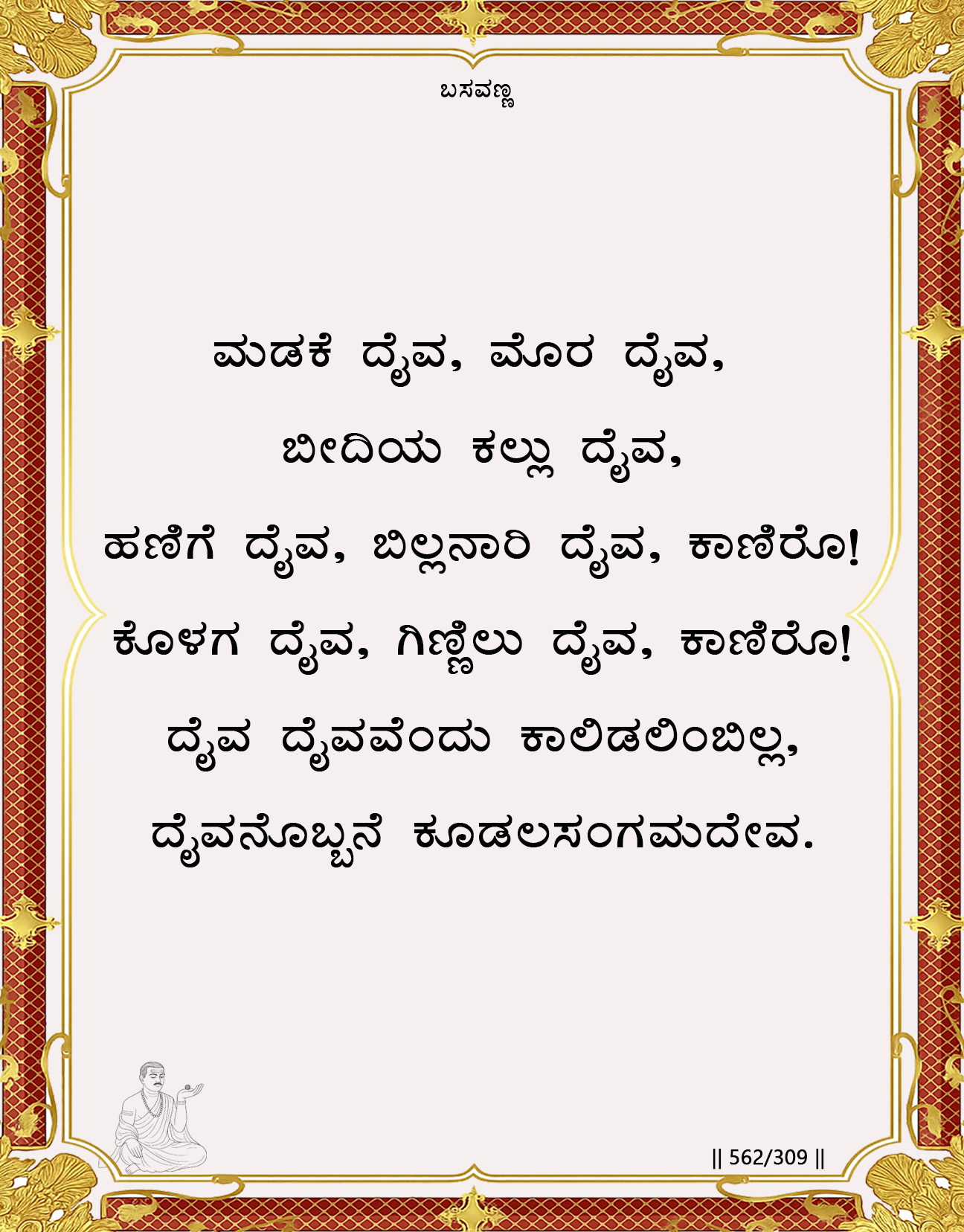
Pot-god, tree-god, street-stone god,
banana-bunch god, three-leafed-twig god
and look, even the measuring
cup becomes a god!
Everywhere I turn, gods multiply like wares
in a crowded marketplace
where there is no room left
to place even a single step.
I do not wander
through this bazaar of countless idols.
For me, there is only One
Koodalasangama Deva.
From a Crowd of Idols to the Clarity of One Living Presence In this vachana, Basavanna confronts the tendency to scatter devotion across innumerable objects and localized deities. His list pot-god, tree-god, street-stone-god reveals not contempt for the sacredness of creation, but caution against confusing temporary forms with the eternal source. He depicts society as a spiritual marketplace overflowing with deities, so crowded that no space remains for true inner seeking. This imagery critiques not polytheism itself, but spiritual fragmentation the attitude that looks for God in objects rather than in the living, undivided Presence within. Basavanna calls seekers back from this cluttered bazaar to the simplicity and unity of direct realization: One Consciousness, one Divine Reality, manifest through all but limited by none. Thus the vachana affirms that genuine devotion arises not from multiplying idols, but from recognizing the single, all-pervading Koodalasangama who shines through every form while remaining beyond them.
Spiritual Context
Core Spiritual Principle: Economy of Devotion (Bhakti Lāghava). True devotion is characterized by lightness, directness, and simplicity. Complexity and proliferation are signs of a seeking mind that has not yet found its true center. The most profound relationship is singular, not multiple.
Cosmic Reality Perspective: This is a non-dual critique of fragmentation. The Shiva-Shakti dynamic here is the one Consciousness (Shiva) and its infinite power of manifestation (Shakti). The error lies in worshipping the manifestations (the pots, trees) as separate, static endpoints, rather than recognizing them as temporary expressions of the singular, dynamic source. It confuses the waves for the ocean.
Historical Reality (Anubhava Mantapa Context): This vachana served as a powerful doctrinal clarifier within the Basavayoga movement. At a time of diverse folk practices, it established the iṣṭalinga not as “one more god” in the marketplace, but as the singular, personal focus that reorients one’s entire perception away from fragmentation toward the unifying center. It was a call to move from animistic/localized piety to a conscious, unified theism grounded in direct personal experience.
Interpretation
1. “Pot-god, tree-god, street-stone god…” The listing is not ridicule but phenomenological mapping. It traces the human tendency to reifyto take a finite object, isolate it from the seamless fabric of existence, and project absolute significance onto it. Each “god” represents a cognitive stopping point, a place where inquiry halts.
2. “Everywhere I turn, gods multiply like wares in a crowded marketplace where there is no room left to place even a single step.” This is the critical consequence: spiritual claustrophobia. The proliferation of external reference points doesn’t create freedom; it creates paralysis. The seeker’s “step”meaning their capacity for inward movement, growth, and actionis blocked by the very objects they believe will help them.
3. “I do not wander through this bazaar… For me, there is only OneKoodalasangama Deva.” This is the leap from complexity to simplicity, from extroverted seeking to introverted finding. “I do not wander” indicates the end of spiritual consumerism. The “One” is not another object, but the subject itselfthe very awareness (cit) within which all “gods” and “marketplaces” appear and disappear.
Practical Implications: Spiritual practice becomes one of simplification and integration. Instead of accumulating rituals, the seeker focuses on deepening the recognition of the one Presence in all moments. The question shifts from “Which god should I appease for this problem?” to “How do I abide in the One consciousness amidst this situation?”
The Cosmic Reality
Anga (Human Dimension): The Anga matures into a unifier of perception. Its role is to heal the fragmented vision that sees sacredness in isolated objects. It practices seeing the Linga not as an object among pots and trees, but as the substratum of pots and trees. The Anga’s mind becomes the clear space the marketplace lacked.
Linga (Divine Principle): Koodalasangama is revealed as the ground of being from which all forms arise. The Linga is the “clearing” in the metaphysical marketplace. It is the open, uncluttered reality that contains all potential forms but is not obstructed by any of them. To anchor in the Linga is to find the “room to place a step.”
Jangama (Dynamic Interaction): The Jangama is the process of continuous integration. It is the active, moving intelligence that refuses to let consciousness settle on or be defined by any partial manifestation. The Jangama is the “step” itselfthe dynamic movement of awareness that flows through the world without getting caught in its stalls.
Shata Sthala
Primary Sthala: Prasadi. The state described is a direct expression of Prasadithe stage of grace-bestowed clarity. The discernment to reject the fragmented marketplace and see the singular Divine is not an intellectual achievement but a gift of illuminating grace (prasāda). It is the mind being cleared.
Supporting Sthala: Maheshwara. The Maheshwara is one who sees the Great Lord (Maheśvara) in all. This vachana provides the necessary precondition for that vision: you cannot see the Great Lord in all if you are busy seeing little lords in everything. It clears the perceptual field so the Maheshwara vision can dawn.
Practical Integration
Arivu (Awareness Practices): Practice “Dereification.” When you notice yourself attributing absolute importance to an object, person, or idea (turning it into a “pot-god”), pause. See it instead as a transient wave on the ocean of consciousness. Return awareness to the ocean itself.
Achara (Personal Discipline): Simplify your spiritual routine. If it involves many disparate elements, inquire if they all point to the same center. Choose one core practice (like iṣṭalinga worship) and perform it with the intention that it integrates your perception of the entire day, not as an isolated event.
Kayaka (Sacred Action): Perform your work as an offering to the One, not to multiple, conflicting sources of validation (boss’s praise, peer approval, social status). Let the unity of your inner purpose integrate the diverse tasks of the day.
Dasoha (Communal Offering): In community, help steer collective focus away from proliferating rituals, debates, and divisions (the “marketplace” of opinions) and back to the shared experience of the One. Be a unifying presence that creates “room to step.”
Modern Application
The Spiritual Supermarket and Identity Fragmentation. Today’s seeker faces an infinite digital marketplace of gurus, modalities, therapies, and ideologiesa literalization of Basavanna’s metaphor. The result is not enlightenment but overwhelm, “seeker fatigue,” and a fragmented spiritual identity composed of countless adopted pieces.
Cultivating the Inner Monotheism of Consciousness. The practice of Lingayoga today is to declare a moratorium on spiritual consumption. It is to choose one authentic, integrated path (the ekānta mārga) and dive deep. It is to find the “One” in the midst of the digital noisethe silent, aware presence that uses the phone but is not defined by its content. This unclutters the psyche and creates the inner space necessary for genuine transformation.
Essence
The world hung its ornaments
on every branch and stone,
till the path was strung with lights
and I stumbled in the glare.
I have taken down the trinkets.
Now the tree is simply tree,
the stone is simply stone,
and the path is clear, leading
to the only Jewel
that wears itself.
This vachana describes the cognitive shift from a particulate to a field-based perception of reality. The “marketplace” represents the classical, Newtonian view of reality as composed of separate, solid objects (gods). Basavanna’s “One” represents the quantum fieldthe unified, non-local ground from which all particles (forms) momentarily emerge. Spiritual progress is the shift from observing particles to abiding as the field.
Imagine your mind as a browser with 100 tabs open, each playing a different video (pot-god, tree-god). It freezes; there’s “no room to click.” Basavanna’s solution is not to open more tabs, but to close all tabs and realize you are the computer’s operating systemthe clear, singular awareness that can run any program without being any of them.
We are afraid of the emptiness of the One. We fill it with many things to feel secure, to feel we have options, to feel covered. Basavanna exposes this as a trap that ultimately paralyzes us. The courage to face the singular, all-sufficient Reality feels like a risk, but it is the only risk that leads to true freedom and space. Our deepest longing is not for more, but for the One that is already, and always, enough.

Views: 0