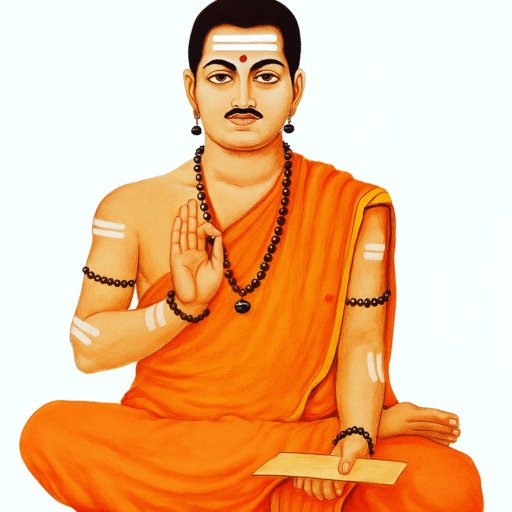

Poetic Rendering

Who sits beneath a tree
and dares to say,
“This shade belongs to me”?
Before Your Sharanas,
what sort of bhakta am I?
Before their vast knowing,
what claim can my little wisdom make?
Standing in the midst
of those who live You,
how can I utter,
“I am the devotee”?
For the moment the “I”
enters devotion,
that very moment
falsehood rises like flame
and burns it to ash
O Kudalasangama Deva.
Humility as the True Ground of Devotion Basavanna dismantles the subtle ego that tries to own devotion, wisdom, or spiritual status. Through the simple image of sitting under a tree, he demonstrates that spiritual blessings like shade cannot be possessed. They are received, not claimed. Before the Sharanas those who embody divine consciousness Basavanna recognizes that no personal qualification, knowledge, or identity can stand. In their presence, even calling oneself a “devotee” becomes an act of ego. The central teaching is transformative: True devotion begins only when the “I” dissolves. If the sense of “I am the devotee” arises, it corrupts devotion at the root. Pure devotion is not a self-description but a state of grace, free of ownership, free of self. Thus Basavanna invites us to a devotion without claim, without pride, without identity a devotion as effortless and unpossessable as the shade of a tree.
Spiritual Context
Core Spiritual Principle: The Law of Non-Appropriation (Aparigraha-Sāra). The essence of spiritual progress is the release of all appropriation, including the appropriation of spiritual qualities, states, and identities. The final possession to release is the possession of “my devotion.”
Cosmic Reality Perspective: This is a non-dual critique of the subject-object dichotomy in spirituality. In the Shiva-Shakti dynamic, Shakti is the power of devotion. When that power is perceived as “my devotion” (a quality possessed by a separate subject), it remains trapped in duality. When the “I” dissolves, Shakti is recognized as simply the natural, unobstructed flow of consciousness (Shiva) toward its own essence. The shade is not an object of the tree; it is the tree’s own presence extended.
Historical Reality (Anubhava Mantapa Context): This vachana served as a corrective against spiritual pride and hierarchy within the Basavayoga community. In a revolutionary movement where traditional social hierarchies were rejected, there was a danger of new spiritual hierarchies forming (e.g., “senior” devotees, “advanced” practitioners). Basavanna preemptively dismantles this by stating that before a true Sharana, no one can claim any spiritual title. It enforced a radical equality of humility, where the only valid stance is one of not-knowing and not-claiming.
Interpretation
1. “Who sits beneath a tree and dares to say, ‘This shade belongs to me’?” This establishes an empirical, self-evident truth about relational goods. Shade is a condition created by the tree’s existence and the sun’s position, enjoyed by a temporary visitor. To claim ownership is logically absurd and reveals a profound cognitive error. This error is the root of all ahaṃkāra (ego-sense) which misattributes relational conditions to inherent possession.
2. “Before Your Sharanas… what claim can my little wisdom make?” This applies the logic to the field of consciousness. If you cannot claim a material condition (shade), how much less can you claim an intangible quality like wisdom or devotion, which are conditions created by the “tree” of divine grace and the “sun” of the Guru’s guidance? The presence of a true Sharana acts as a mirror that exposes the smallness and borrowed nature of “my” understanding.
3. “For the moment the ‘I’ enters devotion… falsehood rises like flame and burns it to ash.” This reveals the auto-combustive nature of egoic spirituality. Devotion is the fire of love. When the “I” (a bundle of false identifications) enters that fire as fuel, claiming “I am burning with devotion!”, it is consumed. The ash is the hollow, performative shell left behind. Pure devotion is the fire itself, burning without a separate claim to be the fire.
Practical Implications: The entire orientation of practice shifts from “cultivating my devotion” to “removing the obstacles that prevent devotion from flowing.” The primary obstacle is the claiming “I.” Practice becomes vigilant self-inquiry: “Who is claiming this? Who feels devoted?” until the claimant is found to be insubstantial. One learns to simply be in the shade of grace, without building a fence around it.
The Cosmic Reality
Anga (Human Dimension): The Anga’s final task is to cease being an “Anga”to stop being a claimant. Its role evolves from a practitioner to a transparency. It must learn to receive shade, wisdom, and devotion without turning them into properties. Its maturity is marked by the dissolution of spiritual CV.
Linga (Divine Principle): Koodalasangama is the sole proprietor. The Linga is the tree, the shade, and the rightful claim of “mine.” In the non-dual realization, the individual’s renunciation of ownership merges with the divine affirmation of ownership. The devotee’s “not mine” becomes the Lord’s “all is mine,” and these are seen as the same truth from two sides of the dissolving veil.
Jangama (Dynamic Flow): The Jangama is the living “not-claim.” A true Jangama does not walk around saying “I am a Jangama.” They are a walking humility, a presence that naturally dissolves the claims of others. They are the perfect embodiment of the shade providing refuge, being itself, but never claiming to provide or be anything for anyone.
Shata Sthala
Primary Sthala: Aikya. This vachana describes the preparatory consciousness for Aikya. In full union, the question “Am I a devotee?” does not arise, because the devotee-devotion duality has collapsed. The intense, fiery self-inquiry described here is the final process of burning away the last subtle dualities before abiding in union.
Supporting Sthala: Pranalingi. For the Pranalingi, the Linga is the life breath. This vachana asks: Can you claim the air you breathe as “my breath”? It is given, taken, and returned. The Pranalingi’s identification is so total that the idea of claiming a separate devotional identity becomes as absurd as a lung claiming ownership of oxygen.
Practical Integration
Arivu (Awareness Practices): Practice the “Shade Meditation.” Sit and feel the shade/sunlight/wind. Contemplate: “This is not mine. It is given. My very sense of a self sitting here is given.” Extend this to thoughts and feelings: “This thought of peace is not my peace. It visits. This feeling of love is not my love. It flows through.”
Achara (Personal Discipline): Institute a vow of “Spiritual Non-Claiming.” Refrain from describing your spiritual experiences or progress, even to yourself in self-congratulatory thoughts. When praise comes, internally deflect it: “The shade is good today,” acknowledging the source, not the sitter.
Kayaka (Sacred Action): Perform action as an offering that leaves no trace of a “doer.” Engage in service anonymously or without need for recognition. Let the work be like the tree providing shadea natural function, not an identity-driven achievement.
Dasoha (Communal Offering): Cultivate a community culture where spiritual titles and claims are minimal. Honor humility and silent integrity over eloquent professed devotion. Celebrate those who serve without needing the label of “server.”
Modern Application
The Spiritual Brand and the Enlightenment Ego. The age of social media has created a marketplace for spiritual identity. People build personal brands as “devotees,” “healers,” “gurus,” commodifying the shade. This leads to spiritual inauthenticity, competition, and the very “fire of falsehood” Basavanna warns of where the image of devotion burns up the substance.
Anonymous Sanctity. The practice of Lingayoga today is to seek anonymity in one’s spiritual life. It is to value the hidden practice, the silent prayer, the unrecognized service. It is to find freedom in being a “nobody” in the spiritual marketplace, discovering that true devotion flourishes in the secret, unclaimed shade of the heart, where no “I” can post a selfie with it.
Essence
All my life I built a shelf
for the trophy of myself.
“Devotee,” it would have read.
Now I sit where the great tree spreads
its unaccountable grace.
The plaque, the name, the claiming space
I leave them in the sun to bleach.
To be sheltered is enough.
To be without description
is the only proof.
This vachana describes the quantum principle of superposition as it applies to spiritual identity. The state of “being a devotee” and “being the divine” are mutually exclusive observed states. The act of claiming “I am the devotee” is an act of measurement that collapses the quantum wave function of consciousness into a definite, limited state (the devotee), eliminating the simultaneous potential of the unified state (Aikya). The “fire of falsehood” is the decoherencethe loss of quantum potential caused by this premature, ego-driven measurement. The path is to suspend all self-measurement, to remain in superposition as pure, unclaimed consciousness until grace itself performs the “measurement” that reveals the true state.
Imagine you’re in a movie theater, utterly absorbed in the film (state of devotion/absorption). The moment you think, “Wow, I am really absorbed in this film!” (I am the devotee), you’ve popped out of absorption and are now observing yourself being absorbed. You’re no longer fully in the film; you’re in your head thinking about being in the film. Basavanna says true devotion is staying in the film, forgetting you’re even in a theater.
We have a deep need to be something, to have a name, a role, an identity. Even spirituality can become a costume we wear. Basavanna points to the terrifying, liberating truth that our deepest fulfillment lies not in being a devotee of the divine, but in disappearing into the devotional relationship itself, until only the relationship the shade, the shelter, the belong ingremains. Our greatest fear is anonymity, yet our greatest peace is found there, in the unclaimed, unbranded, sheer given ness of grace.

Views: 0