Poetic Rendering

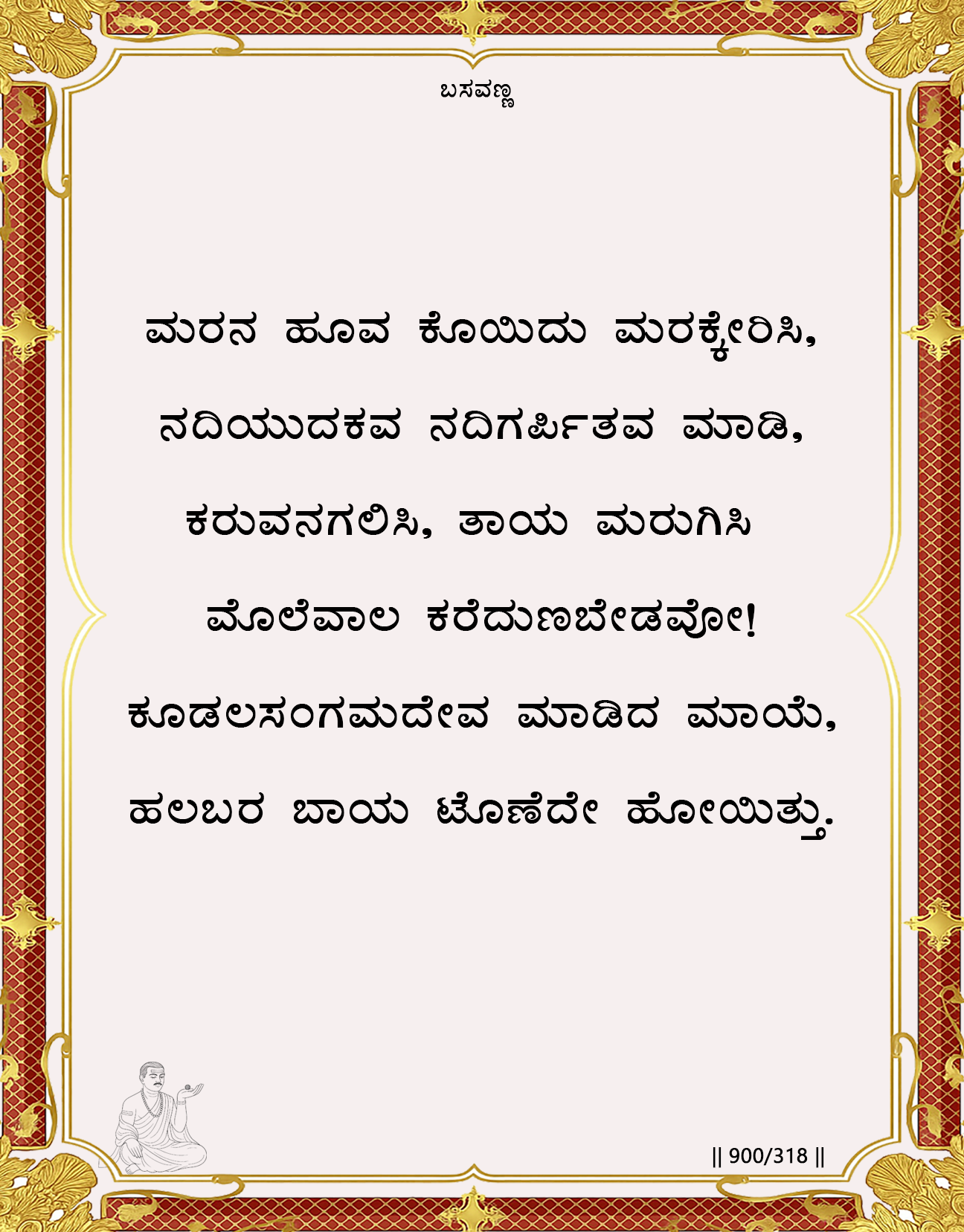
You pluck a flower from the plant
and return it to the same plant
as though it were an offering.
You lift water from the river
only to pour it back into that very river
calling it worship of the Divine.
You draw the mother’s milk for your own use,
while her hungry calf stands helpless
leaving her heart aching with sorrow.
Such acts, blind to compassion,
are blows aimed at truth itself.
Kudalasangama Deva withdraws
from those whose rituals wound life
while claiming to honor it.
Rituals That Contradict Their Own Purpose This vachana exposes the contradictions hidden within mechanical, unexamined religious practices. Basavanna reveals how rituals that appear sacred on the surface can become empty or even harmful when separated from awareness and compassion. Plucking a flower only to “offer” it back to the same plant, or returning river water to the same source, are acts that merely mimic devotion without adding meaning or deepening awareness. The third example goes further: drawing milk meant for a calf and using it for oneself is not just meaningless ritualit actively causes suffering. Through these vivid images, Basavanna teaches that true worship can never violate the integrity of life. A ritual that ignores compassion contradicts its own purpose and becomes spiritually hollow. The final lines declare that Kudalasangama Deva does not reside in such contradictions. Authentic devotion is not found in ritual performance, but in living intelligence, compassion, and truth-aligned action.
Spiritual Context
Core Spiritual Principle: The Non-Duality of Means and Ends (Sādhyasādhanāikya). In authentic spirituality, the method of worship cannot contradict the nature of the worshipped. If the divine is truth (satya) and compassion (dayā), then any act in the name of worship that violates truth or compassion is a metaphysical contradiction and thus void.
Cosmic Reality Perspective: This is a non-dual critique of transactional spirituality. The Shiva-Shakti dynamic is one of inseparable unity. The ritualist who plucks and returns the flower operates under the dualistic illusion that Shiva (the divine) is separate from Shakti (the creative power manifest as the flower). The act reinforces separation. True worship recognizes the flower as Shakti and honors it in its natural state, seeing the offering in its blooming, not in its plucking.
Historical Reality (Anubhava Mantapa Context): This vachana was a direct assault on Brahmanical ritual orthodoxy and a constitutional principle for the Basavayoga community. It dismantled the authority of complex, extractive Vedic rituals (yajña) that often involved animal sacrifice and priestly intermediation. It established that any practice causing harm or violating natural justice even if scripturally sanctionedwas spiritually invalid. It made compassion and common sense the litmus test for all religious observance within the Sangha.
Interpretation
1. The Flower: This represents the error of circularity and misplaced agency. The beauty of the flower is already an offering from the divine to creation. The human act of plucking and returning it is a redundant loop that arrogates agency (“I am making an offering”) where there is only participation. It mistakes ritual gesture for devotional substance.
2. The River Water: This represents the error of redundancy and spiritual inflation. Pouring water back into the river is adding the finite to the infinite, a futile gesture that ignores one’s place within the perpetual flow of grace. It is the ego’s attempt to “contribute” to the divine, failing to see that one is already carried by the current. True worship is to drink deeply and be nourished.
3. The Calf’s Milk: This represents the error of active harm and ethical contradiction. Here, ritual becomes theft justified by tradition. It prioritizes human ritual consumption over natural compassion and rightful belonging. This is the most severe error, as it actively creates suffering (duḥkha) while invoking the sacred. It reveals how ritual can sanctify exploitation.
Practical Implications: Every spiritual act must pass a double test: 1) The Test of Intelligence: Is it meaningful, or is it a empty, circular performance? 2) The Test of Compassion: Does it cause unnecessary harm or separation? If it fails either, it must be abandoned or radically re-imagined. Practice becomes the alignment of action with conscious, compassionate awareness.
The Cosmic Reality
Anga (Human Dimension): The Anga is called to become an ethical mystic. Its role is to scrutinize every inherited practice, to hold it up to the light of innate intelligence (viveka) and compassion (karuṇā). Its worship is not in performing rituals but in ensuring its actions are coherent expressions of the unity it seeks.
Linga (Divine Principle): Koodalasangama is truth-in-action and compassion-as-substance. The Linga is not a passive receiver of offerings but the active principle of coherence. It “withdraws” from contradiction not as punishment, but as a natural law: consciousness cannot affirm what contradicts its own nature. Where compassion is violated, the feeling of divine presence vanishes.
Jangama (Dynamic Flow): The Jangama is living worship. For the Jangama, fetching water is an act of service, tending a plant is reverence, and ensuring a calf is fed is sacred duty. Their life is a continuous, non-ritualistic offering where action, intelligence, and compassion are seamlessly unified.
Shata Sthala
Primary Sthala: Prasadi. This vachana explains the condition for Prasadi (grace). Grace illuminates the mind, revealing contradictions. To then act against that illumination (by performing harmful or absurd rituals) is to refuse grace, causing its apparent withdrawal. The feeling of God’s absence is the direct result of living in contradiction to the truth grace has revealed.
Supporting Sthala: Maheshwara. The Maheshwara is one who sees the Great Lord in all. The rituals described fail this vision spectacularly: they see the plant as separate from God, the river as separate from God, the cow and calf as separate from God. A true Maheshwara would see the divine in the blooming, the flowing, and the nurturing bond, and would act accordingly.
Practical Integration
Arivu (Awareness Practices): Practice “The Compassionate Audit.” Before any regular spiritual practice (puja, prayer, meditation), ask: “Is the form of this practice inherently meaningful, or has it become a hollow loop? Does any aspect of it (materials used, time demanded) cause harm or neglect to myself, others, or other beings?” Let awareness, not tradition, be the guide.
Achara (Personal Discipline): Simplify your spiritual routine to its essence. Remove any action that feels like a meaningless “putting back of the flower.” Replace it with a discipline of direct perception: spending time in nature observing interdependence, or in silent service.
Kayaka (Sacred Action): Let your primary “offering” be work that alleviates suffering or fosters life. Nursing, farming, teaching, cleaning these are acts that pour water where it is needed, feed the hungry calf, and honor the flower by letting it bloom. This is kayaka as true ritual.
Dasoha (Communal Offering): Build community rituals that are inherently meaningful and non-exploitative. Collective gardening, shared meals from ethically sourced food, or studying vachanas together are rituals that nourish the root (mūla) of understanding and connection, rather than plucking at the surface.
Modern Application
Virtue Signaling and Ethical Consumerism. The modern equivalent of “putting the flower back” is performing gestures of solidarity or environmentalism (e.g., social media activism, buying “green” products) without altering underlying exploitative habits or systems. The “calf’s milk” metaphor applies to spiritual or wellness practices that consume vast resources while ignoring the suffering in their supply chains or communities.
Embodied Integrity as Revolutionary Act. The practice of Lingayoga today demands a ruthless alignment of spiritual values with lifestyle. It means your environmentalism must shape your consumption, your compassion must direct your finances, your quest for peace must address injustice. It rejects “feel-good” rituals that don’t translate into tangible good. True worship is building a life where no part contradicts the truth of interconnection.
Essence
Do not play the merchant
with what was always a gift.
Do not praise the river
with a cup of its own water.
And never,
in the name of any god,
still the cry of the hungry.
The altar is not a table
for this empty arithmetic.
The only offering He receives
is the unbroken line
from the heart’s understanding
to the hand’s action.
This vachana describes a spiritual system failing due to a loss of feedback integrity. In a healthy system, action generates feedback that corrects and refines understanding. Ritualism severs this loop: the action (plucking flower) is performed, but the feedback (this is absurd/harmful) is ignored in favor of doctrinal validation. This creates a closed, entropic system where energy is wasted in meaningless loops (“putting back the flower”). The divine “withdrawal” is the system’s failure to sustain coherence; it collapses under the weight of its own internal contradiction. Authentic practice re-establishes the feedback loop: action is constantly evaluated against the lived experience of truth and compassion.
It’s like a man in a house on fire who carefully washes a single window while ignoring the flames. He’s following a “cleanliness ritual” while violating the imperative of “safety.” The ritual is not just useless; it’s tragically blind to the actual context. Basavanna says God is not in the window-washing; God is in the intelligent, compassionate response to the fire.
We cling to rituals because they give us a sense of control and certainty in an uncertain world. Basavanna exposes the terrible risk: that in our quest for certainty, we can become blind to obvious truth and deaf to cries of pain. Our deepest spiritual need is not for the comfort of routine, but for the courage to let our actions be dictated by clear seeing and genuine feeling. The divine is not found in the repetition of the sacred, but in the sacralization of the real.

Views: 0