Poetic Rendering

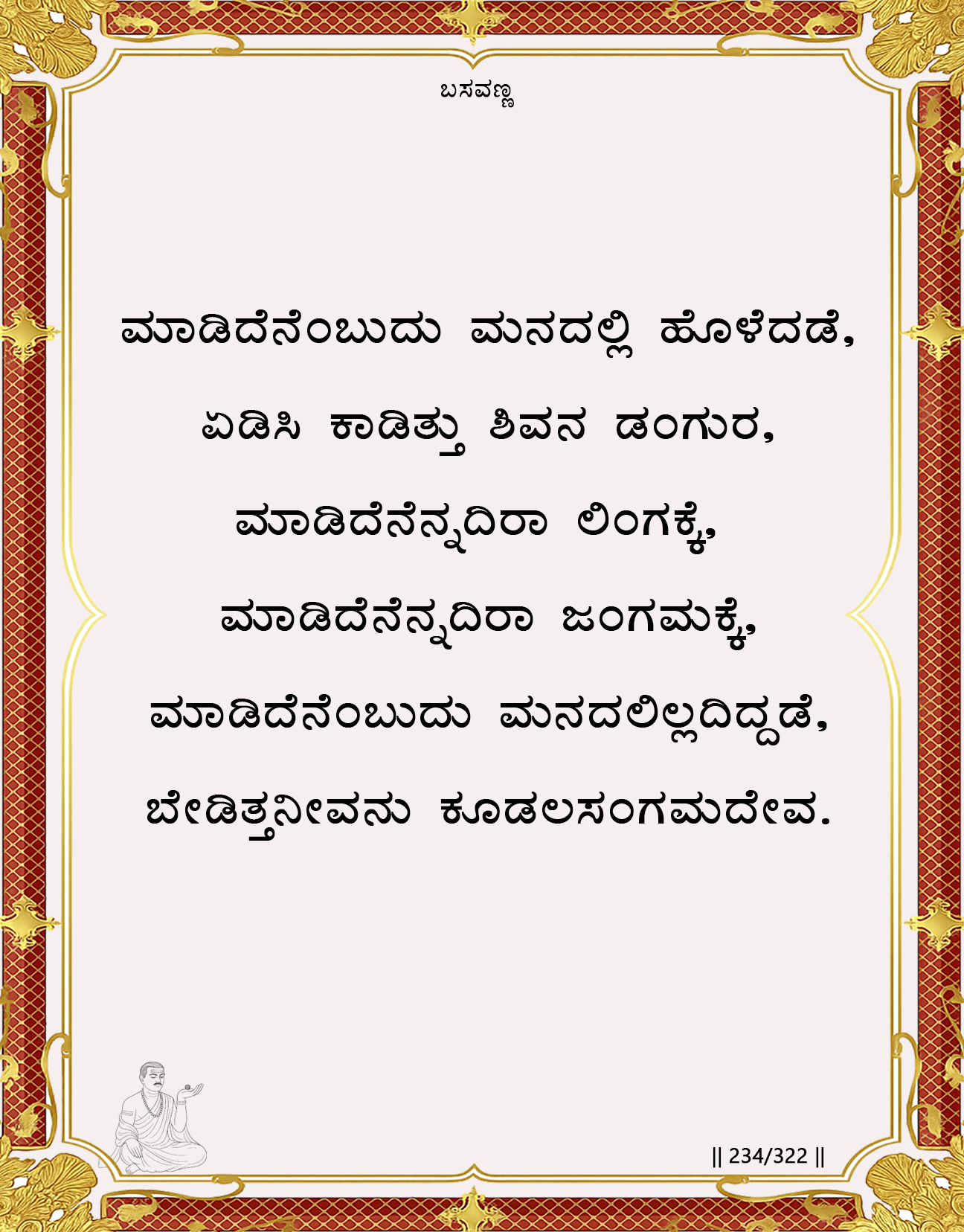
When deeds are done, let ego be still.
Do not cry, “I did this for the Linga,”
nor boast, “I did this for the Jangama.”
Like Shiva’s drum,
let the sound arise without the drummer’s claim.
Only when “I” falls silent in the doing
does Your grace, O Koodalasangama,
freely rain.
When Action Becomes Prayer and Ego Falls Silent This vachana represents Basavanna’s profound teaching on the final purification of spiritual action the transcendence of the “spiritual ego” that claims ownership even of devotional service. He addresses the most subtle obstacle on the path: the tendency to appropriate spiritual achievements as personal accomplishments. The teaching presents the culmination of karma yoga in the Way of Basava where action becomes not just an offering to the Divine but the very expression of the Divine, with no sense of individual doership remaining. Basavanna reveals that even service to the highest spiritual ideals (Linga and Jangama) becomes binding when performed with egoic consciousness. This vachana marks the transition from being a devotee who serves God to becoming the instrument through which divine will expresses spontaneously.
Spiritual Context
Core Spiritual Principle: The Discipline of Non-Appropriation in Action (Karma-Aparigraha). The final renunciation is not of action itself, but of the ownership of action. Even actions performed for the highest spiritual ends must be released from the clutch of the “I” to be truly liberating.
Cosmic Reality Perspective: This is a non-dual completion of the theology of action. In the Shiva-Shakti dynamic, Shakti is the power of action. When that power is filtered through the limited identity of “I, the devotee,” it remains conditioned and bound. When the “I” is silent, Shakti moves as an unconditioned expression of Shiva himself like the damaru’s spontaneous sound emanating from the Lord of the Dance. The drum (damaru) symbolizes the cosmos; its sound is the rhythm of creation, not the achievement of an individual drummer.
Historical Reality (Anubhava Mantapa Context): This vachana served as a corrective against spiritual competitiveness and credentialism within the Shivayoga community. In a group dedicated to selfless service (kayaka) and offering (dasoha), there was a danger of members subtly competing in piety or building spiritual reputations. Basavanna cuts this at the root, establishing that the only valid action is that which leaves no trace of a doer’s signature. It fostered a culture of anonymous, egoless service as the highest ideal.
Interpretation
1. “Do not cry, ‘I did this for the Linga,’ nor boast, ‘I did this for the Jangama.'” This identifies the twofold trap of spiritual appropriation. The first trap is vertical appropriation: claiming one’s actions as an offering to the transcendent Divine (Linga), which can create a sense of being a special benefactor to God. The second is horizontal appropriation: claiming one’s actions as service to the immanent Divine (Jangama), which can create a sense of spiritual superiority or moral authority over others.
2. “Like Shiva’s drum, let the sound arise without the drummer’s claim.” This introduces the metaphor of spontaneous emanation. Shiva’s damaru is not struck by a hand; its sound is an inherent aspect of his dynamic, cosmic presence. The ideal action is not something “I” make happen through effort, but something that happens through me as a clear channel of a larger, divine rhythm. The “drummer” is the illusion of separate agency.
3. “Only when ‘I’ falls silent in the doing does Your grace freely rain.” This reveals the mechanics of grace. The claiming “I” is like an upturned cup; it cannot receive rain. Its constant assertion (“I did, I offered, I served”) creates a barrier. When that mental formation falls silent, the cup is righted, and the ever-present rain of grace (prasāda), which was always falling, can finally fill it. Grace is not triggered by the action, but received when the action does not create a roof of ego.
Practical Implications: The focus of practice shifts from what we do to how we hold the doer. After any act of service, worship, or discipline, one must vigilantly watch for the arising of the thought, “I have done well.” That very thought is the residue to be surrendered. Success is measured not by the magnitude of the deed, but by the silence that follows it.
The Cosmic Reality
Anga (Human Dimension): The Anga perfects its role as a transparent instrument. Its task is to get its self-consciousness out of the way. It must learn to act with full engagement but zero appropriation, to be the hollow bone through which the flute’s breath flows without the bone claiming the melody.
Linga (Divine Principle): Koodalasangama is the rhythm and the source of the rhythm. The Linga is the vibrational pattern of reality itself (the damaru’s specific sound) and the energy that generates it. All true action is a localized expression of this universal pattern.
Jangama (Dynamic Flow): The Jangama is action as pure process. It is the unclaimed sound moving through space, the service that leaves no name, the help that seems to come from nowhere. A true Jangama is a living damaru their very presence and movement create a harmonizing vibration, and they have forgotten they are the “drummer.”
Shata Sthala
Primary Sthala: Aikya. The state described is the mature fruit of Aikya. In union, the dichotomy between doer, deed, and recipient collapses. Action arises from the unified field of consciousness, not from a personal will. There is no “for the Linga” because there is no entity separate from the Linga to act for it.
Supporting Sthala: Sharana. This is the ultimate refinement of Sharana surrender. It is the surrender not only of the self but of the self-as-doer. One takes refuge so completely that even the most virtuous actions of the refuge-seeker are released into the hands of the refuge.
Practical Integration
Arivu (Awareness Practices): Practice “Post-Action Silence.” After completing a task, especially a spiritual or charitable one, sit quietly. Observe the mind for any stirrings of pride, self-congratulation, or hope for recognition. Consciously offer those stirrings back to the source with the thought: “Not mine, but Thine.”
Achara (Personal Discipline): Engage in “Anonymous Service.” Regularly perform a useful act cleaning, helping, giving in a way that ensures no one, not even the recipient, can trace it back to you. Let the act exist without an author.
Kayaka (Sacred Action): Perform your daily work as “Shiva’s Drum.” Approach your profession or duties as your unique way of sounding the divine rhythm in the world. Focus on the quality and harmony of the “sound” (the work), not on the musician’s biography.
Dasoha (Communal Offering): In community, celebrate deeds, not doers. Shift praise from “You did a great thing” to “This was a great thing that happened.” Cultivate a culture where the work is honored, and the workers remain happily invisible.
Modern Application
The Spiritual Influencer and the Monetization of Virtue. The digital age has created an economy where spiritual actions, mindfulness, and service are performed, packaged, and displayed for social capital, likes, and financial gain. The “I” is not just present; it is amplified and branded. This is the antithesis of the unclaimed drum.
Cultivating the Invisible Life. The practice of Lingayoga today is a commitment to invisible integrity. It is to derive joy from actions that will never be seen on a resume or social feed. It is to find fulfillment in the anonymous contribution, the secret kindness, the prayer without a witness. In a culture shouting “Look at my goodness!”, it is the radical, silent discipline of letting goodness look after itself.
Essence
The flute does not announce,
“I am singing.”
The river does not declare,
“I am giving water.”
I have learned to stand so still
that when the wind of Your will moves through me,
even the leaves forget
they are attached to a tree.
Let all my doing
be like that:
a passing weather
that leaves no name,
only the clean, soaked earth
and the returning green.
This vachana describes the quantum field theory of action. The individual ego is a localized particle excitation in the unified field of consciousness (Linga). When this particle claims to be the source of an action, it creates a “measurement” that collapses the wave function of possibility into a solid, limited event owned by that particle. However, when the particle’s self-awareness dissolves back into the field, action arises as a wave-like propagation of the field itself spontaneous, non-local, and without a point source. The damaru’s sound is like a quantum fluctuation in the field of Shiva; it has no separable cause. Grace is the unimpeded flow of the field’s potential; the claiming ego is a dam.
Imagine a wind chime. When the wind blows, it makes a beautiful sound. A foolish chime might think, “I am making this music!” and feel proud. But the music belongs to the wind; the chime is just the means. Basavanna says: Be the wind chime that knows it is hollow, that has polished itself so cleanly that when the wind of grace passes through, the only thing that matters is the music, not the metal. The moment you think “I am singing,” you’ve stopped listening to the wind.
Our deepest need is to matter, to be the author of our story. Yet, the most profound peace comes when we realize we are not the author, but a sentence in a grander story. Basavanna guides us to this ultimate humility: to act with full vigor, but to relinquish authorship so completely that our life becomes an anonymous gift to the universe. The terror of insignificance is healed not by building a monument of spiritual achievements, but by disappearing into the significance of everything. We are most truly ourselves when we stop claiming ourselves.
This vachana offers liberation from the universal human burden of self-importance. The message applies to all domains of human endeavor: in science, we discover more when we serve truth rather than our reputation; in art, we create better when we serve beauty rather than our fame; in relationships, we love more deeply when we serve the relationship rather than our needs.
The Way of Basava ultimately reveals that our greatest contribution to life comes not from what we achieve but from how completely we become transparent to the intelligence, creativity, and love that seek expression through us. When we stop trying to be somebody and instead allow life to be what it is through us, we discover our true purpose as conscious instruments of the cosmic symphony.
This is the final freedom: to be nothing in particular so we can be everything in essence, to claim no achievement so we can participate in all accomplishment, to own no action so we can be the space in which all action unfolds. “The deed is sacred when the doer is silent.
Grace descends not upon the proud, but upon the hollow where the sound of God’s drum can resound.”

Views: 0