Poetic Rendering

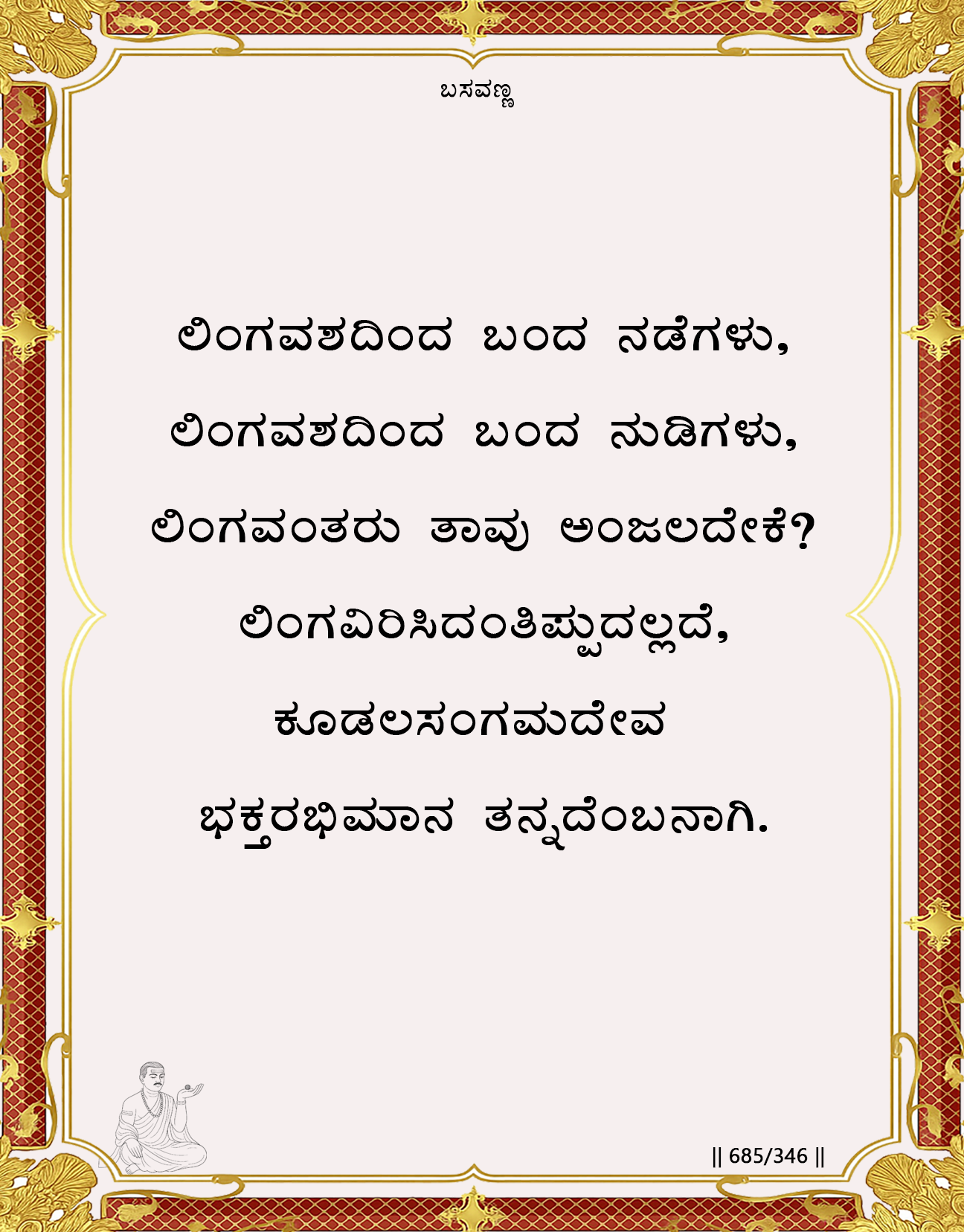
The steps that unfold from the Linga,
the words that arise from the Linga
why should the Lingavanta ever fear?
When breath itself moves
only by the will of the Linga,
then wherever this body stands,
wherever this voice is heard,
there, O Kudalasangama,
You alone reside
claiming every act of devotion
as Your own,
even the honors, praises,
or faults placed upon this body.
For nothing of “me” remains
when all is Yours.
This vachana describes the pinnacle of spiritual surrender where the devotee becomes a transparent instrument of the Divine. Basavanna reveals that when every movement, breath, and word is recognized as arising from the Linga, the sense of personal doer ship dissolves completely. In such a state, fear disappears for fear belongs only to the separate self. Once the devotee knows:
“My steps are His steps,
My speech is His speech,”
there is no longer anything to protect, defend, or claim as one’s own. All praise and all blame that touch the body are absorbed into the Divine, for the devotee no longer stands apart from Kudalasangama. This represents the highest intimacy with the Divine: a life where devotion is not performed but lived effortlessly, as the Divine expresses through the devotee in every breath and act. This is Basavanna’s vision of fearlessness born from perfect surrender the freedom that comes when the devotee becomes the Divine’s own movement in the world.
Spiritual Context
Core Spiritual Principle: Transparency of Agency (Kartṛtva-Śūnyatā). The final liberation is freedom from the sense of being the doer (kartā). Actions continue, but they are experienced as natural, spontaneous expressions of the Divine will flowing through an empty vessel. This is the end of spiritual practice; life itself becomes līlā (divine play).
Cosmic Reality Perspective: This is the full embodiment of Shiva-Shakti non-duality. Shiva (Linga) is the pure, unmoving source-consciousness. Shakti is his dynamic power of expression. In this state, the individual human is no longer a separate entity identified with Shakti’s movements, but has become a perfectly clear space where Shiva as Shakti dances without obstruction or distortion.
Historical Reality (Anubhava Mantapa Context): This vachana described the empowered state of the true Lingayoga revolutionary. Freed from all fear of social censure, blame, or violence (a real threat in that era), such a being could act with impeccable, fearless integrity. Their actions were not personal rebellions but divine movements for justice and compassion. It was the spiritual foundation for fearless social action.
Interpretation
1. “The steps that unfold from the Linga, the words that arise from the Linga why should the Lingavanta ever fear?” This identifies the root of fear. Fear is the emotion of a vulnerable, separate self protecting its boundaries. When steps and words are known to be not “mine” but “Its,” the presumed protector vanishes. There is no entity left to be harmed.
2. “When breath itself moves only by the will of the Linga, then wherever this body stands, wherever this voice is heard, there… You alone reside.” This expands non-doership to autonomic life. Breath (prāṇa) is the most intimate, involuntary process. To see even this as God’s will collapses the last bastion of ownershipthe very life-force. Consequently, all locations and actions of the body are sanctified as divine occupancy.
3. “Claiming every act of devotion as Your own, even the honors, praises, or faults placed upon this body.” This describes divine impersonality. The world, still operating in duality, will project praise and blame onto the form. The realized one experiences these as weather patterns on a mountainthey touch the form but do not affect the essence, for the essence is the mountain itself (God), which is beyond such dualities.
4. “For nothing of ‘me’ remains when all is Yours.” This is the final equation. It is not annihilation, but a correction of identity. The “me” was a misperception, a ghost. Its disappearance reveals what was always true: the totality of the being is, and always was, an expression of the Divine.
Practical Implications: The spiritual journey culminates not in special powers or states, but in the ordinary life lived with extraordinary transparency, where responsibility is replaced by responsiveness, and anxiety by a serene participation in the unfolding moment.
The Cosmic Reality
Anga (Human Dimension): The Anga is the hollow flute. Its entire purpose is to be empty so the divine breath (Linga) can produce the music (Jangama). Its shape gives the music a particular form, but it claims no authorship of the melody.
Linga (Divine Principle): Kudalasangama is the musician and the music. It is the consciousness that wills the breath and the harmonious expression that results. It is both the source of the action and the action itself.
Jangama (Dynamic Interaction): The Jangama is the perfect performance the music flowing unimpeded. In this state, the devotee is the Jangama, not as a role but as the very fact of God-in-motion.
Shata Sthala
Primary Sthala: Aikya. The vachana’s core realization” nothing of ‘me’ remains” is the absolute definition of Aikya. It is the endpoint of the Shatsthala progression.
Supporting Sthala: Sharana. The process that leads here is total surrender, the act of the Sharana. This vachana describes the state achieved when that surrender is absolute.
Practical Integration
Arivu (Awareness Practices): Practice “Source Attribution.” During daily activities, pause and inwardly affirm: “This movement is the Linga’s step. This speech is the Linga’s word. This breath is the Linga’s will.” This gradually rewires the sense of agency.
Achara (Personal Discipline): When receiving praise or criticism, consciously mentally redirect it: “This is addressed to the form through which You work. It belongs to You.” This builds emotional resilience and deepens humility.
Kayaka (Sacred Action): Engage in work with the attitude of a scribe taking dictation. Your role is not to invent the story but to accurately transcribe what is given. Let focus and skill be your offerings, while releasing anxiety over outcomes.
Dasoha (Communal Offering): In community, foster a culture that honors the divine source in each other’s actions. Thank and critique actions while recognizing the larger consciousness operating through individuals, reducing personal egotism and collective drama.
Modern Application
The Tyranny of Personal Agency and Burnout. We are conditioned to believe we are the sole authors of our lives, responsible for every success and failure. This leads to crushing anxiety, performance pressure, and burnout. We fear missteps and obsess over our personal “brand,” trapped in a prison of our own making.
The Art of Sacred Conduit ship. The practice of Lingayoga today is to embrace the relief of being an instrument. It means doing your best work while releasing the egoic burden of being its “Creator.” It involves seeing your career, creativity, and relationships as channels for a larger intelligence and compassion to flow into the world. This brings immense peace, dissolves performance anxiety, and allows for truly innovative, selfless action because the fear of personal failure is gone.
Essence
I thought I was the dancer,
agonizing over each step’s grace,
each gesture’s meaning,
fearful of the crowd’s silent critique.
Now I know:
I am the cleared floor,
the available space.
The music is Yours.
The movement is Yours.
When the applause comes,
it ripples through my emptiness
and returns to its source.
When the silence falls,
it is Your silence, resting in itself.
This is the only freedom:
to be danced, completely.
This vachana illustrates the transition from a Newtonian to a Quantum model of the self. The Newtonian self is a discrete object (ego) upon which forces (praise/blame) act, causing predictable reactions (pride/shame). Here, the self becomes a quantum field a probability distribution of divine expression. The “steps” and “words” are collapses of the wavefunction (the Linga’s infinite potential) into specific manifestations. The “I” is not the collapsing particle, but the field itself, which is unchanged by any particular collapse. Fear belongs to the particle; the field is fearless.
Imagine a puppet. The ordinary person identifies as the puppet, feeling jerked around by strings (desires, fears) and worried about the audience’s reaction. The enlightened one identifies as the puppeteer (the Linga). But Basavanna goes further: the ultimate realization is that there is no separate puppeteer eitheronly the one, seamless act of puppetry arising from the divine consciousness. You are not the puppet, nor the puppeteer; you are the puppetry. In that, there is no one to fear, nothing to claim, and everything is perfect, spontaneous play.
Our suffering is built on the foundational assumption: “I am the doer.” This assumption creates a vortex of anxiety about past actions and future consequences. Basavanna’s revelation is that this assumption is the primal error. Letting go of doership feels like death to the ego, but it is in fact the birth of true life. What remains is not a void, but a vibrant, fearless participation in existence, where life is lived with the effortless authenticity of a river flowing downhill. It is the ultimate trust fall into the arms of reality itself. The “Divine Instrument” is not a diminished being, but one who has traded the brittle, lonely sovereignty of the ego for the boundless, fearless sovereignty of the Whole, playing its unique, essential note in the eternal symphony.

Views: 0