Poetic Rendering

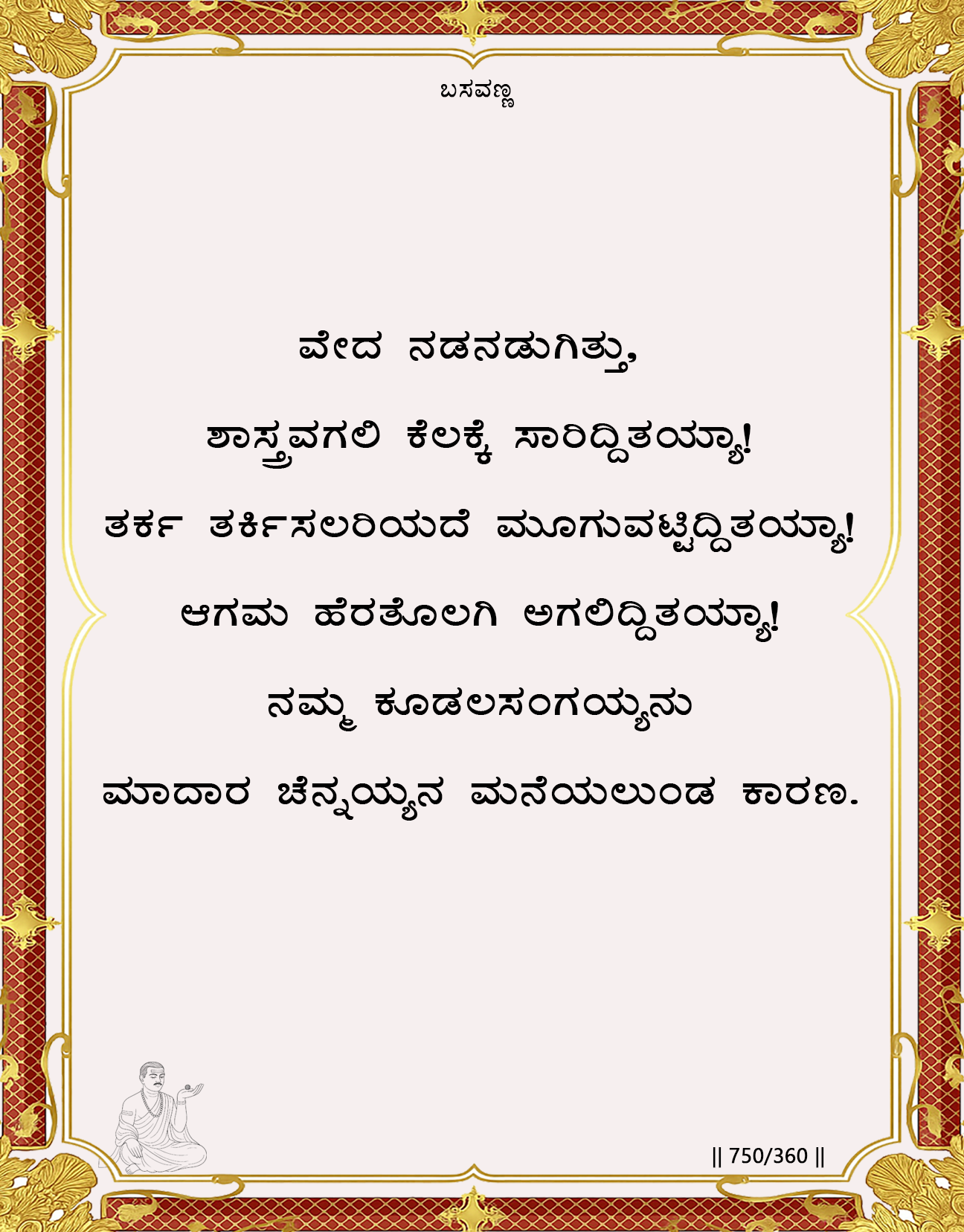
The Vedas trembled in their scrolls,
the shastras faltered, speechless and bare.
All their thinkers, turning and turning,
found no path into living truth
their words collapsed
for want of experience.
And the coming of true consciousness
they could not receive it,
they could not bear it.
But I, O Kudalasangama Deva,
tasted the living essence
in the house of Śaraṇa Maadara Chennayya
there I saw scripture walking,
there I saw the Linga breathing,
there I learned the way.
This vachana marks Basavanna’s bold declaration that inherited religious authority has crumbled under its own emptiness. The Vedas and shastras “quake” and “fall silent” not because they lack truth, but because: those who teach them do not embody them. Their recitation is mechanical, their understanding superficial, their spiritual vision absent. Thus, the old order collapses not from attack, but from its own hollowness. In contrast, Basavanna proclaims that he discovered realized truth not in libraries or debates, but in the home of Śaraṇa Maadara Chennayya, the humble worker-saint. Chennayya becomes: the walking scripture the living Veda the embodied Linga the method and the proof
Through him, Basavanna learns that consciousness is accessible in this very moment (kudala), through inner merging (sangama) not through inherited ritual or rote memory. The vachana thus establishes a revolutionary principle: A single realized being outweighs endless mountains of unexperienced scripture. Living truth supersedes learned tradition. This is the moment where the spiritual hierarchy is overturned, and Basavanna aligns himself not with the scholars of the old world, but with the awakened worker whose life itself is the scripture.
Spiritual Context
Core Spiritual Principle: Embodiment as Apocalypse. The fullest manifestation of divine consciousness within a human being creates a spiritual crisis for all systems that merely point toward, describe, or ritualize that consciousness without embodying it. Living truth has an inherent, disruptive authority that silences dead tradition.
Cosmic Reality Perspective (non-dual, Shiva-Shakti dynamics): Shiva (pure consciousness) is eternally free and unconditioned. Shakti is its dynamic power of manifestation. When Shakti fully embodies Shiva in a human form (the Sharana), it demonstrates that the divine is not a remote principle described in texts but a present reality. This embodiment exposes the gap between the map (scriptures) and the territory (living God), causing the map to “quake.”
Historical Reality (Anubhava Mantapa context): This is Basavanna’s theological manifesto for the Anubhava Mantapa revolution. It explains why the old Brahminical order, with its monopoly on Vedic recitation and ritual, is spiritually bankrupt. Authority is transferred from the scholarly priest (Brahmin) to the realized worker (Sharana like Chennayya). It validates the community’s rejection of caste-based religious authority and establishes Anubhava (experience) as the new cornerstone of faith.
Interpretation
1.”The Vedas trembled in their scrolls”: The Vedas (Shruti) represent the foundational vibrational truths of the cosmos. To “tremble” signifies that these very vibrations are reactivethey resonate with a higher frequency when confronted with their own living source. The scroll (the medium) is shaken by the direct appearance of the message (the divine).
2.”The shastras faltered, speechless and bare”: Shastras (Smriti) are human commentaries and laws. They “falter” because they are derivative. Their “speechlessness” reveals their dependent nature; they have nothing to say when the subject of their commentary stands before them in flesh and blood.
3.”Their words collapsed for want of experience”: This is the core diagnosis. Words about God, without the substance of direct experience (Anubhava), are empty signifiers. They form a hollow structure that collapses under the weight of the real.
4.”They could not receive it, they could not bear it”: The institutional mind is conditioned to control and mediate the divine. The unmediated, raw presence of God-in-a-human is both incomprehensible (cannot receive) and threatening to its power structures (cannot bear).
5.”In the house of Śaraṇa Maadara Chennayya…”: The location is crucial humble worker’s home, not a temple or academy. Here, truth is not studied but lived. “Scripture walking” means dharma in action. “The Linga breathing” means the divine principle is the very life force of the person.
Practical Implications: It calls for a profound humility and openness. One must be willing to let one’s most cherished beliefs and practices be challenged and overturned by the encounter with a truly realized being or a direct awakening of consciousness within oneself. It warns against clinging to forms when the essence has appeared.
The Cosmic Reality
Anga (Human Dimension): The entire edifice of human-made religionits texts, its logic, its rituals. This Anga is useful as a finger pointing to the moon, but it mistakes itself for the moon and is shattered when the moon’s light shines directly into the eyes.
Linga (Divine Principle): The direct, unmediated light of divine consciousness. It is not against the Vedas; it is what the Vedas are about. Its coming is an event of pure grace and truth that judges all partial representations.
Jangama (Dynamic Interaction): The historical and spiritual event of the Sharana’s emergence. It is the dynamic, disruptive movement of the divine entering history in a new way, not through priestly lineages but through the sanctified consciousness of the common devotee, forcing a re-evaluation of all spiritual authority.
Shata Sthala
Primary Sthala: Aikya (Union). Maadara Chennayya represents the achievement of Aikyasuch perfect union that his person is the divine manifest. This state is the living proof that renders all other stages and their practices provisional.
Supporting Sthala: Sharana (Total Surrender). Chennayya’s state is the fruit of absolute surrender. His humble home becomes the temple because he has offered his entire being as the altar. This stage is the necessary precursor that makes Aikya visible in the world.
Practical Integration
Arivu (Awareness Practices): Practice “Bearing the True Consciousness.” In meditation, move beyond reciting or visualizing sacred texts. Sit in silent openness, asking: “Can I bear the unmediated presence of truth, without any concept or image to filter it?” Cultivate the receptivity that the old order lacked.
Achara (Personal Discipline): Let your discipline be to prioritize essence over form. Regularly audit your practices: “Am I doing this because it’s traditional, or because it genuinely connects me to the living truth right now?” Have the courage to simplify or abandon forms that have become empty shells.
Kayaka (Sacred Action): Make your work and life your primary “scripture.” Strive to become someone in whose presence the “Linga breathes” where your actions, ethics, and being are so aligned with truth that they speak louder than any holy book. Let your life be the text that clarifies and corrects mere doctrine.
Dasoha (Communal Offering): Build communities that can “receive and bear” true consciousness. Foster environments where embodied wisdom is honored over scholarly citation, where humility is valued over rank, and where the living example of integrated individuals is the central teaching.
Modern Application
Institutional Rigidity and Spiritual Authenticity Crisis. Modern religious institutions often seem more concerned with preserving dogma, tradition, and institutional power than with fostering direct spiritual experience. This leads to empty ritualism, fundamentalism, and a failure to address contemporary existential crises. Similarly, the “spiritual but not religious” seeker often lacks the embodied depth of a true Sharana.
Become a Site of the Living Apocalypse. Use this vachana to courageously evaluate all spiritual authority in your life. Does your tradition or teacher facilitate direct experience, or does it create dependency on external forms? Strive to become, like Chennayya, a Living Epistle: let your transformed character your compassion, integrity, and awakened presence be the disruptive force that quietly challenges hollow religiosity around you. Support spiritual expressions that prioritize experiential wisdom and humble embodiment over institutional prestige.
Essence
The libraries of heaven shook,
the lawyers of the divine lost their speech,
when God walked out of the temple
and took up residence in a cobbler’s hands.
O Truth that unmakes all lesser truths,
Let my learning be this:
to kneel at the feet
where scripture has taken flesh,
and to become a home
where You, too, might choose to live.
This vachana illustrates the metaphysical principle of paradigm-shift through embodiment. In the evolution of consciousness, a new paradigm is not established by winning arguments within the old framework, but by the appearance of a fact that the old framework cannot explaina living fact. Maadara Chennayya is that fact: the embodiment of divine union. His existence is an anomaly in the old religious paradigm, causing its conceptual components (Vedas, shastras) to “quake” and lose coherence until a new paradigm (Lingayoga, centered on Anubhava) emerges to make sense of this new fact.
Imagine a society that has written countless brilliant books on the theory of flight. One day, a person who has never read those books builds a simple machine and flies. At that moment, all the theoretical books “tremble.” Their authority is not gone, but it is permanently relativized by the living fact of flight. The humble inventor’s workshop becomes the new center of learning. Basavanna says Chennayya is that inventor, and the old religious scholars are left with their silent books.
We have a deep-seated need for security and authority, often found in established traditions and texts. Yet we also yearn for direct, authentic, unmediated contact with truth a contact so real it can be terrifying in its intensity. This vachana speaks to the moment when the yearning for direct contact overcomes the need for security, causing a personal and collective revolution. It affirms that the ultimate authority is not in a book or institution, but in the transformative encounter with a consciousness that has become one with the Divine. This is both a terrifying and liberating truth: it places the responsibility for ultimate knowing squarely on our own capacity to open, receive, and embody of the humble.

Views: 0