Poetic Rendering

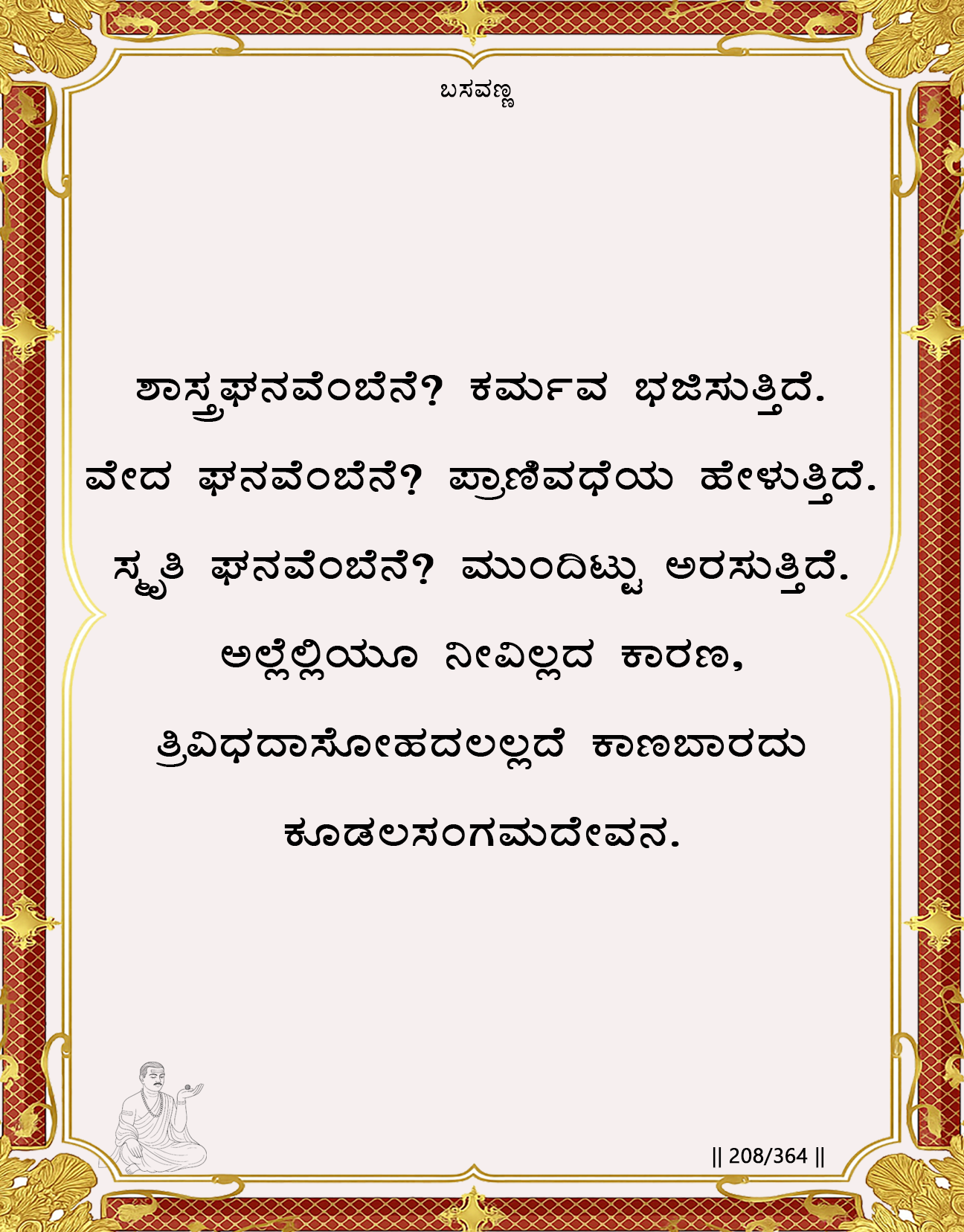
What worth are the Shastras,
when they bind the seeker
in knots of hollow ritual?
What worth are the Vedas,
when their hymns tremble
with the cries of sacrifice?
What worth are the scriptures,
when they bend and break
before the whims of kings?
Finding no trace of You
in their tangled words
or trembling pages, O Lord,
I turn instead
to the living path
the Guru who awakens,
the Linga that illumines,
the Jangama who walks as truth.
In these three
I finally meet You,
Kudalasangama Deva.
Basavanna shifts authority from texts to living spiritual experience In this vachana, Basavanna questions the spiritual authority of traditional scriptures: Shastras: They burden the seeker with rigid rituals. Vedas: They contain violence embedded in sacrificial traditions. Other scriptures: They often yield to political power and lose integrity. Basavanna is not rejecting knowledge but exposing how texts fail when they are cut off from living truth. Since the Divine cannot be found in books distorted by ritualism, blood-sacrifice, or royal manipulation, Basavanna turns toward the living triad of Sharana spirituality: Guru the inner and outer guide Linga the direct experience of the Divine Jangama the realized being in motion For Basavanna, these three are the living scripture of the heart truth in action, truth embodied, truth realized. This marks a pivotal moment in spiritual history: authority moves from the dead letter to the living experience.
Spiritual Context
Core Spiritual Principle: The Primacy of Living Transmission (Guru-Shishya-Parampara) Over Textual Idolatry. Authentic spirituality is transmitted heart-to-heart, consciousness-to-consciousness, through a living lineage of awakened beings. Texts are secondary supports; when they contradict the living truth of compassionate awareness, they must be set aside.
Cosmic Reality Perspective (non-dual, Shiva-Shakti dynamics): Shiva is pure, living consciousness. Shakti is its dynamic expression. Scriptures are a fossilized record of Shakti’s past expressions. To privilege the fossil over the living flow is to prefer a photograph of sunlight to the sun itself. The Guru-Linga-Jangama triad represents Shakti actively expressing Shiva in the present moment: Guru (the awakening power), Linga (the anchoring presence), Jangama (the moving expression).
Historical Reality (Anubhava Mantapa context): This vachana was a theological declaration of independence for the Lingayoga movement. It formally severed the community’s dependence on Brahmanical scriptural authority, which was used to justify caste, ritual violence (bali), and royal tyranny. It established the Anubhava Mantapa’s authority on the direct experience (Anubhava) of its realized members (the Gurus and Jangamas), anchored by the personal Linga.
Interpretation
1.Shastras as “Knots of Hollow Ritual”: Shastras are treatises on Dharma (law, duty). When followed mechanically, they create Karma-bandhana (bondage through action)a complex web of dos and don’ts that traps the seeker in outward conformity (Samskara) without inner transformation. The “knot” symbolizes entanglement in formalism.
2.Vedas “Trembling with the Cries of Sacrifice”: The Vedas contain descriptions of Yajna (sacrifice). Basavanna hears not the cosmic metaphysics but the suffering of the sacrificed being. This critiques the dissociation that allows spiritual ideology to justify violence. It asserts that any revelation that requires violence is a flawed revelation, or at least a corrupted interpretation.
3.Scriptures “Bending Before the Whims of Kings”: This exposes the politicization of religion. Scriptures are often interpreted or edited to legitimize political power (Rajashraya). This severs their connection to transcendent truth (Satya) and makes them tools of Matsya Nyaya (the law of the fish, where the big devour the small).
4.The Turn to the Living Triad: This is the positive pivot. Guru: Not merely a teacher of texts, but the Acharya who awakens (Bodhaka) through their own realized state. They are the living doorway.
Linga: The personal, immediate icon of the formless divine. It is not a symbol in a book but the tangible focal point for direct communion (Sakshatkara).
Jangama: The wandering renunciant who embodies the truth in motion. They are scripture walking, demonstrating that truth is not static but must be lived and shared dynamically.
Practical Implications: It demands spiritual autonomy and courage. One must learn to distinguish between the essence of a teaching and its corrupted institutional form. The ultimate reference point becomes one’s own experience of truth, ethics, and compassion, validated by and in dialogue with living masters (Guru/Jangama) and one’s own deepest connection to the divine (Linga).
The Cosmic Reality
Anga (Human Dimension): The intellect that can be enslaved by texts or liberated by discernment. It is the faculty that must courageously reject Papadèsa (false instruction) even when it comes wearing sacred garments.
Linga (Divine Principle): The living reality that scriptures attempt, and often fail, to describe. It is the Sphurana (divine throb) that is directly perceptible to the awake heart, bypassing all conceptual intermediaries.
Jangama (Dynamic Interaction): The historical and personal process of reformation. It is the dynamic movement of consciousness that constantly critiques and renews spiritual forms to keep them aligned with the living truth. The Jangama is the agent of this reform.
Shata Sthala
Primary Sthala: Sharana (Total Surrender). The definitive act here is surrendering to the living triad. This is a surrender to a dynamic, relational truth (Guru, Linga, Jangama) rather than to a static, impersonal text. It represents the maturation of surrender from the conceptual to the existential.
Supporting Sthala: Maheshwara (Great Lordliness). To reject the Shastras and Vedas required immense spiritual authority and confidence the hallmark of the Maheshwara. One must become a “lord” of one’s own understanding before one can properly surrender.
Practical Integration
Arivu (Awareness Practices): Practice “Source Discernment.” When encountering any spiritual teaching, ask: “Does this come from a living source of wisdom and compassion (a Guru/Jangama), or is it a dead letter? Does it align with the silent truth of my Linga, or does it create conflict?” Develop an inner barometer for truth that references lived experience over textual citation.
Achara (Personal Discipline): Let your discipline be loyalty to the living truth. This may mean respectfully setting aside traditional practices that feel hollow or harmful. Your primary discipline becomes maintaining integrity between your inner realization (via Linga), your guidance (Guru), and your action in the world (embodied as a Jangama-like presence).
Kayaka (Sacred Action): Let your work be guided by the wisdom of the living triad, not by scriptural dictates divorced from context. Let compassion (a Jangama virtue) and insight (a Guru/Linga gift) be your guides in complex ethical situations.
Dasoha (Communal Offering): Build communities that value living wisdom over scriptural scholarship. Create spaces where the experiences of the Jangamas and the guidance of the Guru are considered the primary “texts.” Foster a culture of discerning dialogue rather than dogmatic citation.
Modern Application
Scriptural Fundamentalism and Spiritual Bypassing. In reaction to modernity, many retreat into fundamentalist readings of scriptures, using them as weapons for division and oppression. Conversely, “spiritual bypassing” uses vague, non-scriptural teachings to avoid ethical engagement. Both are escapes from the demanding, living truth of the present moment.
Embracing a Living Tradition. Use this vachana to cultivate a Living-Reference Spirituality. Evaluate all teachings ancient or modern by the “triad test”: Does this connect me to an awakening presence (Guru)? Does it resonate with my deepest, silent knowing (Linga)? Does it manifest as compassionate, truthful action in the world (Jangama)? This approach protects against both fundamentalism and flaky spirituality, grounding practice in ethical, experiential reality.
Essence
Why chain the soul to pages
that sanction chains?
Why listen for God in verses
that drown out the cry of the bound?
Why seek truth in ink
that fades at the king’s command?
I lay the books aside.
My Guru is my grammar,
my Linga my lexicon,
my walking with the wise
my only scripture now.
In this living language of grace,
I finally learn to read You.
This vachana enacts a metaphysical shift from a sacerdotal to a pneumato logical model of authority. Sacerdotal authority rests on sacred objects (texts, relics) and fixed rituals. Pneumato logical authority rests on the living spirit (Pneuma, Shakti) as it moves through awakened persons and communities. Basavanna declares that the spirit (Kudalasangama) cannot be confined to the sacerdotal container; it bursts forth in the Guru-Linga-Jangama continuum, which is a dynamic, relational network rather than a static object.
Imagine you need to learn about a foreign country. You can read a 100-year-old travel guide (Scriptures), or you can talk to a recent traveler who lived there (Guru), use a real-time map application (Linga as your direct orienting device), and actually start walking around a neighborhood with a local guide (Jangama). Basavanna says the latter is the only way to truly know the place. The old guidebook might have some useful history, but it’s outdated, may contain biased advice, and certainly can’t tell you about today’s weather or the current mood of the people.
We crave certainty and authority, often handing over our spiritual autonomy to texts or institutions because the responsibility of direct discernment is terrifying. This vachana calls us to that terrifying and liberating adulthood. It acknowledges that texts can become prisons and gods can be used to justify terrible things. Our deepest longing is for a truth we can trust completely. Basavanna says that trust can only be placed in the living pulse of wisdom, presence, and compassionate action a triad that is constantly self-correcting, relational, and real. It moves the search for God from the library of the past to the laboratory of the present moment, in community with other seekers.

Views: 0