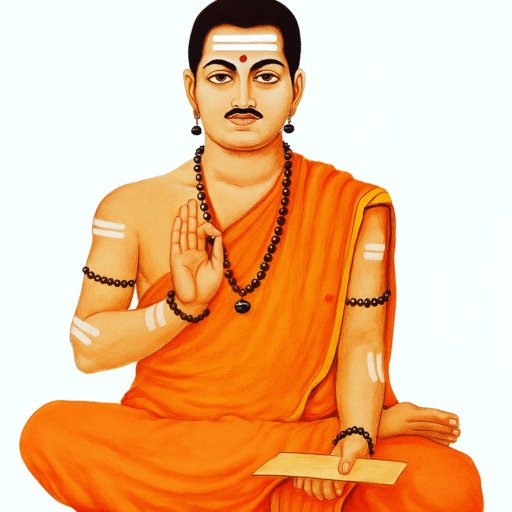

Poetic Rendering

Born in the house of Shiva,
your very breath shaped
by the all-pervading One
you accepted the
Linga as the path to liberation,
yet your tongue strays toward other gods,
your mind wanders through borrowed rites,
your actions bow before passing powers.
You stand like a wall molded from wet sand
smooth to the eye,
but when a single rain-cloud opens,
you dissolve from the very roots,
undone by the division within.
Such is the fate, O Kudalasangama
for those who wear devotion as a mask:
even in this very birth
their consciousness falls to the womb of a dog;
for what is split within
can never stand upright in the
bright gaze of Truth.
This vachana is Basavanna’s stern reminder that initiation is not a social ornament but a sacred integration. The moment the Guru places the Linga in one’s hand and reveals its inner truth: Anga the body becomes a divine instrument, Linga the all-pervading Consciousness becomes intimate and worshipped with awareness, Jangama the same Consciousness is honored in all living beings. This triad is not symbolic; it is the living infrastructure of Lingayoga. Yet Basavanna warns:
If after receiving this path, one still strays seeking rituals elsewhere, chasing other deities, following practices that fragment the mind then one tears apart the unity that the initiation was meant to awaken. Such inner division weakens the seeker like a wall built from wet sand.
At the first touch of challenge, confusion, or karmic storm, the whole structure collapses. Thus Basavanna says: even in this birth, the seeker spiritually descends to the “womb of a dog”
not as punishment, but as the natural consequence of returning to instinct-bound, unconscious living. The core teaching: If one does not live the unity of Anga–Linga–Jangama, the Linga becomes an ornament, the path becomes imitation, and Truth remains out of reach. Only an undivided heart can stand firmly in the light of Kudalasangama.
Spiritual Context
Core Spiritual Principle: Initiation as Structural Integration, Not Ornamentation. In Lingayoga, initiation (Linga Diksha) is the architectural event that reconfigures the human being (Anga) around the divine center (Linga) for dynamic sacred engagement (Jangama). To then introduce foreign elements (“other gods,” rites, powers) is to introduce incompatible materials into the sacred architecture, guaranteeing structural failure.
Cosmic Reality Perspective (non-dual, Shiva-Shakti dynamics): Initiation aligns the individual Shakti (the seeker’s life-force) with the cosmic Shiva principle. This creates a coherent, resonant system. Seeking “other gods” injects dissonant frequencies into this system, creating destructive interference. The “mud wall” is a state of decoherence the Shakti is no longer singularly focused on Shiva but is scattered, losing its potency and structural integrity.
Historical Reality (Anubhava Mantapa context): This was a crucial discipline for the early Sharana community. In a pluralistic religious landscape, converts might have been tempted to syncretistically blend Lingayoga with their prior rituals or to seek favor from local deities for worldly ends. This vachana establishes a strict boundary: the path of the Linga requires uncompromising, undivided loyalty. It defines the community’s spiritual integrity against eclectic dilution.
Interpretation
1.”Born in the house of Shiva… accepted the Linga”: This describes the ontological shift of initiation. The seeker is reborn into Shiva-kula (Shiva’s lineage). The Linga is not just received but accepted as the path meaning it becomes the exclusive organizing principle (Moola Siddhanta) for all of life.
2.”Yet your tongue strays… mind wanders… actions bow”: This trilogy (speech, thought, action) encompasses the totality of human expression. Their misdirection signifies a comprehensive betrayal. “Other gods” symbolize any ultimate concern other than the non-dual reality realized through the Linga. “Borrowed rites” are empty formalism from other paths. “Passing powers” are worldly authorities or temptations.
3.The Mud Wall Metaphor: The wall is built (it has form, like a spiritual persona) but from wet sanda material that coheres only temporarily through external molding, not internal fortitude. It represents a spiritual life constructed for appearance (Aakara) without the binding agent of authentic, unified consciousness (Chit).
4.”Dissolve from the very roots”: Collapse is not partial but total because the weakness is foundational. The “roots” are the core commitment and understanding. Division at the root means no part of the structure is sound.
5.”Consciousness falls to the womb of a dog”: This is a stark depiction of regression. The “dog” represents the Pashu (animal state)consciousness driven by instinct, fear, and servitude to base desires. This is the karmic consequence, not an external punishment, but the natural state of a consciousness that has abandoned the unifying discipline of the Linga.
Practical Implications: Post-initiation, the primary sadhana is vigilance over one’s integration. One must constantly examine: Are my words, thoughts, and deeds flowing from and toward the Linga? Any diversion must be seen not as a minor slip but as a crack in the foundation of one’s spiritual existence.
The Cosmic Reality
Anga (Human Dimension): The initiated individual who has become a sacred site temple under construction. Hypocrisy is the equivalent of building with defective materials or for a different deity, violating the temple’s consecrated purpose.
Linga (Divine Principle): The singular cornerstone and blueprint of the temple. It demands that the entire structure be built according to its non-dual logic. No other blueprint can be mixed in. Jangama (Dynamic Interaction): The weathering process wind, rain, time that tests all structures. For the sincere, it strengthens; for the hypocrite, it reveals. The Jangama is the relentless truth of cause and effect operating on the architecture of the self.
Shata Sthala
Primary Sthala: Maheshwara (Great Lordliness). The failure is one of governance. The Maheshwara is meant to be an absolute monarch in the inner kingdom, eradicating all competing loyalties. The hypocrite is a weak ruler whose court is filled with conspirators (“other gods”).
Supporting Sthala: Sharana (Total Surrender). The initial surrender is incomplete or rescinded. The seeker surrenders to the Linga but then secretly negotiates treaties with other powers, violating the terms of absolute surrender.
Practical Integration
Arivu (Awareness Practices): Implement a “Triad Integrity Scan.” Regularly pause and inquire: Anga: Is my body/mind acting as a unified instrument? Linga: Is my awareness anchored in the divine center? Jangama: Is my interaction with the world reflecting this unity? Any “no” is a patch of wet sand.
Achara (Personal Discipline): Create a “Unity Vow.” Simplify your spiritual practice to those that directly reinforce the Anga-Linga-Jangama nexus. Ruthlessly eliminate practices, affiliations, or habits that foster inner division or scatter your spiritual focus.
Kayaka (Sacred Action): Let your work be a continuous audit of your integration. The challenges of work will quickly reveal where your actions “bow before passing powers” (e.g., greed, fear, approval). Use these revelations as prompts for recentering.
Dasoha (Communal Offering): The community must function as both support and mirror. It should provide the satsang (company of truth) that reinforces unity, and the loving accountability that gently points out when a member’s “wall” shows signs of wet sand.
Modern Application
Spiritual Eclecticism and Identity Fragmentation. The modern seeker often assembles a personalized spirituality from multiple traditions a bit of mindfulness here, a yoga pose there, a pagan ritual elsewhere. While sometimes sincere, this can easily become a form of spiritual consumerism that prevents the deep, transformative integration promised by a single, committed path like Lingayoga. This creates a “mud wall” of appealing, eclectic spirituality with no coherent foundation.
Commit to Coherent Integration. Use this vachana to choose Depth over Breadth. If you have taken up a serious path like Lingayoga, commit to exploring its depths exclusively for a sustained period. Suspend the collection of other practices. Examine your life for “other gods” (e.g., the god of careerism, the god of romantic obsession, the god of political ideology) that command your ultimate loyalty. Work to repatriate that loyalty back to the central, unifying principle of your path. Build a monolithic, not modular, spirituality.
Essence
You were given the plan for a temple,
stone upon stone, grace upon grace.
But you gathered sand from every roadside,
molded a wall to please every passerby.
You called it a temple, but the blueprint was forgotten.
Now the first truth falls like rain,
and what returns to earth
is only what it ever was:
sand, and the memory of water.
O Cornerstone of All That Stands,
let my devotion be single,
that my life may become
a structure that shelters
even in the storm.
This vachana describes a metaphysical failure of topological unity. In the state of initiation, the seeker’s consciousness is mapped onto a singular, non-dual topological space (the “house of Shiva”). Hypocrisy attempts a forbidden operation: it tries to map the same consciousness onto multiple, contradictory topological spaces simultaneously (Shiva’s house + the houses of “other gods”). This is topologically impossible; the map tears. The “mud wall” is this torn, inconsistent map. The “rain” is the applied pressure of reality that forces the tear to become manifest as a complete collapse.
Imagine a navigator given one true compass (the Linga). If they then constantly check other, false compasses (“other gods”), their course becomes a confused average of all readings, and they sail in circles. When a storm (the rain) hits, they have no clear bearing to steer by, and they shipwreck. The “womb of a dog” is the aimless drifting after the shipwreck. Basavanna says: trust the one true compass absolutely, or do not pretend to be on the voyage.
We fear commitment because it feels limiting. We want to keep our options open. This vachana reveals that in the spiritual realm, this very fear is the cause of our undoing. Our soul longs for the stability and truth of a unified existence, but our ego clings to multiple identities for safety. The result is the exhausting, unstable state of the “mud wall.” The vachana presents a terrifying but liberating ultimatum: to stand upright in the gaze of Truth, we must choose one ground to stand on. That choice is the end of hypocrisy and the beginning of real spiritual strength.

Views: 0