Poetic Rendering

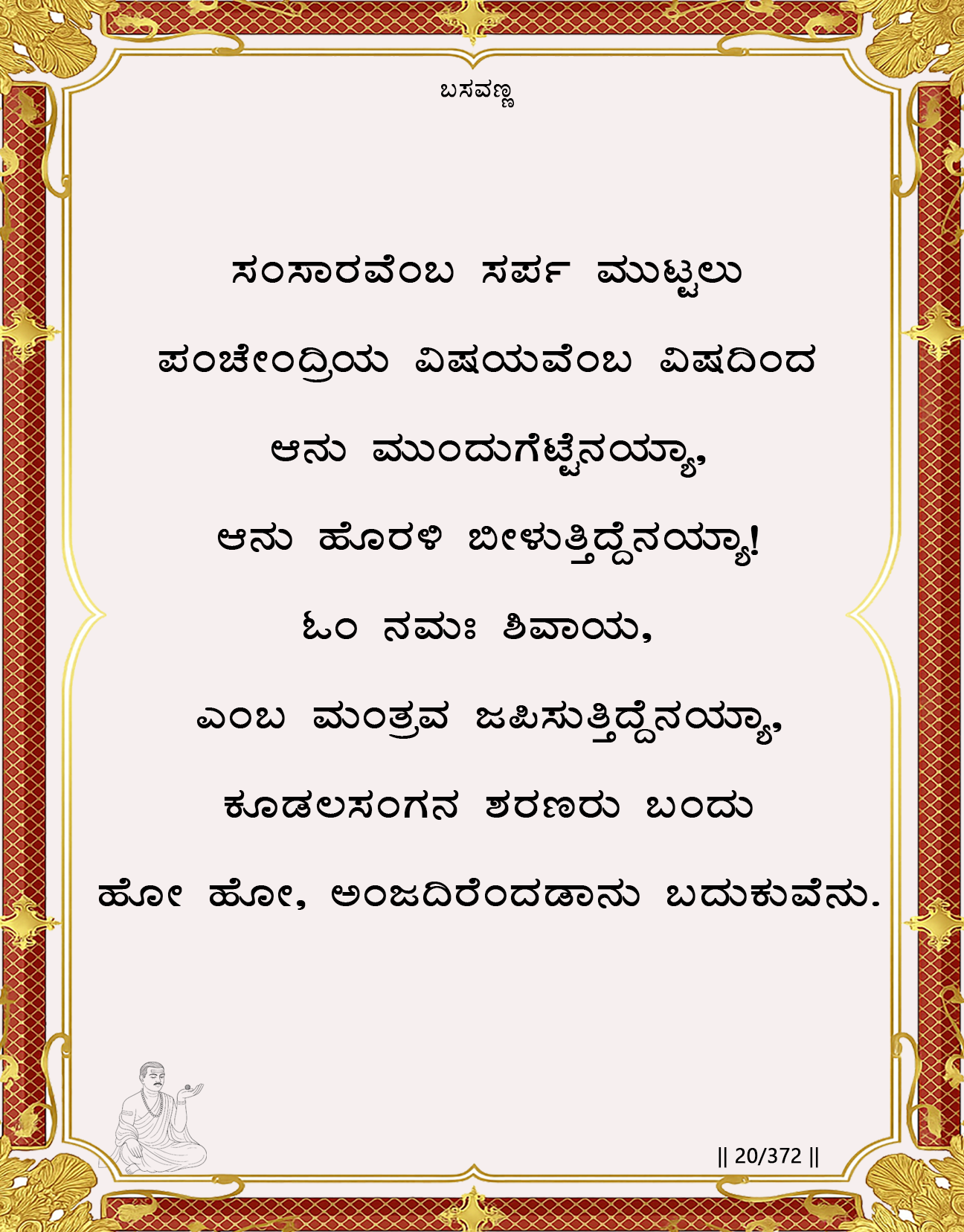
When I grasped the serpent of this worldly life,
the fivefold senses bit me, injecting their venom.
I was struck down, I stumbled and fell into a pit,
though I kept chanting
‘Om Namah Shivaya’ as my shield.
But when your Sharanas arrived, saying:
“Do not fear, do not fear!”
Then I was restored to life, O Kudalasangama.
The Serpent’s Bite and the Sharana’s Antidote This vachana presents a profound allegory of spiritual crisis and healing, mapping the journey from egoic entanglement to liberation through divine grace. Basavanna uses the powerful metaphor of serpent venom to represent the intoxicating and paralyzing effect of unawakened sensory engagement with the world. The teaching reveals the limitations of individual spiritual effort and establishes that ultimate healing comes not through personal practice alone but through the living transmission of fearlessness from realized beings.
Spiritual Context
Core Spiritual Principle: Grace Manifests as Fearless Community. The deepest wounds of the soulthe venom of separation, fear, and egoic contractioncannot be self-extracted. Healing requires the living transmission of fearlessness (abhaya-dana) from those who abide in the non-dual truth. The community (Sangha) is thus a hospital for the soul, and the Sharanas are its physicians.
Cosmic Reality Perspective (non-dual, Shiva-Shakti dynamics): The serpent and its venom represent Shakti perceived through the distortion of maya creative energy experienced as entanglement and poison. The mantra is an effort to invoke Shiva (consciousness) as a shield. However, complete healing occurs only when Shiva-consciousness, fully embodied in the Sharana (Shiva+Shakti unified), actively engages with the poisoned seeker. The fearless word “Ma bhayaha” (Do not fear) is the vibration of non-dual reality directly dissolving the vibrational distortion of fear.
Historical Reality (Anubhava Mantapa context): This vachana defines the therapeutic function of the spiritual community. The Anubhava Mantapa was not merely a debating society but a sanctuary for healing the existential poison of caste hypocrisy, ritual arrogance, and social alienation. The elder Sharanas were seen as physicians of the soul, and their primary medicine was the assurance of one’s inherent divine nature, breaking the fever of self-doubt and spiritual inadequacy.
Interpretation
1.”When I grasped the serpent of this worldly life…”: “Grasped” (pidisuvudu) implies active engagement and identification, not mere proximity. The seeker attempted to possess and control worldly experience through the ego, which inevitably activates its poisonous nature.
2.”the fivefold senses bit me, injecting their venom.”: The senses are neutral channels of Shakti. The “bite” and “venom” are the subjective experiences of raga (attachment) and dvesha (aversion) that arise when sensory data is processed by the egoic mind. The venom is the biochemical of separation.
3.”I kept chanting ‘Om Namah Shivaya’ as my shield.”: This is crucial. The mantra is a shield (a defensive barrier), not an antidote (an internal cure). It prevents new poison but cannot neutralize what is already in the bloodstream. This distinguishes between practice that contains damage and grace that actively heals it.
4.”But when your Sharanas arrived, saying: ‘Do not fear, do not fear!'”: The repetition (“ma bhayaha, ma bhayaha”) is incantatory, a vibrational transfusion. The Sharana’s statement is not psychological reassurance but a ontological declaration: “The separate, fearful self you believe you are does not exist. Abide as what you are.” This is the direct injection of the truth of non-duality.
Practical Implications: It teaches humility: when in deep crisis, your own practices may only be holding the line. Actively seek the company of the awakened. It also defines the duty of an advanced seeker: to become a vessel of this fearless, healing presence for others.
The Cosmic Reality
Anga (Human Dimension): The Anga is a living system in toxic shock. Its natural state of unity-consciousness has been suppressed by the venom of ahamkara. Its own immune system (personal sadhana) is overwhelmed. It requires an external antidote that matches the potency of the poison.
Linga (Divine Principle): The Linga is the original, non-poisoned state of the system pure, fearless awareness. It is both the memory of health and the source of the healing serum. Kudalasangamadeva is the pharmacy, the Sharanas are the medics delivering the medicine.
Jangama (Dynamic Flow): The Jangama is the entire healing event: the cry of the afflicted, the movement of the Sharanas toward them, the utterance of the fearless word, and the subsequent restoration. It is grace in motion, the dynamic interplay that resolves the static condition of poisoning.
Shata Sthala
Primary Sthala: Prasadi. The seeker’s experience is a textbook case of Prasadi. They are utterly reliant on a grace that comes from beyond their current capacity. The healing is bestowed, not achieved. The vachana maps the moment of receiving Prasada, which is often precipitated by acute crisis.
Supporting Sthala: Aikya. The antidote itself” Do not fear” is the living expression of Aikya (non-dual unity). Fear exists only in the gap between a subject and a threatening object. The Sharana, abiding in Aikya, speaks from the reality where no such gap exists. Their words carry the vibrational signature of that unity, which restores the poisoned one to their own inherent Aikya.
Practical Integration
Arivu (Awareness Practices): Practice “venom detection.” With subtle awareness, notice the moment a sense impression (criticism, flattery, loss, gain) turns into the “venom” of a reactive emotion. Catch the bite as it happens.
Achara (Personal Discipline): When poisoned (angry, fearful, deeply attached), have the discipline to stop “grasping the serpent.” Withdraw the mental hand. Use your mantra not to blame the world but to stabilize your inner field, creating the calm needed to receive help.
Kayaka (Sacred Action): Let your work include being a “first responder.” Offer simple, fearless presence to those in crisis. Your most sacred labor may be to sit with someone and, through your calm, silently say “ma bhayaha.”
Dasoha (Communal Offering): Contribute to creating and maintaining a community that functions as a healing sanctuary. Protect it from gossip, judgment, and competition these are the social forms of the serpent’s venom. Make the Sangha a zone of fearlessness.
Modern Application
“Existential Poisoning” and “Therapeutic Consumerism.” We are bitten daily by the serpents of anxiety (future), regret (past), social comparison, and digital overload. We often seek the “mantra as shield” through self-help techniques, meditation apps, or positive thinking, which manage symptoms but don’t cure the core poisoning of separation. We then shop for therapists or gurus, seeking a consumer solution to a spiritual crisis.
This vachana liberates us from the myth of the purely self-made recovery. It directs us to seek not just techniques, but transmission to find or form small communities where fearless truth is spoken. It transforms healing from a private project into a communal event. It suggests that the cure for our modern anxieties is not more analysis, but the direct, relational experience of non-separateness, often found in silent, compassionate presence or in words that point us back to our fundamental wholeness.
Essence
I grasped the glittering coil of day and night,
And felt the fanged senses clamp and bite.
My holy chant, a shield held tight,
Could not stop the spreading night.
Then came the ones whose eyes were clear,
Who spoke the words that dissolve fear:
A simple truth, a cure applied
In their “Fear not,” the venom died.
This vachana operates on the homeopathic principle of spiritual healing. The cure for a potent poison is an even more potent counterpart. The venom is the extreme affirmation of separation and mortality (“I am a vulnerable self in a dangerous world”). The antidote is the extreme affirmation of non-dual unity and immortality (“You are the deathless reality; there is no other”). The Law of Similars (similia similibus curantur) applies: the disease and its cure occupy the same profound level of existential impact. The Sharana’s words are a spiritual allergen that triggers the system’s radical immune response against the ego itself.
Imagine someone freezing to death in the snow. Wrapping them in a blanket (personal practice) can slow heat loss. But to truly save them, you need to get in the sleeping bag with them skin-to-skin contact to transfer vital warmth directly. The blanket is the mantra-shield. The fearless Sharanas are the ones who get into the “sleeping bag” of your consciousness, transferring the living warmth of non-dual truth that your own system can no longer generate.
At our core, we are not afraid of specific things; we are afraid of being a separate, fragile self. This is the primordial venom. We build mantra-shields of identity, achievement, and belief systems to protect this fragile self. The ultimate healing occurs when we encounter a presence so utterly fearless and undivided that it mirrors back to us our own inherent, invulnerable reality. The cry “Do not fear” is not advice; it is the diagnosis of our true state. We are restored to life not by becoming better protectors of a small self, but by remembering we were never that small self to begin with. The bite held the paradoxical gift: the pain of separation so acute it forced us to seek the only cure that truly matters.

Views: 1