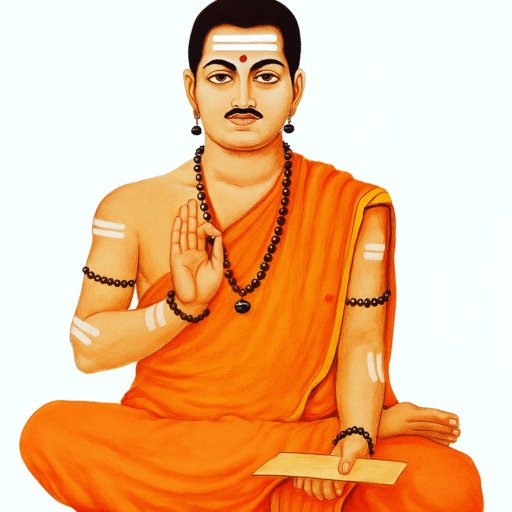

Poetic Rendering

In the thick jungle of this worldly life
there are indeed tigers,
there are indeed bears
dangers seen and unseen at every turn.
But the Sharana walks unshaken.
Even where others tremble,
his steps do not falter.
For the one who has taken
Kudalasangama as refuge
fear has no doorway,
no resting place
within his heart.
In this vachana, Basavanna presents fearlessness not as bravery or defiance, but as the natural state of one established in divine refuge. The Jungle as Samsara The “tigers and bears” symbolize: worldly anxieties, unpredictable dangers ,the forces of karma and circumstance, and the mind’s habitual fears. Most beings navigate life with caution and insecurity. The Sharana’s Fearlessness For the true Sharana: fear is dissolved at its root, not because dangers vanish, but because his inner ground is unshakeable. He knows he stands in the sanctuary of Kudalasangama the abiding, all-pervading One. The Teaching Fearlessness is not gained by battling fears but by abiding in the truth of one’s divine refuge. When the center is stable, the world’s chaos cannot penetrate. Thus Basavanna proclaims: The real security is not outsidebut within the heart aligned with the Divine.
Spiritual Context
Core Spiritual Principle: Fearlessness is the Litmus Test of Realization. The absence of existential fear (abhaya) is the primary symptom of abidance in the non-dual Self. It is not a psychological state to be cultivated, but a natural consequence of correct identification. If fear remains, identification still rests with the perishable Anga, not the imperishable Linga.
Cosmic Reality Perspective (non-dual, Shiva-Shakti dynamics): The jungle with its tigers and bears is the dynamic, creative, and sometimes fierce play of Shakti. The ordinary person, misidentifying as a separate fragment, experiences this play as threat. The Sharana, established in Shiva (pure, unchanging consciousness), experiences the same Shakti as a manifestation of the One. The “walk” is the harmonious integration of Shiva (the still witness) and Shakti (the dynamic movement through the world).
Historical Reality (Anubhava Mantapa context): In the socio-political jungle of 12th-century Karnataka with its orthodoxy, caste violence, and political intrigue this vachana was both a declaration and an empowerment. It told the community that their revolutionary path would have real “tigers and bears” (persecution, social ostracization), but that their refuge in the Ishtalinga and their fellowship should make them inwardly unassailable. It cultivated a courage rooted not in rebellion, but in transcendence.
Interpretation
1.”In the thick jungle of this worldly life…”: “Thick jungle” implies obscurity, entanglement, and the unknown. It is a realm where the path is not always clear, and threats can emerge unexpectedly. This is an honest assessment, not a denial of life’s challenges.
2.”there are indeed tigers, there are indeed bears…”: The repetition affirms the objective reality of dangers. Basavanna does not spiritualize them away. Tigers represent sudden, acute dangers; bears represent looming, powerful threats. They symbolize all forms of loss, pain, and mortality.
3.”But the Sharana walks unshaken.”: “Walks” is key. This is not a state of frozen detachment or retreat. It is engaged movement through the world. “Unshaken” (angadu) means the center of gravity is immutable. The periphery (body, emotions, circumstances) may register events, but the core is undisturbed.
4.”For the one who has taken Kudalasangama as refuge fear has no doorway…”: This is the causal mechanism. Refuge (sharana) is not a hopeful prayer but a ontological relocation of identity. The heart (hridaya) is no longer a small, vulnerable chamber but has expanded to become the space containing the refuge itself. Fear, which needs a contracted, separate “I” to enter, finds no such structure here.
Practical Implications: It reframes spiritual progress. Ask not “Do I have blissful experiences?” but “Am I fundamentally less afraid?” When facing a “tiger,” practice discerning: “What is the unchanging ground within me that witnesses this fear?” Abidance there is the practice.
The Cosmic Reality
Anga (Human Dimension): The Anga is the walking body-mind organism. In the state of fear, the Anga believes it is alone in the jungle. In the state of fearlessness, the Anga is understood to be a temporary formation within the refuge, a vehicle for the Linga’s expression, and therefore not ultimately at risk.
Linga (Divine Principle): The Linga is the infinite, open “clearing” in the midst of the jungle. It is the fearless space-awareness that contains all trees, tigers, and bears. Taking Kudalasangama as refuge is the recognition that you are that clearing, not the figure lost within it.
Jangama (Dynamic Interaction): The Jangama is the fearless walking itself the continuous integration of this recognition into every step. It is the dynamic proof that the Linga (refuge) is not a static place to hide, but a moving reality to inhabit. The Jangama is the lived non-duality of the walker and the walk.
Shata Sthala
Primary Sthala: Aikya. The description is of one established in Aikya. The dissolution of the subject-object dichotomy (“fearful me” vs. “dangerous tiger”) is complete. The walker, the path, the tigers, and the refuge are seen as modifications of the same singular reality. Fearlessness is the emotional signature of this unity.
Supporting Sthala: Sharana. The figure who embodies this is the Sharana, the “refuge-taker.” This vachana shows the final maturity of taking refuge: one becomes indistinguishable from the refuge itself. Thus, the journey from Sharana (taking refuge) culminates in Aikya (being the refuge).
Practical Integration
Arivu (Awareness Practices): Practice “jungle awareness.” Move through your day noting the “tigers and bears” the emails, conversations, news, and tasks that trigger subtle or gross anxiety. Then, practice “refuge awareness.” Feel the background space of consciousness within which these threats arise and subside. Abide as that space.
Achara (Personal Discipline): Discipline yourself to make small, fearless choices. Speak a kind but difficult truth. Refuse to engage in gossip. Take a principled stand on a minor issue. Let these be training walks in the smaller jungles to prepare for the larger ones.
Kayaka (Sacred Action): Perform your work as a “fearless walk.” Let your labor be an expression of your deepest values, even if it’s risky or unpopular. Do not let the fear of failure or criticism distort the integrity of your action.
Dasoha (Communal Offering): Your greatest offering to the community is to be a stable, fearless presence. In times of collective anxiety or crisis, your unwavering center becomes a living pillar of refuge for others. Help create a Sangha that feels like a fearless caravan walking together through the jungle.
Modern Application
“Chronic Ambient Fear.” Our modern jungle is digital, financial, social, and existential. The “tigers and bears” are market crashes, pandemics, social media shaming, climate anxiety, and identity politics. We live in a state of low-grade, chronic fear, seeking security in insurances, algorithms, and echo chambers, which only amplifies the sense of a threatening jungle.
This vachana liberates us from the futile quest to eliminate all tigers. Instead, it offers the technology of inner refuge. It suggests turning off the news (the jungle report) not out of denial, but to consciously re-establish in the inner clearing of Kudalasangama (through meditation, mantra, or contemplative silence). From that center, we can re-engage the world, our actions informed not by reactive fear, but by the clarity and compassion that flow from fearlessness.
Essence
The jungle is thick, the dangers real and known
The tiger’s flash, the bear’s deep-throated groan.
Most tread with care, a tightness in the chest,
Convinced that fear defines the world’s grim test.
But one who knows the Refuge at the core
Walks the same path, yet is afraid no more.
Not that the threats have somehow slipped away,
But that the ground he walks on cannot sway.
This vachana illustrates the topological principle of spiritual orientation. In the geometry of consciousness, fear is a function of believing oneself to be a point within a threatening space (the jungle). Fearlessness arises from the topological inversion where one realizes oneself to be the space itself within which the point (the ego) and the jungle appear. The “refuge” is not another point within the space, but the dimensionality of the space. The walker who knows this is no longer navigating through the jungle; the jungle is arising and moving within the walker’s boundless presence.
Imagine you are watching a terrifying movie on a vast screen. You jump at the scary parts because you identify with the character in the movie. Now, shift your identification to the screen upon which the movie is playing. The same terrifying images still appear, but the screen is not scared, not damaged, not affected. The Sharana has realized they are the screen, not the character. The walk through the jungle is the movie; fearless awareness is the screen.
Our deepest suffering is not the experience of pain, but the fear of pain. We are haunted not by what is, but by what might be. This vachana points to the only true solution: to discover the part of us that has already survived every imaginable catastrophe the witnessing awareness that was present before birth and will be present after death. To take refuge there is to come home to the only safety that has ever existed. The fearless walk is the life of one who has died to the mortal self and been reborn as the immortal ground of all experience. The tigers may take the body, but they have long since lost the soul.

Views: 1