Poetic Rendering

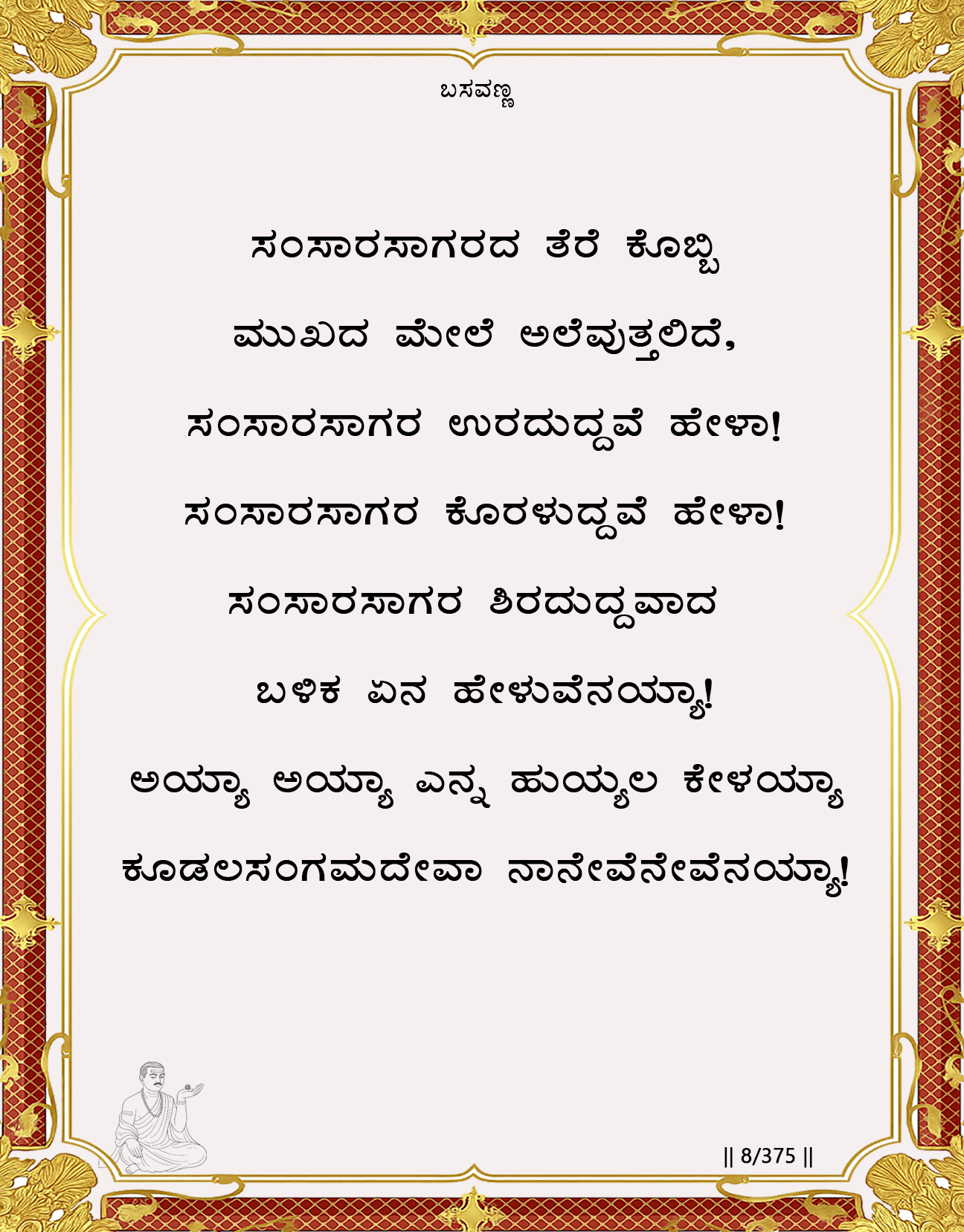
The waves of this ocean of worldly life
rise and crash, dashing against my very face.
Tell me where is its shore?
Tell me where is its depth?
When its furious waves have
drowned even my head,
how can I speak? How can I call out?
I am lost, lost! Hear my choked cry!
O Kudalasangama, You alone are my refuge!
The Drowning and The Cry: Surrender as Salvation This vachana represents the critical turning point in the spiritual journey the complete exhaustion of egoic resources and the birth of authentic surrender. Basavanna maps the anatomy of spiritual crisis with profound psychological precision, showing how the very failure of the separate self becomes the gateway to divine recognition. The teaching reveals that our deepest desperation, when fully embraced, contains the seed of our liberation, for it forces the consciousness beyond its self-imposed limitations into the recognition of its true nature as the ocean rather than the drowning wave.
Spiritual Context
Core Spiritual Principle: Surrender is Born of Shipwreck. Authentic, unconditional surrender (atma-nivedana) is not an act of will but a state arrived at when the will is utterly broken. The spiritual journey often requires not the strengthening of the ego, but its complete and honest failure, which then opens the door to a power beyond the self.
Cosmic Reality Perspective (non-dual, Shiva-Shakti dynamics): The furious ocean is Shakti in her aspect of all-consuming, dynamic force (maha shakti). The separate ego (a small wave) tries to navigate her, but is inevitably overwhelmed. The drowning is the dissolution of the wave’s temporary form. The cry to Kudalasangama is the wave’s remembering of its true nature as the ocean itself (Shiva). The “refuge” is the recognition of non-difference; the ocean cannot drown in itself.
Historical Reality (Anubhava Mantapa context): This vachana gave voice to the existential and social drowning experienced by those oppressed by caste and ritual orthodoxy. It validated spiritual despair as a legitimate, even necessary, stage on the path. It told the community that when the world’s injustices and one’s own inner failings became an overwhelming ocean, the only authentic response was not a better philosophy but a desperate cry to the Divine, which would be answered by the supportive fellowship (the living Jangama) of the Sangha.
Interpretation
1.”The waves of this ocean of worldly life rise and crash, dashing against my very face.”: The experience is immediate and visceral (“my very face”). This is not abstract philosophy but embodied suffering. The ocean is not observed; it assaults the observer.
2.”Tell me where is its shore? Tell me where is its depth?”: These are the final, frantic questions of the intellect seeking a solution within the framework of the problem. The “shore” is escape (moksha as an external place). The “depth” is understanding (jnana as comprehension). Both are revealed as non-existent within the samsaric framework itself.
3.”When its furious waves have drowned even my head, how can I speak? How can I call out?”: The “head” represents the faculties of reason, language, and control the tools of the ego. Their drowning signifies the end of the ego’s project. The subsequent inability to speak signifies a state beyond conceptualization, a pre-linguistic reality of pure desperation.
4.”I am lost, lost! Hear my choked cry! O Kudalasangama, You alone are my refuge!”: The “choked cry” is the sound of the soul stripped bare. It is not a polite prayer but an existential scream. This raw acknowledgment of being “lost” is the first truth spoken from beyond the ego. It creates the space for the second truth: the recognition of the only possible refuge.
Practical Implications: It sanctifies the experience of hitting rock bottom in one’s spiritual life. It teaches that when all practices, philosophies, and efforts fail, do not despair this may be the crucial moment. Stop strategizing and simply cry out from the heart. Authentic helplessness is a more powerful prayer than perfected ritual.
The Cosmic Reality
Anga (Human Dimension): The Anga is not just suffering; it is being consumed by suffering. It is in the process of dissolution. This dissolution, however, is not annihilation but the stripping away of false identity. The Anga is the locus where the illusion of separation is being violently dismantled by experience.
Linga (Divine Principle): The Linga is the silent, unmoving bed of the ocean. It is the fundamental reality that was present before the storm, during the storm, and after the storm. It is not a rescuer who enters the scene, but the ever-present ground that the drowning being has forgotten.
Jangama (Dynamic Interaction): The Jangama is the entire arc from the drowning to the cry to the declaration of refuge. It is the dynamic process of ego-death and grace-recognition. It is the turbulent movement that leads from identification with the drowning wave to remembrance of the oceanic nature.
Shata Sthala
Primary Sthala: Prasadi. The vachana is a perfect portrait of the Prasadi stage in its moment of inception. The seeker is wholly in a position of receiving. They contribute nothing but their own acknowledged emptiness and desperation. The grace that saves them is pure gift, unearned and unsought until all other options vanished.
Supporting Sthala: Aikya. The direction of the cry points toward Aikya. To take the ocean itself as your refuge is, in the end, to realize you are the ocean. The drowning of the separate self (the wave) is the painful but necessary precondition for the realization of non-dual unity with the whole (the ocean).
Practical Integration
Arivu (Awareness Practices): Practice “conscious drowning.” In moments of overwhelm (anxiety, grief, failure), instead of fighting the feeling, allow yourself to fully feel the sensation of being submerged. Observe the panic of the “head” going under. Then, listen for the deeper, wordless cry beneath the panic.
Achara (Personal Discipline): Cultivate the discipline of vairagya (dispassion) not as dry detachment, but as the honest admission when something is beyond your control. Practice saying “I cannot handle this” as a sacred utterance that opens the door to grace.
Kayaka (Sacred Action): When your work or responsibilities feel like a drowning wave, stop trying to “swim” better. Offer the very feeling of drowning as your labor. Say, “This overwhelm is my offering. I cannot do this, so let it be done through me.”
Dasoha (Communal Offering): Be a sanctuary for others who are drowning. Do not offer easy answers or strategies. Instead, offer a fearless, listening presence that can hear their “choked cry” without flinching, mirroring back the refuge you have found.
Modern Application
“Burnout and Spiritual Bankruptcy.” The modern condition is one of constant, low-grade drowning in information, expectations, social comparisons, and existential uncertainty. We respond by learning better “swimming techniques” (productivity hacks, mindfulness apps). This vachana addresses the moment when those techniques fail, leading to burnout, depression, or a sense of profound meaninglessness the modern “drowning of the head.”
This vachana liberates us from the tyranny of self-optimization. It validates the crisis as a potential breakthrough. It suggests that when you are drowning in work, anxiety, or sadness, stop the frantic paddling. Allow the despair. Let the cry of “I am lost!” be your most honest meditation. In that space, the illusion of the separate, managing self collapses, and a deeper intelligence (Kudalasangama as your own true nature) can emerge as your sole refuge and guide.
Essence
The wave I thought I was has met the sea’s full force,
My mapped-out shores now vanished from my course.
The clever head that plotted ways to flee
Is pulled beneath the dark and roaring sea.
All strategies have sunk, all questions drowned.
From depths where no false hope can ever be,
One raw cry tears itself from me:
“I am not! You ARE! Now, let Your will be found!”
This vachana demonstrates the catastrophe theory of spiritual awakening. In dynamical systems, a “catastrophe” is a sudden, qualitative shift in behavior resulting from a small, continuous change in input. Here, the continuous input is the pressure of samsaric suffering.
The egoic system (the wave) tries to maintain stability through adjustment (asking questions, seeking shores). Finally, at a critical threshold of pressure, the system undergoes a catastrophic bifurcationit cannot return to its old state. The only possible new attractor is the basin of “refuge” in the Divine. The drowning is the catastrophic collapse of one attractor state (the separate self), making way for a new, more stable one (the non-dual ground).
Imagine a man walking a tightrope over a canyon (the ego managing life). The wind picks up (samsaric pressure). He adjusts, wobbles, tries harder. The wind becomes a gale. At a certain point, continuous adjustment is impossible; he must fall. This vachana is about the moment of falling. Yet, in this spiritual equation, the canyon is not empty; it is filled with a heretofore invisible net (the Linga). The falling is necessary to discover the net that was always there. The cry is the sound of the fall; the refuge is the discovery of the net.
Our deepest fear is annihilationt he dissolution of the “I.” We structure our entire lives to avoid this feeling. This vachana speaks the terrifying, liberating truth: that annihilation is the gateway. It is only by allowing the fictional, separate “I” to drown in the ocean of experience that we discover our true identity as the ocean itself limitless, deathless, and inherently at peace. The choked cry is the sound of the small self dying. The recognition of refuge is the first breath of the true Self being born.

Views: 0