
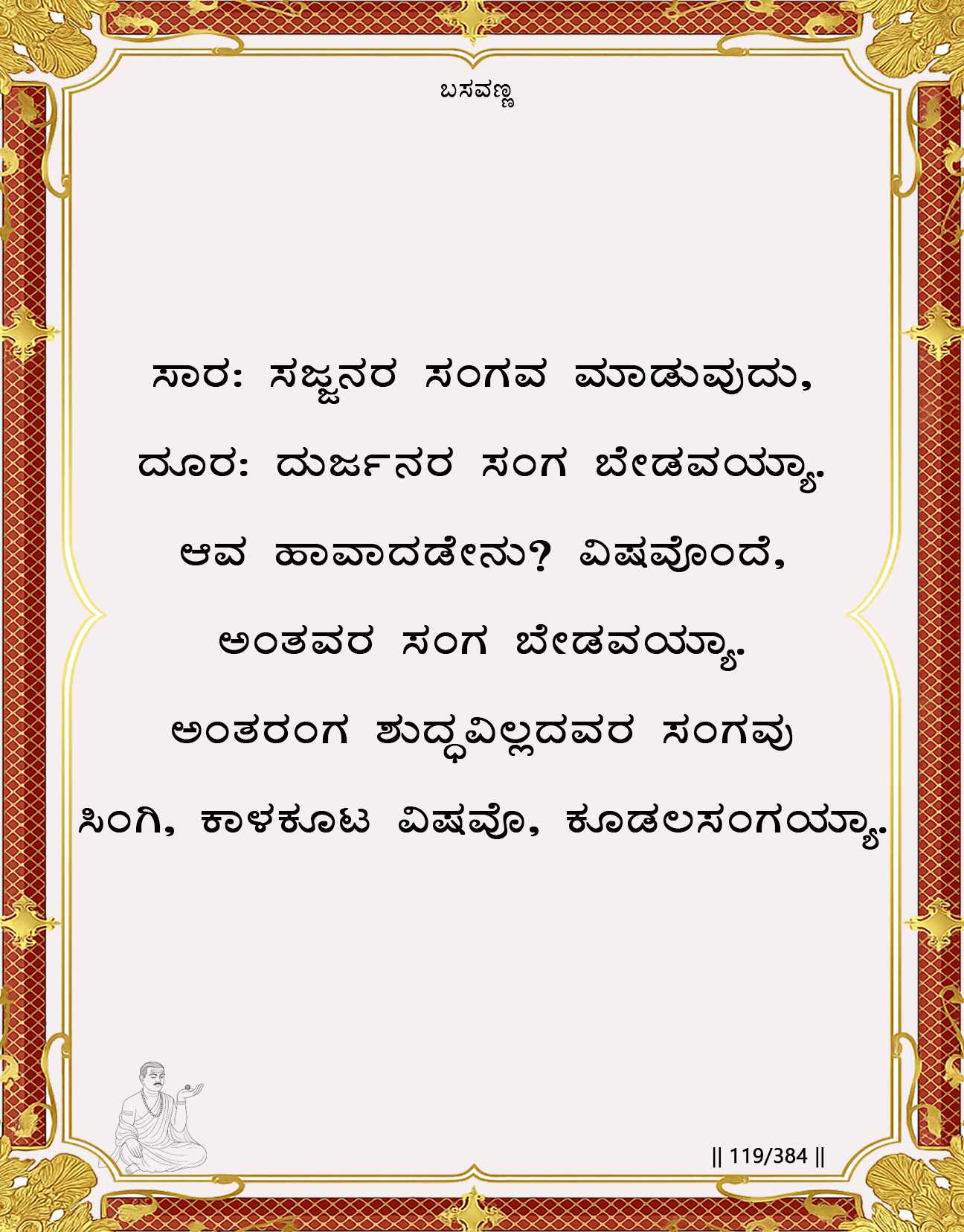
Poetic Rendering

Seek the company of the noble
their presence shapes and uplifts.
Turn away from the company of the corrupt
for what is a snake, however patterned or splendid,
but poison wrapped in shimmering scales?
So too is the company of the impure at heart
deadlier even than the fabled Kālakuṭa,
the poison churned from the cosmic sea.
O Kudalasangama,
protect me from such venomed fellowship!
This vachana continues Basavanna’s exploration of the profound spiritual consequences of the company one keeps, but with an elevated intensity. By invoking Kālakūṭa, the deadliest poison in Hindu mythology, Basavanna emphasizes the catastrophic impact that corrupt association can have on the inner life.
Kālakūṭa: The Deadliest Poison in Myth and Symbol To convey the severity of negative influence, Basavanna alludes to Kālakūṭa (कालकूट)the “black mass” or Hālāhala, the lethal poison that emerged during the Samudra Manthan, the cosmic churning of the Ocean of Milk.
According to the Purāṇas and the Mahābhārata:The Devas and Asuras churned the ocean seeking Amṛta, the nectar of immortality. Before the nectar appeared, a terrifying poison arose so potent that its fumes threatened to destroy all three worlds. No deity could contain it; only Śiva, out of compassion, drank it to save the universe. Parvati stopped the poison in his throat, turning it blue and earning him the name Nīlakaṇṭha (The Blue-Throated One).This myth symbolizes the destructive forces that arise before spiritual gain, the perils hidden within ambition, and the ultimate sacrifice required to protect the world.
Basavanna’s Use of the Metaphor By comparing corrupt company to Kālakūṭa, Basavanna makes a profound point:toxic association is more spiritually dangerous than the deadliest poison known to myth, because while external poison harms the body, inner poison corrodes the soul.
Corrupt Company Conceals Its Venom Like a beautifully patterned serpent whose appearance hides its lethal fangs, the company of the impure:may seem charming, cultured, or even spiritual,but slowly infects the mind with cynicism, ego, and impurity.Basavanna warns the seeker to look beyond appearances and discern the subtle influence people exert on one’s consciousness.
Spiritual Discrimination Is Essential Good company nourishes the spirit; bad company corrodes it.
To walk the path of Kudalasangama, one must: actively seek noble companions,consciously reject corrupt influences,and guard the mind as one would guard life during a poison outbreak.
The Heart of the Teaching Just as the universe could survive Kālakūṭa only through divine intervention, the soul can survive inner poison only by maintaining pure association. Basavanna’s message is clear and urgent: Choose your company with the same seriousness with which you would handle a vessel of deadly poison.
Spiritual Context
Core Spiritual Principle: Association is a Matter of Cosmic Hygiene. Choosing one’s company is not social preference but an act of preserving the integrity of one’s inner cosmos. Impurity of heart in others is a contagion of cosmic proportions; to expose oneself to it is to risk a dissolution far worse than physical deaththe death of spiritual potential.
Cosmic Reality Perspective (non-dual, Shiva-Shakti dynamics): The churning of the ocean (Samudra Manthan) is Shakti’s dynamic interplay, from which both poison (Kālakūṭa) and nectar (Amrita) emerge. Corrupt company represents the unassimilated, rarefied poison of separation (ahamkara) that emerges from the churning of worldly life (samsara sagara). Shiva’s act of drinking it symbolizes the conscious, compassionate containment of this poison within the stable field of pure awareness. The seeker, by invoking Kudalasangama (Shiva), seeks to replicate this containment: to have their own awareness become the “blue throat” that holds the poison of negative influence without letting it spread to their heart (Parvati’s role) and destroy their inner world.
Historical Reality (Anubhava Mantapa context): This was a radical doctrinal weapon. By equating the orthodox, casteist establishment with Kālakūṭa, Basavanna portrayed the dominant social and religious order not just as wrong, but as an active, world-negating poison.
The Lingayoga community’s separation was thus reframed: they were not heretics abandoning society, but devotees enacting the role of Shiva, voluntarily “drinking” the social ostracization and persecution (the poison) to create a protected space (Sangha) where the nectar of egalitarian devotion (Amrita) could be shared. Choosing noble company within the Sangha was the practical act of consuming the nectar, not the poison.
Interpretation
1.”Seek the company of the noble their presence shapes and uplifts.”: This is the pursuit of Amrita (nectar). The noble are those who have accessed the nectar of liberation; their company is a continuous infusion of its immortalizing qualities.
2.”Turn away from the company of the corrupt for what is a snake, however patterned or splendid, but poison wrapped in shimmering scales?”: The “turn away” is a life-saving evasion. The simile reveals that the poison is not in the circumstance but in the essential nature of the being, beautifully concealed. This demands discernment of essence over form.
3.”So too is the company of the impure at heart deadlier even than the fabled Kālakūṭa…”: This is the monumental claim. Kālakūṭa could destroy the physical universe. The poison of corrupt association destroys the universe of meaning, purpose, and divine connection within the soul. It annihilates the possibility of liberation, a fate worse than cosmic dissolution.
4.”O Kudalasangama, protect me from such venomed fellowship!”: This final cry recognizes that mere human caution is insufficient against a poison of this caliber. It is an appeal for the divine protective power of Nīlakaṇṭha to be activated within one’s own consciousness, to grant the strength to resist and the wisdom to see the poison for what it is.
The Cosmic Reality
Anga (Human Dimension): The Anga is the “Ocean of Milk” being churned. Its daily life and interactions are the churning. It must be eternally vigilant for what emerges: will it be the nourishing nectar of sat-sanga or the deadly poison of dus-sanga? The Anga’s choice determines which substance it ingests.
Linga (Divine Principle): The Linga is Shiva as the neutralizing principle. It is the transformative power that can take the darkest, most lethal byproduct of existence and hold it without being destroyed by it. In the seeker’s life, this manifests as the grace to be in the world but not corrupted by it.
Jangama (Dynamic Interaction): The Jangama is the act of churning itself engagement with the world. The teaching is not to stop churning (living), but to develop the divine discrimination to immediately offer any emerging poison to the Shiva-consciousness within (through prayer, discernment, and rejection) and to share any emerging nectar with the community.
Shata Sthala
Primary Sthala: Maheshwara. The vachana’s grand, mythical scale and its focus on protection from cosmic-level threats align with the Maheshwara stage. The Maheshwara acts as a guardian for the spiritual ecosystem, fiercely discriminating against poisonous influences to safeguard the nectar of the Sangha.
Supporting Sthala: Bhakta & Sharana. For the Bhakta, it is a terrifying and vital warning. For the Sharana, it defines the seriousness of their refuge: their fellowship must be a fortress against this cosmic poison, a collective embodiment of Nīlakaṇṭha.
Practical Integration
Arivu (Awareness Practices): Develop “poison detection” at the subtle level. Before and after interactions, scan your inner state. Does it feel coherent, expansive, and clear (nectar)? Or fragmented, contracted, and agitated (poison)? Trust this somatic intelligence.
Achara (Personal Discipline): Institute a “mythic standard” for relationships. Ask: “If this influence were a substance, would it be Amrita or Kālakūṭa?” Have the courage to categorically avoid what you identify as the latter, regardless of social cost.
Kayaka (Sacred Action): Let your work be an act of distributing nectar, not poison. Ensure your professional actions contribute to clarity, healing, and unity. Refuse to engage in or propagate toxic systems, even if profitable.
Dasoha (Communal Offering): The highest Dasoha is to help create and maintain a community that is a “nectar-distribution center.” Vigilantly protect its culture from the ingress of gossip, cynicism, and ego-competition the social forms of Kālakūṭa.
Modern Application
“The Normalization of Spiritual Toxins.” Our digital and cultural environment constantly churns out normalized poisons: cynicism masquerading as wisdom, hate disguised as opinion, materialism sold as success, and narcissism packaged as self-care. We are daily asked to ingest low-grade Kālakūṭa and call it life.
This vachana empowers a radical detox. It justifies withdrawing from toxic social media, news cycles, and cultural narratives as a spiritual survival imperative, not mere disengagement. It validates the seeker’s need to create “poison-free zones” small communities of practice built on shared reverence and integrity as modern acts of invoking Nīlakaṇṭha. It redefines spiritual strength not as enduring poison, but as the discernment to reject it and the community to share the antidote.
Essence
The world is churning; from its deep, tossed breast,
Both nectar and the deadly poison crest.
One sip of nectar grants the soul its flight,
One taste of poison quenches heaven’s light.
The serpent’s beauty is the danger’s art,
A patterned lie to still the guarded heart.
So seek the company that makes you whole,
And shun the venom that devours the soul.
For fellowship with hearts impure and cold
Is poison worse than myths of old.
O Blue-Throated Lord, my refuge be,
And from this darker churning, set me free.
This vachana applies the ecological concept of bioaccumulation and toxicity to consciousness. Kālakūṭa represents a persistent, bioaccumulative toxin. Exposure to corrupt company is not a single event but repeated ingestion of trace amounts of spiritual toxins (doubt, judgment, fear). These toxins do not flush out; they accumulate in the “soft tissues” of the psyche (samskaras), eventually reaching a critical concentration that systemically disrupts the organism’s spiritual functions (faith, compassion, clarity). The “noble company” provides the binding agents (truth, love) that help detoxify and flush these accumulations.
Imagine your consciousness is a pristine lake. The “company of the corrupt” is a slow, steady drip of industrial pollutant, invisible at first but steadily accumulating. The “company of the noble” is a constant inflow of fresh, clean, oxygenating water. Basavanna says: you cannot have both inflows and expect the lake to stay pure. You must choose your tributaries with the knowledge that the pollutant is a cumulative, ecosystem-killing poison, not just temporary dirt. Plug the poison source; open the clean floodgates.
We have an innate, often ignored, capacity to feel the “toxicity” or “nourishment” of an environment or relationship. We override this sense for social convenience, gain, or fear of loneliness. This vachana validates that visceral sense as the highest form of intelligence the soul’s early warning system for Kālakūṭa. It argues that the profound anxiety and depletion of the modern age are not personal failures but symptoms of collective bioaccumulation of spiritual poison. The path forward is not to build a higher tolerance, but to exercise ruthless selectivity about what we allow into our inner ecosystem, and to seek fellowship with others doing the same, thus creating pockets of clean, breathable consciousness in a polluted world.

Views: 3