Poetic Rendering

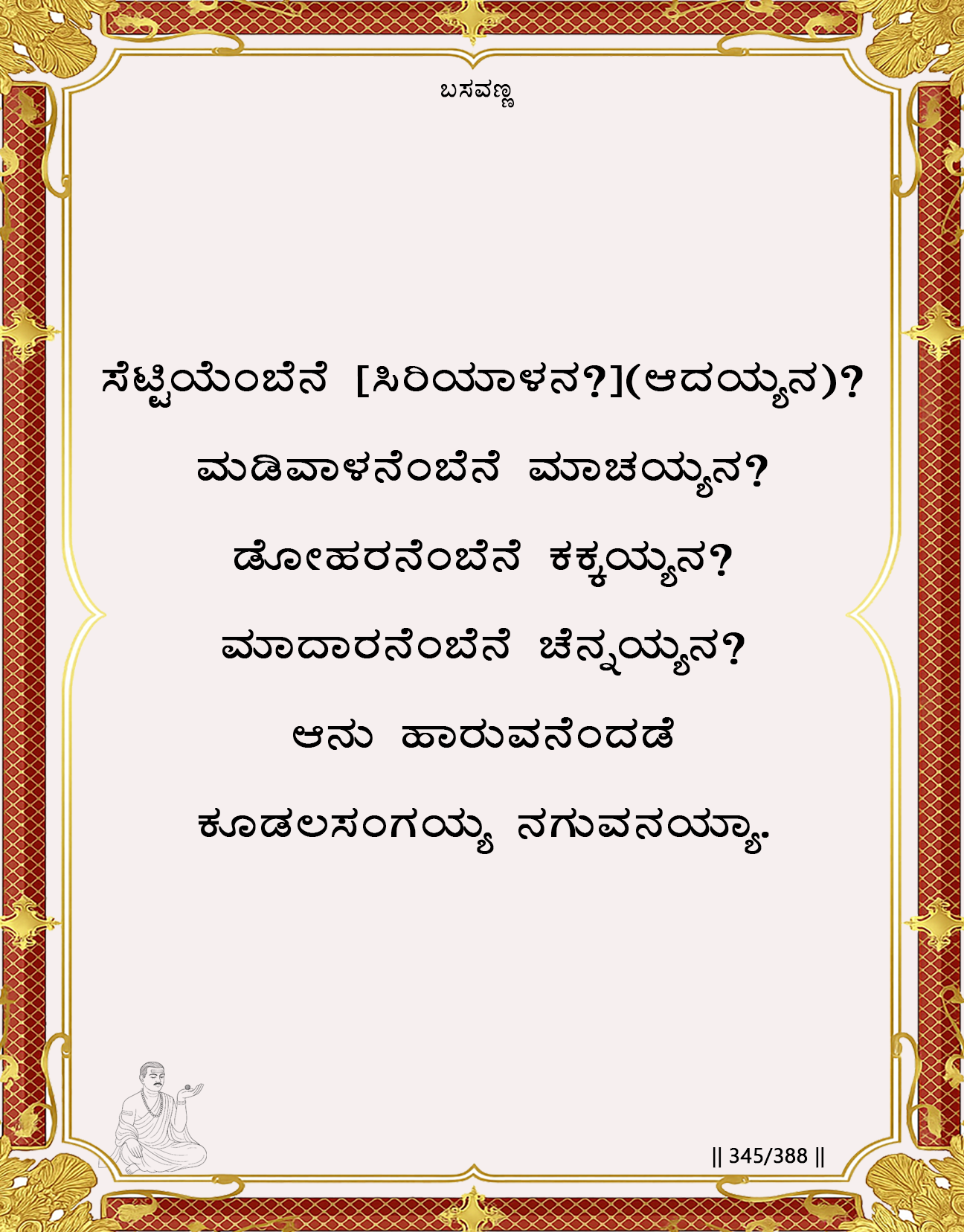
Can I call the all-embracing Siriyalaa devotee who offered even his only son
a mere merchant?
Can I call Sharana Machideva, radiant in truth, a washerman?
Can I call Sharana Kakkaya, pure as his compassion, nothing more than leather?
Can I call Sharana Chennaya, steadfast in devotion, a sandal-weaver?
But the moment I dare to call myself a Brahmin
Kudalasangama bursts into laughter.
In this vachana, Basavanna dismantles caste-based hierarchies with sharp spiritual clarity. He names four Sharanas whose outer occupations were traditionally considered “low,” yet whose inner devotion shines with supreme purity:
- Siriyala, the legendary devotee who, in obedience to a vow to Shiva, offered even the flesh of his own son to a Jangama. His story exemplifies ultimate self-surrender, unwavering faith, and unconditional hospitality.
- Machideva, admired for his humility and spiritual discipline.
- Kakkaya, whose birth in a leather-working community did not prevent him from attaining profound realization.
- Chennaya, a sandal-weaver whose devotion elevated him beyond all social definitions.
Basavanna asks: How can such realized beings be reduced to the names of their professions? And yet the punchline: If I call myself a Brahmin, God laughs. Why does Kudalasangama laugh? Because:
- Divinity does not recognize caste or birth-based hierarchy.
- Devotion, sacrifice, and truthnot line age define spiritual worth.
- Siriyala’s legendary offering stands far above any claim of ritual superiority.
- The ego that clings to caste reveals spiritual immaturity.
In the mirror of their devotion, any claim to inherited holiness becomes a cosmic joke. Basavanna shows us: True sanctity is earned through surrender, love, sacrifice, and awareness not through caste. God laughs not at the devotees, but at our delusions about ourselves.
Spiritual Context
Core Spiritual Principle: Spiritual Authority is Empirical, Not Hereditary. The worth of a soul is demonstrated through the fruits of its devotion sacrifice, integrity, wisdom, compassion not proclaimed through lineage. The community’s saints are its true canon, and their lives are the scripture that nullifies birth-based dogma.
Cosmic Reality Perspective (non-dual, Shiva-Shakti dynamics): The Shakti (devotional energy) of the Sharanaslike Siriyala’s ultimate offering was so perfectly aligned with Shiva (Divine Will) that it manifested miraculous grace. Their identities became synonymous with that unified Shiva-Shakti expression. To label them by their worldly shakti (occupation) is to miss the divine union they embodied. The ego’s claim to be a “Brahmin” is an attempt to claim a Shiva-like status (purity, authority) through stagnant social shakti, devoid of the unifying devotional offering. The laughter is Shiva-Shakti’s response to this profound disconnect.
Historical Reality (Anubhava Mantapa context): This vachana was a direct, public canonization of the Lingayoga community’s own saints. By naming Siriyala, Machideva, Kakkaya, and Chennaya, Basavanna created a new spiritual aristocracy based on verified devotion, directly challenging the Brahminical aristocracy of birth. It provided the Sangha with local, accessible heroes whose stories validated their radical social experiment. The laughter was the community’s shared, joyous rejection of the old order’s valuation system.
Interpretation
1.The Four Questions (Can I call Siriyala a merchant? Machideva a washerman?…): Each question is a deliberate provocation. The revered names (Siriyala, etc.) are spiritually potent; the occupational labels are socially reductive. The rhetorical form forces the listener to feel the dissonance, teaching that a Sharana’s identity is their spiritual legacy, not their labor.
2.The Power of Naming: By using specific names, Basavanna grounds his argument in incontrovertible community memory. These were not abstract ideals but known beings. Siriyala’s story, in particular, with its extreme devotion, sets an unsurpassable standard of spiritual merit against which birth claims wilt.
3.The Pivotal Claim: “But the moment I dare to call myself a Brahmin…”: The “I” is deliberately ambiguous it could be Basavanna himself (a born Brahmin) or any ego making a similar claim. This shifts the focus from judging others to a shocking self-critique or universal warning.
4.The Divine Response: “Kudalasangama bursts into laughter.”: The laughter here is richer than in the simpler version. It laughs at the audacity of comparing an untested, birth-based claim to the proven, sacrifice-forged divinity of the Sharanas. It is the sound of truth exposing a fraudulent currency.
The Cosmic Reality
Anga (Human Dimension): The Anga has two manifestations: the functional Anga (merchant, washerman) and the realized Anga (Siriyala, the devotee). The vachana teaches that the latter completely subsumes and redefines the former. The former is a role; the latter is an identity of consciousness.
Linga (Divine Principle): The Linga is the evaluator that recognizes and honors the realized Anga. Its laughter is the inverse of this recognition it is the rejection of the false identity that claims equivalence without the realization.
Jangama (Dynamic Interaction): The Jangama is the process of becoming a named Sharanathe journey of devotion that transforms a “washerman” into “Machideva.” It is also the community’s act of remembering and venerating these transformations, which keeps the truth alive and the divine laughter resonant.
Shata Sthala
Primary Sthala: Aikya. The vachana operates from the conclusion of Aikya. From this unified view, the societal drama of caste is seen in its full absurdity, especially when contrasted with the luminous examples of unity-consciousness embodied by the Sharanas.
Supporting Sthala: Sharana. The four exemplars are the archetypal Sharanas. Their lives define what it means to take true refuge. The vachana uses their established status to illuminate the emptiness of the counterfeit refuge of caste identity.
Practical Integration
Arivu (Awareness Practices): When encountering someone, practice seeing them as a potential “Siriyala” or “Chennaya”a being capable of sublime devotionrather than as their job title or social category. Challenge your own automatic labeling.
Achara (Personal Discipline): Let your discipline be to earn spiritual respect through the quality of your devotion, honesty, and service, not through citing your background, education, or lineage. Seek to be a living proof, not a proud claimant.
Kayaka (Sacred Action): Perform your work with such integrity and dedication that it becomes an offering that redefines the work itself, just as the Sharanas did. Let your action be your title.
Dasoha (Communal Offering): In your community, consciously celebrate and share the stories of those whose character and devotion inspire you, regardless of their status. Create a modern “roll call of saints” based on spiritual merit, not worldly achievement.
Modern Application
“Credentialism and the Cult of Pedigree.” We have replaced caste with new pedigrees: elite university degrees, corporate job titles, and social media influence. We often unconsciously grant spiritual or moral authority based on these “Brahminical” credentials rather than on the content of character or depth of wisdom.
This vachana urges us to perform a “spiritual background check” that ignores resumes and listens for the “Siriyala story”the evidence of actual sacrifice, integrity, and transformative insight. It empowers us to value the wisdom of the unknown, compassionate neighbor over the polished talk of a credentialed but unproven expert. It invites us to laugh, inwardly, at our own and others’ attachment to empty status symbols.
Essence
We name our saints: the merchant who gave his son,
The washer man whose inner light had won,
The leather-worker pure, the weaver true
Their given trades tell nothing of the You
That shone through them. Their birth-names fall away.
But let my ego in the light of day
Claim “Brahmin” as my own inherent right?
God laughsa thunderclap of gentle light
For next to their souls’ fire, so stark and plain,
My claimed inheritance is laughable vain.
This vachana applies the historical-materialist principle of “class consciousness” to spirituality, but inverts it. It posits that true spiritual consciousness arises not from one’s relation to the means of production (merchant, leather-worker), but from one’s relation to the means of grace (devotion, surrender). The “spiritual class” of Sharanas is formed by those who have seized the means of grace, transcending their economic class. The divine laughter exposes the ideological fiction of the hereditary “priestly class” (Brahmin) which claims control of grace without the requisite spiritual praxis.
Imagine a prestigious university that only admits legacy families (Brahmins). Outside its walls, a group of autodidacts, dropouts, and tradespeople (the Sharanas) make groundbreaking discoveries that change the world. The university continues to boast of its exclusive pedigree. To an observer of pure knowledge, the university’s pride is comical; the real authority lies with the discoverers, regardless of their formal tags. Basavanna points to the Sharanas and says, “These are the true discoverers. Your pedigree is a joke to the truth they embody.”
We crave both authenticity and validation. This vachana exposes the tragedy of seeking validation from broken systems (caste, status) while ignoring the authentic recognition that comes from living a life of profound integrity and love. The divine laughter is the sound of that authentic recognition, dismissing the counterfeit. It reassures us that our true worth is not assigned by society but demonstrated through the courage of our devotion, and that the ultimate community is a fellowship of such proven hearts, laughing together at the empty costumes they once wore.

Views: 1