
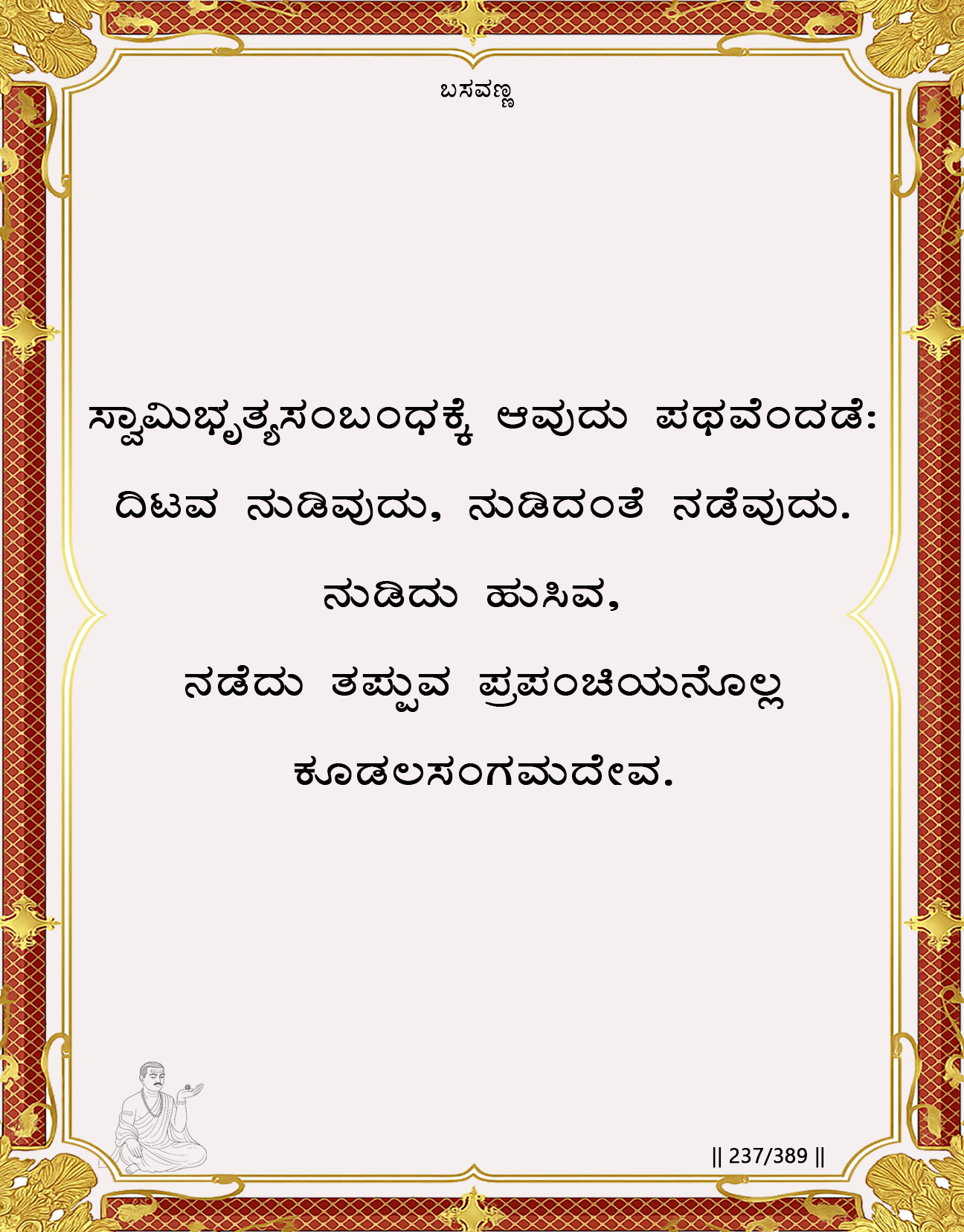
Poetic Rendering

What binds the Primordial Awareness
to this fragile vessel of flesh?
It is this alone:
that the vessel speaks only what is true,
and walks precisely the path
that its own words have declared.
But when the tongue says one thing
and the feet follow another
then the Self, the great Awareness,
finds no dwelling place in all the three worlds,
says Kudalasangamadeva.
In this vachana, Basavanna reveals the sacred contract between the Body (the vessel) and the Inner Awareness (the atman / consciousness / parashiva).This covenant is simple yet uncompromising:
The Teaching This vachana is a call to radical authenticity. Truth is not only what we say it is the alignment of our entire being. Awareness is not a concept it is a living presence that inhabits us when we are whole. The divine does not dwell in ritual or status, but in integrity of the self.
Core Insight To speak truth is good.To live the truth one speaks is divine. Only in such integrity does the Awareness choose to dwell.
Unity of Speech and Action The divine awareness resides only where there is integrity where what one speaks is what one lives. Speech is the expression of inner truth. Action is the embodiment of that truth. When the two are aligned, the vessel becomes a temple.
The Fracture of Hypocrisy But if the vessel speaks one thing and walks another path truth is broken, and the awareness withdraws. Hypocrisy is not merely a moral flaw; it is a spiritual rupture that makes the self uninhabitable for the divine.
Why the Divine Cannot Dwell There The “Self” or “Awareness” Basavanna speaks of is not an external deity. It is the luminous consciousness that dwells within the heart when: Speech is honest Action reflects intention The inner and outer selves are one Life becomes coherent, transparent, and whole Where contradiction rules, the divine spark cannot take root.
Spiritual Context
Core Spiritual Principle: Integrity is the Architecture of the Temple. The divine does not dwell in a heart or body fractured by self-contradiction. Spiritual realization is not an addition of something new, but the subtraction of all inner dissonance, creating a coherent vessel capable of hosting the Infinite.
Cosmic Reality Perspective (non-dual, Shiva-Shakti dynamics): The “Primordial Awareness” is Shivapure, silent consciousness. The “vessel” is Shaktithe dynamic energy of expression and action. For the divine play (Lila) to unfold perfectly, Shakti’s movement must be a flawless expression of Shiva’s stillness. When speech (Vak Shakti) and action (Kriya Shakti) are contradictory, Shakti is at war with herself, creating a chaotic field where Shiva (as peaceful awareness) cannot be recognized or stabilized.
Historical Reality (Anubhava Mantapa context): This vachana was the operational manifesto for the conduct of the Sharanas. In a world of ritual hypocrisy and caste-based double standards, the Anubhava Mantapa community was to be a living experiment in absolute integrity. A Sharana’s word was their bond; their teaching was their life. This unimpeachable congruence was their spiritual authority, making them a collective “dwelling place” for the divine and granting their social revolution unassailable moral force.
Interpretation
1.”What binds the Primordial Awareness to this fragile vessel of flesh?”: This opening question frames the human condition as a potential hosting of the Absolute. The “bind” is not a chain but a covenant of coherence.
2.”It is this alone: that the vessel speaks only what is true…”: “Truth” here is not factual accuracy but satya the authentic expression of the deepest realized understanding. It is speech free from egoic manipulation or social pretense.
3.”…and walks precisely the path that its own words have declared.”: This is the crux. Action (kriya) must be the literal, physical enactment of the expressed truth (vak). The “walk” is the proof of realization, the test of the teaching.
4.”But when the tongue says one thing and the feet follow another…”: This describes the state of avidya (ignorance) or self-betrayal. It is the fragmentation of the being into conflicting parts, a living lie.
5.”…then the Self, the great Awareness, finds no dwelling place in all the three worlds…”: The consequence is not punitive but ontological. A house divided against itself cannot stand, nor can it host a guest of peace. The “three worlds” signify all states of existence; nowhere in that fractured psyche can unified consciousness find a stable home.
The Cosmic Reality
Anga (Human Dimension): The Anga is a resonator. When its components (thought, word, deed) vibrate in harmony, it produces a clear tone that attracts and holds the frequency of the Divine. When they are discordant, it produces only noise.
Linga (Divine Principle): The Linga is the pure, unwavering tone of reality itself. It can only resonate sympathetically with a vessel that can match its constancy. It does not “choose” to leave; it simply cannot be heard or felt amidst the dissonance.
Jangama (Dynamic Interaction): The Jangama is the continuous tuning of the instrument. It is the daily, hourly practice of adjusting one’s actions to match one’s words, and refining one’s words to match one’s deepest knowing. This tuning is the spiritual practice.
Shata Sthala
Primary Sthala: Maheshwara. The vachana is a blueprint for the Maheshwara, the stage of “inner greatness.” This greatness is forged in the fire of this very covenant: the relentless pursuit of personal integrity where no gap exists between principle and practice.
Supporting Sthala: Aikya. The fruit of perfect integrity is Aikya. When the vessel’s expression is wholly non-contradictory, the seeker realizes there was never a separate “vessel” and “indweller” only the single, undivided reality expressing itself flawlessly.
Practical Integration
Arivu (Awareness Practices): Practice the “pause of alignment.” Before speaking or acting, create a moment of silence to ask: “Is this an expression of my deepest truth? Can I embody this fully?” After speaking, use it as a vow: “Now I must walk this path.”
Achara (Personal Discipline): Make your primary discipline the auditing and closing of integrity gaps. Start small: if you say you will meditate for 10 minutes, do it. If you speak of compassion, enact it in a difficult interaction. Let your life be a closed circuit of truth.
Kayaka (Sacred Action): Let every act be a fulfillment of a prior truthful intention. See your work as the embodied proof of your values. If your work contradicts your core truths, have the courage to reform the work or change it.
Dasoha (Communal Offering): Foster a community of gentle, compassionate accountability. Help each other see and close integrity gaps without judgment. Create a culture where a person’s word is their bond, and where living one’s truth is the highest form of service.
Modern Application
“The Performance of Self.” In the age of social media, personal branding, and virtue signaling, we are experts at curating a “truth” we proclaim while our actions often follow a different, unseen algorithm of convenience, fear, or desire. This creates profound internal fragmentation, anxiety, and a sense of spiritual homelessness.
This vachana is an antidote to performative living. It commands: Stop performing. Start embodying. It urges a radical audit of life from social media posts to daily habits to eliminate contradictions. It validates the profound peace that comes from making one’s external life a simple, transparent reflection of one’s inner compass, creating a “dwelling place” for authentic peace and power.
Essence
The Self seeks a home, a temple clear and plain,
Not built of stone, but of a truth sustained.
The mortar for its walls is this alone:
The spoken word, by faithful action, shown.
But if the lips profess what feet deny,
The sacred architect will pass on by.
For heaven cannot rest in shifting ground,
Where what is said and what is done are sound
And echo, mismatched, in a hollow shell
A house where no divine awareness dwells.
This vachana illustrates the cybernetic principle of integrity in complex systems. For a system (the human being) to maintain homeostasis and function optimally, its subsystems (belief, communication, action) must be in feedback alignment. Dissonance creates internal “error signals” (shame, anxiety) and prevents the system from achieving a higher-order state (self-realization). The “Primordial Awareness” is the system’s highest possible ordered state. Integrity is the necessary negative feedback loop that corrects deviations and allows the system to stabilize in that state.
Imagine a choir. For a beautiful, unified sound (the divine harmony) to emerge, every singer must sing the same note in tune. If one singer loudly professes to sing a C but actually sings a F (hypocrisy), it creates discord that ruins the entire chord. The conductor (Awareness) cannot manifest the intended harmony through that choir. The singer must either truly sing the C or honestly change their professed note. Only then can the music flow.
We suffer not from a lack of spiritual experience, but from the exhausting burden of maintaining multiple, conflicting versions of ourselves. This vachana points to the profound relief of singularity of being one person, whole and undivided. It teaches that the awe we seek in spiritual experiences is already present in the awe-inspiring simplicity of a life where nothing is hidden, and every action rings true to the deepest note of our being. The covenant is not with a distant god, but with our own potential for wholeness.

Views: 2