Poetic Rendering

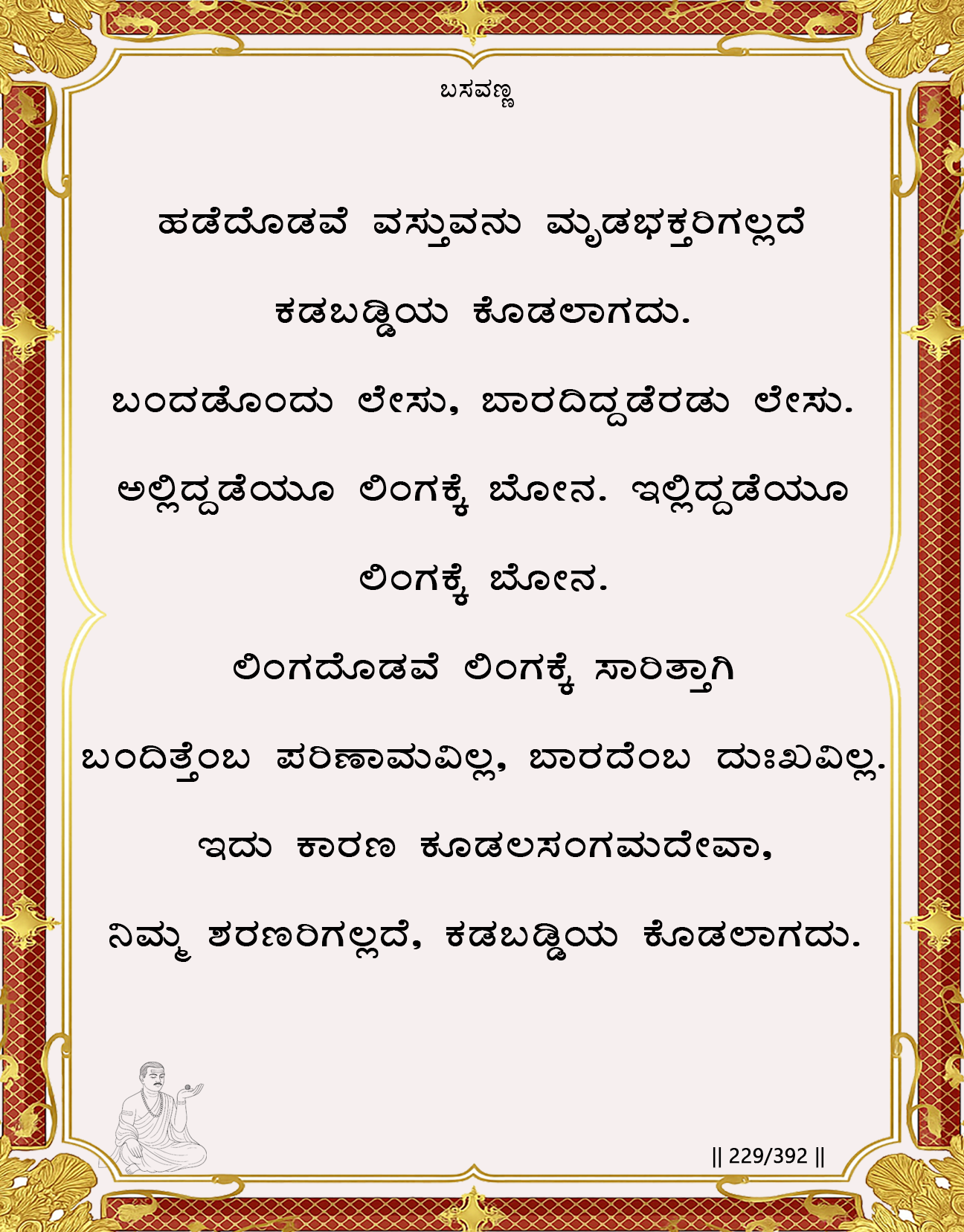
All that appears to be “mine” in this world
lands, goods, wealth, and things acquired
are, in truth, held only in trust
for the children of Shiva, the Sharanas.
If such things come to me unaskedgood.
If they do notgood still.
If they lie within the reach of another,
let them be for the all-pervading Linga.
Even if they lie within my very hand,
they are meant only as an offering to the Linga.
Whether these things fall into my possession
or pass beyond it
neither binds me, nor stirs resentment in me.
For this reason, O Kudalasangamadeva,
all that exists is for Your Sharanas alone.
Nothing may be claimed, hoarded, or consumed
for personal gain or pride.
In this vachana, Basavanna teaches a radical and liberating spiritual principle:
Nothing truly belongs to us. All possessions are divine resources entrusted for divine purpose. The Final Insight He concludes: Everything exists only for God and God’s devotees. Nothing may be used for selfish gain. This overturns worldly hierarchy and places devotion above possession, service above ownership, and inner freedom above material accumulation. Possession Is Only Custodianship Basavanna says that everything we think we “own” land, wealth, materials, honors are actually the property of Shiva’s devotees, the Sharanas. This means they are meant to serve the spiritual community, not the individual ego. Acceptance Without Clinging He teaches a profound equanimity:
• If something comes to us good.
• If it doesn’t good still.
Value does not come from having or not having, but from freedom from craving and complaint. Nothing Is for Personal Enjoyment Even if wealth is literally in our hands, it remains dedicated to the Linga, the divine presence permeating all existence. Whether we possess or lose something should not disturb our peace, because possession is not ownership, and loss is not deprivation. The Divine Economy Basavanna presents a spiritual “economy” based not on accumulation, but on sharing, service, and surrender. True wealth is measured not by what we keep, but by what we do not claim.
Spiritual Context
Core Spiritual Principle: True non-possession (Aparigraha) is not poverty but a state of conscious, joyful trusteeship. Freedom is found not in having or not having, but in being utterly disidentified from the concept of “mine,” thereby becoming a clear channel for divine resource flow.
Cosmic Reality Perspective: In the non-dual reality of Shivayoga, all manifestation (Shakti) is the expressive property of Consciousness (Shiva). To claim “this is mine” is a fragmentation of that unity. The vachana operationalizes non-duality: seeing the Linga in all, one offers all to the Linga, thus maintaining the integral flow of Shiva-Shakti without the block of egoic ownership.
Historical Reality (Anubhava Mantapa Context): This vachana is the constitutional doctrine of the Anubhava Mantapa’s socio-economic experiment. As treasurer, Basavanna applied this to state economics, creating systems where wealth was dasoha (community offering), not svamitva (private property). It directly challenged feudal and Brahminical models of accumulation and hereditary ownership, framing the entire community as “children of Shiva” entitled to the resources held in trust.
Interpretation
1.”All that appears to be ‘mine’… are held in trust for the children of Shiva.” This severs the root of ahamkara (ego) and mamata (mine-ness). The “trust” implies duty, responsibility, and temporary stewardship, erasing the illusion of permanent, self-serving ownership.
2.”If such things come to me unasked good. If they do not good still.” This defines supreme equanimity (samatvam). The Self (Anga anchored in Linga) is established as prior to and unaffected by the comings and goings of worldly objects (vishaya). This is the state of being atmanitya (established in the Self).
3.”If they lie within the reach of another… even if they lie within my very hand, they are meant only as an offering to the Linga.” This collapses the distinction between self and other. The “other’s” possession is also Linga’s property. The “my hand” is merely the current locus of the offering. This is the practical application of seeing the one Linga in all Jangamas.
4.”Whether these things fall into my possession or pass beyond itneither binds me, nor stirs resentment.” This indicates liberation from the dualistic karmic bonds of attachment (raga) and aversion (dvesha). One is free from the sukha-duhkha (pleasure-pain) cycle related to gain and loss.
Practical Implications: One must audit one’s relationship with every resource time, money, talent, property. Each must be re-framed: “This is not mine. This is a resource of the Linga, currently passing through me. How can it best serve the community of seekers (Sharanas)?” This transforms consumption into offering, hoarding into distribution, and anxiety into peace.
The Cosmic Reality
Anga (Human Dimension): The human as accountable trustee. The Anga’s role is to manage resources with utmost integrity, skill (Kayaka), and generosity (Dasoha), knowing it will be held to account by the divine principle (Linga) for its stewardship.
Linga (Divine Principle): Koodalasangamadeva as the sole proprietor. The Linga is the source, the sustainer, and the ultimate consumer (in the form of service to all). All transactions are, in truth, movements within this singular divine economy.
Jangama (Dynamic Interaction): The ceaseless circulation of energy, wealth, and grace among the Sharanas. This is the visible expression of the Linga’s economya flowing, living system of Dasoha where need is met without transaction, because all recognize the common owner.
Shata Sthala
Primary Sthala: PRASADI. This is the quintessential stage of Prasadi, where the devotee receives everything as prasada (sacred offering). Here, Basavanna expands the concept: not just ritual food, but all wealth and possessions are prasada. The Prasadi’s duty is to receive it gratefully and share it completely, without generating a “personal account.”
Supporting Sthala: MAHESHWARA. The Maheshwara stage is characterized by intense moral effort and the destruction of impurities. The vachana supports this by providing the key practice to destroy the impurity of greed and possessiveness: the conscious re-framing of ownership into trusteeship. It is the achara (discipline) that purifies the Maheshwara’s relationship with the material world.
Practical Integration
Arivu (Awareness Practices): Meditate on the path of a single rupee or morsel of food: from earth/source, through many hands, to you. See it not as “your” salary or “your” food, but as the Linga’s energy taking a temporary form in your custody. Contemplate the peace of “no-claim.”
Achara (Personal Discipline): Institute a personal “Dasoha percentage”a minimum portion of income/time/resources that is designated in advance as not yours, to be shared without fanfare. Practice saying inwardly, “This is for the Linga in that person/situation,” whenever you give.
Kayaka (Sacred Action): Perform your work as an act of returning energy to the divine economy. The profit or output of your Kayaka is not your trophy but the Linga’s capital, to be reinvested in the community’s well-being.
Dasoha (Communal Offering): Actively create or participate in systems that embody this trust community kitchens, skill-shares, collective resources where the focus is on need and service, not exchange or debt.
Modern Application
Hyper-capitalism and consumer identity are built on the intensified notion of “mine.” Climate crisis, wealth inequality, and psychological anxiety are direct results of violating this vachana’s principle. “Personal branding” and “self-optimization” are spiritual diseases of misappropriating the Linga’s resources for the Anga’s aggrandizement.
Embrace the concept of “circular stewardship” over linear ownership. Apply it to data, intellectual property, and environmental resources. Find freedom in subscription/access models over possessive accumulation. Cultivate contentment by seeing your salary as the Linga’s trust fund for you to manage wisely for the benefit of all life, reducing personal financial anxiety. This is the basis for ethical entrepreneurship and regenerative economics.
Essence
What comes, is Grace’s hand.
What goes, is Grace’s command.
In mine or yours, the same Light stands.
No ledger kept, no claim, no lands
Just the endless giving,
from the One’s open hands.
This vachana describes the quantum economics of consciousness. Particles (resources) do not have a definite location (“mine” or “yours”) but exist in a superposition of potential service to the whole field (the Linga). The observer (the ego) collapses this wave function into “ownership,” creating entanglement (karma) and scarcity. The Sharana, as a conscious trustee, maintains the resource in its super positional stateable to be utilized wherever the wave function of need collapses within the community, without decoherence into personal lack or greed.
Imagine a village with one common water well. A selfish person builds a private fence, hoards buckets, and suffers anxiety about theft. A Sharana, following this vachana, sees themselves as the well’s temporary caretaker. Their joy is in keeping it clean and helping everyone draw water. They drink when thirsty but feel no more ownership of the water in their cup than of the air in their lungs. The well is the Linga; the community are the Sharanas.
Our deepest insecurity is scarcity the fear of “not enough.” This vachana attacks that fear at its root by revealing that our sense of “self” is too small. When we identity with the small, separate Anga, resources seem limited. When we identity with the flow of the whole (Linga/Jangama), we see we are sustained by a boundless economy. The peace offered is the relief from the exhausting full-time job of being “me, the owner and defender of my stuff.” It is the truth that you are not the manager of a fragile warehouse, but a grateful participant in an abundant, flowing universe.

Views: 0