Poetic Rendering

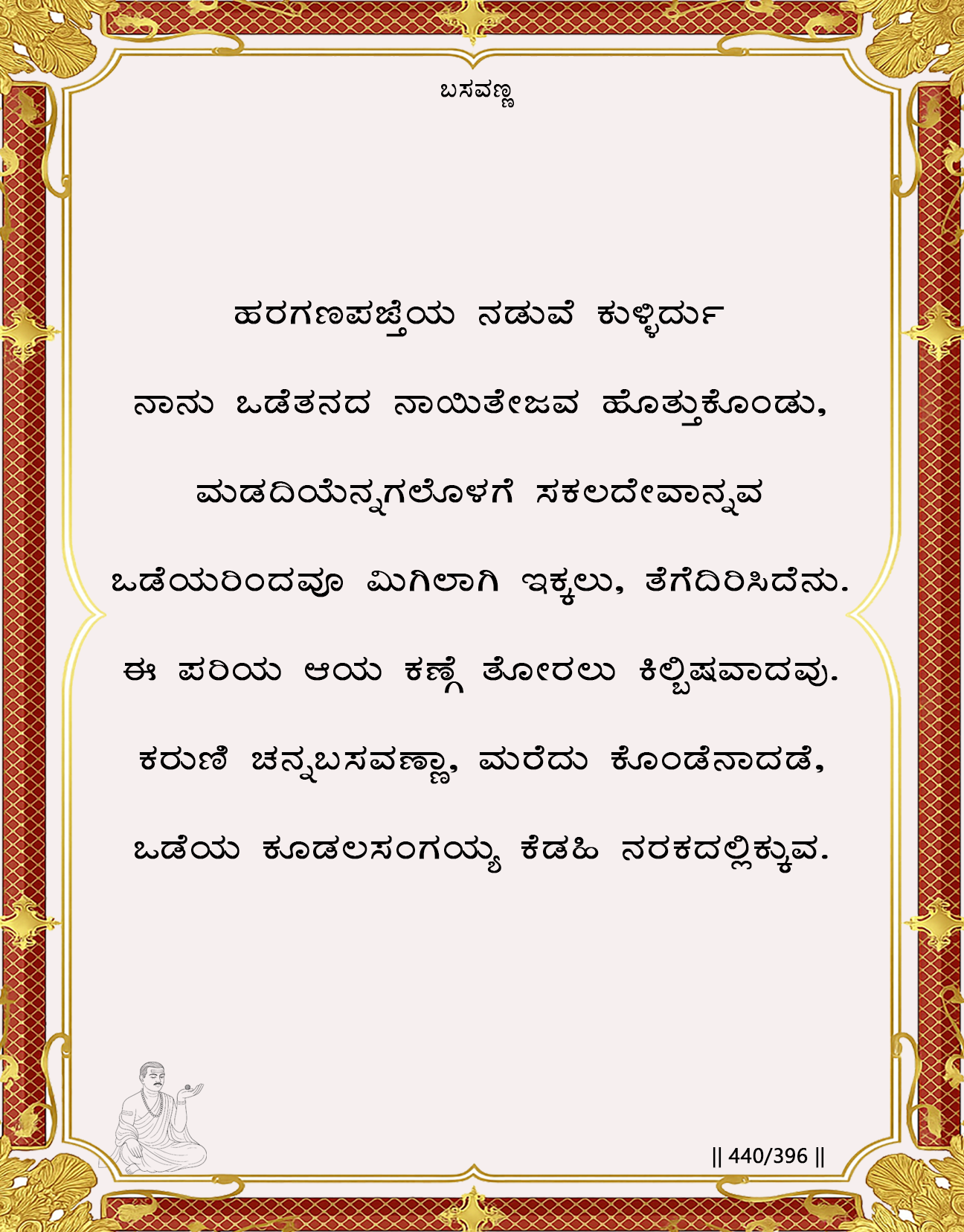
Sitting among Shiva’s own companions,
I let arrogance cling to me
like a famished dog guarding its morsel.
My beloved, bound to me in private affection,
filled my plate alone,
forgetting the Sharanas who stood waiting.
Food served in a vessel tainted with greed
turns to poison, leaching the vessel itself.
If ever I forget You, O compassionate Chennabasavanna,
my Kudalasangama
I will tumble headlong
into the hell I have made with my own hands.
In this powerful vachana, Basavanna exposes a subtle yet devastating truth: spiritual privilege becomes poison when hoarded. Core Insight This vachana teaches:
• Spiritual blessings are entrusted, not owned.
• What we keep for ourselves decays.
• What we share becomes sacred.
The divine current is meant to circulate, not stagnate. Only the humble vessel remains pure. The Setting: Divine Company Misused The opening scene shows Basavanna seated among Shiva’s hosts a metaphor for being surrounded by divine grace, spiritual opportunity, and the company of holy beings. Yet even in this exalted setting, he admits:
• ego creeps in,
• arrogance attaches,
• self-importance arises.
The image of a greedy dog guarding its food is deliberately harsh Basavanna spares no softness in criticizing his own lapse. The Private Favor That Becomes a Sin His companion beloved/wife/devotee) serves food only to him, moved by love, loyalty, or habit. But by favoring him alone, she unintentionally violates the sacred principle of dasoha:
• Food meant to be shared with the community of Sharanas
• becomes a private possession.
This turns a loving act into spiritual harm. The Copper Vessel Metaphor Basavanna invokes a precise and ancient image: Food stored in a copper vessel turns toxic if it lies too long. The poison is not in the food it is in the vessel. Likewise:
• The grace he receives remains pure.
• But his heart, momentarily stained with possessiveness,
corrupts it. Selfishness is the contaminant that leaches poison into the soul. The Hell We Create Basavanna declares that if he forgets Chennabasavanna even for a moment he will fall into: the hell of his own making. This hell is:
• not an external punishment,
• not divine anger,
• but the inevitable consequence of a heart that withholds what should flow freely.
When grace is hoarded, it rots. When devotion becomes private property, it corrupts.
Spiritual Context
Core Spiritual Principle: Grace (prasada) is dynamic energy. Its nature is to flow. When intercepted and held in the stagnant vessel of a possessive ego, a chemical reaction of corruption occurs: the grace turns to poison (visha), and the ego-vessel is leached and damaged. Spiritual safety lies only in continuous, selfless circulation.
Cosmic Reality Perspective: In Shivayoga’s non-dual flow, Shiva is the source, Shakti is the distributing energy, and the world is the field of circulation. The individual (Anga) is meant to be a transparent node in this network. Arrogance (abhimana) creates a dam in this network. The dammed Shaktino longer flowing as gracebecomes a destructive pressure that erodes the dam (the separate self) from within.
Historical Reality (Anubhava Mantapa Context): This is Basavanna’s intimate governance manual for the Anubhava Mantapa. As the community’s leader and treasurer, he publicly confesses a leadership failing: accepting special treatment. He models radical accountability to uphold the foundational rule of Dasoha. The vachana served as a living check against the spiritual aristocracy and guru-worship that could destroy the egalitarian community from within.
Interpretation
1.”Sitting among Shiva’s own companions, I let arrogance cling to melike a famished dog guarding its morsel.” The highest spiritual environment (satsangha) does not automatically immunize against ego. The ego’s most insidious form is spiritual privilegethe sense of being a special recipient. The “famished dog” image reveals this arrogance as a state of poverty, not wealth; a shrill, protective lack, not a serene fullness.
2.”My beloved… filled my plate alone, forgetting the Sharanas who stood waiting.” Private love, when it violates communal sanctity, becomes a spiritual error. The act of separating one’s offering from the collective stream is the moment the vessel is contaminated. Love must be expansive to remain pure.
3.”Food served in a vessel tainted with greed turns to poison, leaching the vessel itself.” This is the core spiritual chemistry. The “food” is grace. The “greed” is the contaminant (mala). The reaction produces “poison” (karmic binding, inner corruption). The “leaching” is the process where this poison dissolves the integrity of the soul-vessel, making it unfit to hold grace.
4.”If ever I forget You… I will tumble headlong into the hell I have made.” “Forgetting” is the switch from circulation to hoarding. The “hell” is not externally imposed; it is the internal state of toxicity, isolation, and spiritual corrosion that is the inherent consequence (svabhava-niyama) of the hoarding action itself.
Practical Implications: One must institute a “spiritual hygiene” practice for all forms of reception praise, wealth, insight, affection. The moment something is received, the mind must immediately ask: “How does this serve the whole? How can I share this?” Stagnant receiving must be viewed with the same urgency as detecting a poison.
The Cosmic Reality
Anga (Human Dimension): The human as a biochemical vessel. Its composition (copper = the sattvic but malleable mind) can be noble, but it is reactive. Its health depends entirely on what it holds and for how long. The Anga’s purpose is to be a clean, transmitting pipe, not a storage tank.
Linga (Divine Principle): Koodalasangamadeva as the infinite, nourishing source. The Linga’s nature is effulgent giving. It does not cease to be grace when received; its transformative or destructive potential is determined entirely by the dynamics of the vessel that receives it.
Jangama (Dynamic Interaction): Chennabasavanna as the functional law of flow. This is the Jangama principle applied to energy: keep it moving. The waiting Sharanas are the immediate field for this flow. The Jangama force is what corrects stagnation, re-establishing circulation before leaching begins.
Shata Sthala
Primary Sthala: PRASADI. This vachana is a master text on the Prasadi stage. It defines the stage’s central peril: mis-handling the prasada. True Prasadi is defined not by the act of receiving, but by the flawless, immediate transmission of what is received. Failure here causes a regression, poisoning the progress made.
Supporting Sthala: MAHESHWARA. The Maheshwara stage involves the burning away of impurities. The “greed” and “arrogance” described are the precise impurities (mala) that the Maheshwara’s fiery discipline must annihilate. The vachana provides the discernment to identify these impurities in their subtlest form spiritual selfishness.
Practical Integration
Arivu (Awareness Practices): Cultivate “flow-awareness.” In meditation, visualize grace as light or water flowing in through the crown, filling the heart, and flowing out through the hands and feet to all beings. Identify and release any internal “knot” or “dam” that wants to capture and hold the light for “me.”
Achara (Personal Discipline): Practice nishkama dana: giving without a trace of thought for reward, recognition, or even the spiritual merit of giving. Make sharing automatic, immediate, and joyfully anonymous where possible.
Kayaka (Sacred Action): Ensure the fruits of your labor are distributed beyond your personal needs. Let your profession include an inherent element of Dasohaa percentage, a service, a training shared freely. Never let profit accumulate without purposeful, compassionate outflow.
Dasoha (Communal Offering): Be the one who remembers the “waiting Sharanas.” In any setting, look for those excluded from the flow of resources, attention, or care, and actively work to include them. Challenge private favors that undermine communal equity.
Modern Application
The “influencer” culture hoarding attention; closed proprietary knowledge in academia and technology; billionaires accumulating wealth beyond any possibility of circulation; spiritual teachers building empires around their personal brand. Ecological “hoarding” through pollution and resource extraction is the planetary-scale leaching of the collective vessel.
Champion open-source systems, universal basic services, and gift-economy models. In personal life, practice “digital Dasoha”share knowledge freely. Support cooperative and regenerative economic structures. Spiritually, follow teachers who empower you to find the source yourself, rather than creating dependency on their exclusive channel.
Essence
Even at the feast of the Divine,
A shadow clingsthe thought “This mine.”
The grace that flows, if made to stay,
Corrodes the vessel, turns to decay.
The only law that keeps the cup whole:
To let the endless river of the Soul
Flow through, not in; to give, not keep
Or in the hell of our own making, weep.
This vachana outlines the spiritual thermodynamics of consciousness. Grace is high-potential energy. The individual consciousness is a system. The Second Law of Thermodynamics (entropy) applies: in a closed system (the hoarding ego), useful energy (grace) inevitably degenerates into disordered, toxic energy (poison/karmic binding). The only way to maintain the system’s purity is to keep it open allowing energy to flow through continuously, performing work (service, compassion) as it passes, thereby increasing the order and integrity of the larger system (the community, the cosmos). The “leaching” is the increase in spiritual entropy within the closed system of the self.
Imagine your heart is a cup. Fresh water (grace) is poured in. If you immediately drink and share it, the cup stays clean and useful. If you seal the cup and store the water, it stagnates, grows algae, and eventually rots the cup from the inside. Basavanna says even being at the divine spring doesn’t help if you have a sealed cup. The act of sharing is the act of keeping the cup clean and connected to the spring.
We are biologically and psychologically tuned for scarcity, which breeds hoarding. Spirituality confronts this with the truth of abundance, which requires sharing. Our deepest fear is “if I give, I will have less.” This vachana reveals the counterintuitive cosmic law: “if you keep, you will become less.” The poison is not in the blessing, but in the clenched fist that refuses to let it go. Liberation is the profound relaxation of that fist, discovering that your hand is most itself not when it is full, but when it is open, both giving and receiving in the same motion.

Views: 0