Poetic Rendering

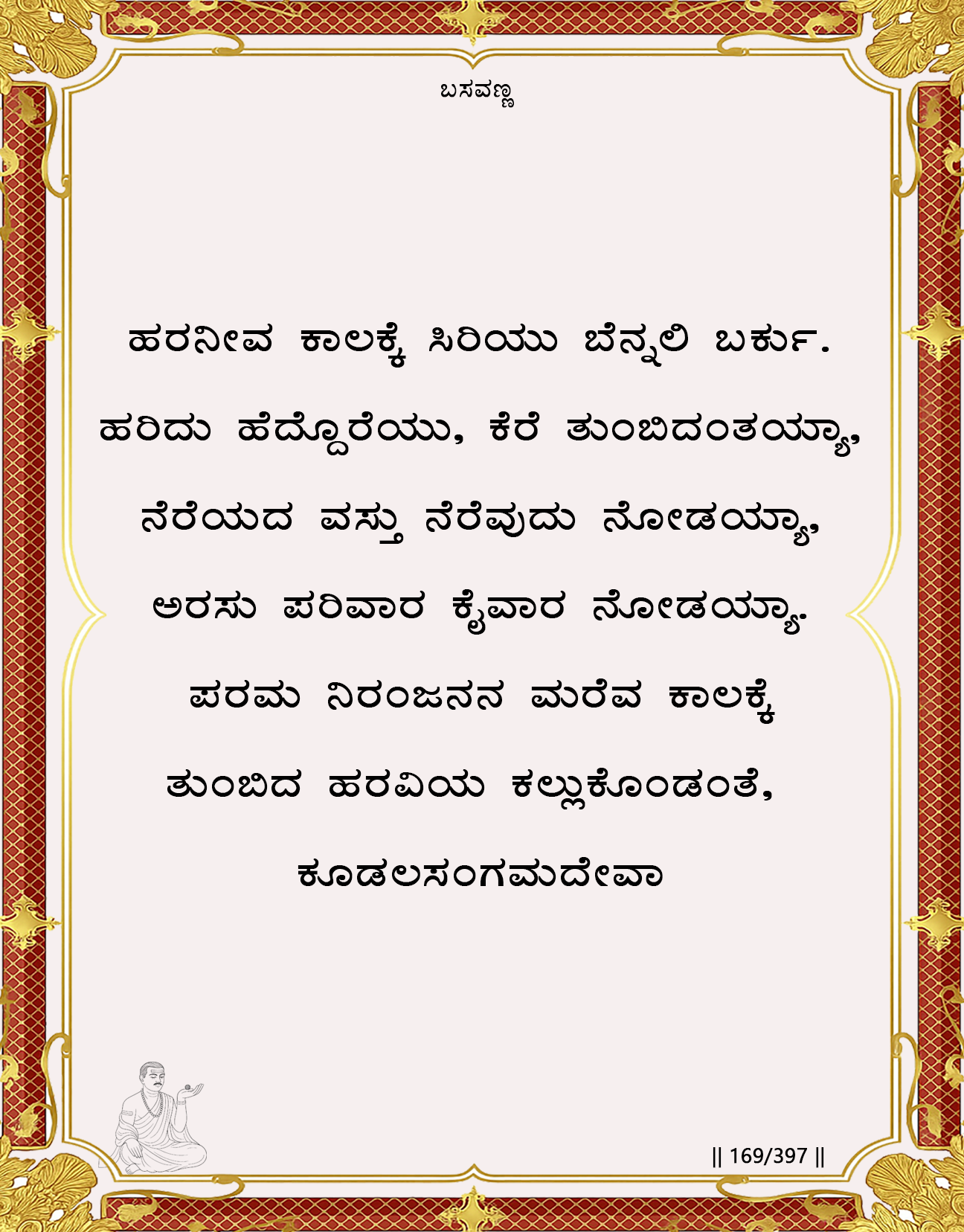
When a flood rolls forward with fortune on its back,
the lakes beside it brim to their edges.
What belongs to another remains theirs
not even kings or clans can claim its course.
But the moment one forgets Niranjana,
the Stainless One who
gives without trace or residue,
the heart becomes like a clay
pot struck by stone
shattered by its own brittleness.
Such is the destiny of those who hoard grace
instead of letting it flow in its natural generosity,
says my Lord Kudalasangama.
(Nir = without, Anjana = stain; Niranjana = the One without blemish.)
The Two Faces of Abundance Basavanna reveals a deep spiritual law by comparing prosperity to a swelling river. When abundance flows freely like a flood nourishing even the lakes on its banks it benefits all around. This symbolizes true prosperity: wealth, ability, or divine grace that circulates in harmony with dharma and dasoha. But the moment ego asserts ownership claiming what is not rightfully one’s own or forgetting that all gifts come from the Stainless One, Niranjanaabundance becomes destructive. Like a clay pot struck with a stone, the ego collapses under the pressure of its own greed and forgetfulness. The message is clear and elemental: Prosperity remains whole only in remembrance of the Divine. When claimed by the ego, it becomes the seed of one’s downfall. Thus, Basavanna measures wealth not by accumulation but by conductivity how gracefully it flows through the individual to the world, free from claim, stain, and self-centeredness.
Spiritual Context
Core Spiritual Principle: Remembrance (smriti) of the Stainless Source (Niranjana) is the sole foundation that allows abundance to be a blessing. Forgetfulness (vismriti) is the active impurity that transforms blessing into curse. The quality of reception determines the consequence of the gift.
Cosmic Reality Perspective: In the non-dual Shivayoga view, Shiva (as Niranjana) is pure consciousness without attribute or need. The “flood” is the spontaneous overflow of Shakti from this plenitude. When the individual consciousness (Anga) reflects this stainlessness, it becomes a transparent medium. When it imposes the stain of “I” and “mine,” it creates a locus of tension that the cosmic flow must resolve, even if through dissolution.
Historical Reality (Anubhava Mantapa Context): This vachana was a radical economic and theological directive for the Sharana republic. Against the feudal “stain” of hereditary ownership and ritualistic transaction, Basavanna posited Niranjanaa deity without need for exchange, mirroring the ideal human as a vessel without greed. The community’s economy of Kayaka and Dasoha was designed to mimic this stainless flow, where wealth moved without accumulating the residue of personal power or social debt.
Interpretation
1.”When a flood rolls forward with fortune on its back, the lakes beside it brim to their edges.” This is the cosmology of grace. Abundance is not a discrete object but a rising energy field. The “lakes” represent all interconnected beings within the field. True reception automatically implies redistribution; to be filled is to overflow. This is the law of an unstained system.
2.”What belongs to another remains theirs not even kings or clans can claim its course.” This asserts a karmic and divine sovereignty that transcends human power structures (“kings or clans”). It is a warning against the fundamental spiritual error of atma-samarpana (offering of another’s soul/property). All fortune follows its own divine logic; egoic claim is a futile fiction.
3.”The moment one forgets Niranjana… the heart becomes like a clay pot struck by stone.” This is the precise mechanics of spiritual corruption. “Forgetting” is the act of applying the stain of separateness to the stainless. The heart, meant to be soft earth (capable of becoming a lake), is “fired” in the kiln of ego into a hard, defined pot. The “stone” is the relentless truth of the ongoing floodthe reality of Niranjana’s unstoppable giving. The encounter between rigid claim and relentless flow ends in the shattering of the claim.
Practical Implications: One must practice “stainless reception.” Upon receiving any benefit, immediately perform a mental triple offering: 1) Acknowledge Niranjana as source, 2) See the community (the “lakes”) as co-inheritors, 3) Dedicate the benefit for collective uplift. This mental ritual prevents the firing of the clay.
The Cosmic Reality
Anga (Human Dimension): The human as ethical topography. The spiritual choice is to be a depression (a lake, which receives by virtue of its lowliness and shares by virtue of its connection) or to be a fired artifact (a pot, which is lifted above the ground, defined by its boundaries, and ultimately fragile).
Linga (Divine Principle): Koodalasangamadeva as Niranjana the “Stainless One.” This key term shifts the conception of God from a transactional deity to a principle of pure, unattributed giving. The Linga is not a being who gives; it is the giving itself, without motive, memory, or residue.
Jangama (Dynamic Interaction): The floodwater and the stone as two aspects of the same Jangama force. The water is Jangama as nourisher; the stone is Jangama as destroyer of obstacles to nourishment. Both serve the same purpose: to ensure the landscape aligns with the law of flow.
Shata Sthala
Primary Sthala: PRASADI. This vachana is the ultimate scripture for the Prasadi stage. It defines the core competency of this stage: to receive prasada in the mode of Niranjana. The Prasadi is one who has internalized that any “stain” of possessiveness will turn the grace to poison. Their spiritual expertise is in flawless, instantaneous distribution.
Supporting Sthala: AIKYA. The state of non-dual union. “Forgetting Niranjana” is the description of falling from Aikya. The “clay pot” is the symbolic form of the separate self that re-forms in that forgetfulness. The vachana explains why the realized being cannot hoard: to do so would be to spontaneously manifest a separate self, which would then be instantly shattered by the reality of the unity they still inhabit.
Practical Integration
Arivu (Awareness Practices): Meditate on the concept of Niranjana. Contemplate giving without a trace of thought for reward, recognition, or even the identity of “giver.” Then, reverse the meditation: contemplate receiving in the same way without a trace of claim, pride, or fear of loss.
Achara (Personal Discipline): Adopt the discipline of “immediate dasoha.” When a resource comes, let the first act be to share a portion before attending to personal need. This enacts the “overflow to the lakes” as a physical ritual, training the mind in stainless reception.
Kayaka (Sacred Action): Let your work be judged by its conductivity. Does it create more dams, pots, and kings? Or does it create more channels, lakes, and shared fertility? Choose projects that increase the flow of value to the commons.
Dasoha (Communal Offering): Build systems that are inherently stainless. Anonymous giving, collective ownership models, and open-source knowledge are structural expressions of Niranjana-consciousness, designed to minimize the “stain” of egoic attachment in both giver and receiver.
Modern Application
Capital as a Stain. The modern economy is built on the accumulation and interest-bearing ownership of capital the ultimate “stain” of claiming ownership over a flow. “Intellectual property” is a legal clay pot. The environmental crisis is the shattered landscape resulting from humanity’s collective “forgetting of Niranjana,” treating nature’s flow as a hoard able commodity.
Champion post-ownership models: stewardship, usership, and access-over-ownership. Support regenerative economics that mimic ecological flows. Personally, cultivate “wealth conductivity” by measuring net worth not by assets held, but by value circulated. Spiritually, reject any theology that portrays God as keeping accounts; embrace the God of Stainless Giving (Niranjana) as the model for your own life.
Essence
The flood is pure, a stainless tide,
That fills the lakes from side to side.
But build a pot of “I” and “me,”
A vessel of claimed identity,
The flow that fed will strike like stone
And break the shell that stood alone.
Be not the pot, so hard and defined,
But be the lake, to all aligned.
This vachana describes the spiritual principle of superconductivity. Niranjana represents the state of zero resistance (zero “stain”). The flood of grace is a current of high-potential energy. The human consciousness can be in two states: 1) A superconductive state (remembrance), where it offers no resistance to the flow, allowing energy to pass without loss, creating a field that elevates all nearby systems (the lakes). 2) A high-resistance state (forgetfulness), where the “stain” of ego creates intense localized resistance. Energy transfer halts, causing catastrophic breakdown (shattering) at the point of resistance. The law is thermodynamic: the system moves toward equilibrium, and obstacles to equilibrium are removed.
Imagine a network of crystal-clear pipes (the community) connected to a spring (Niranjana). If you are an open section of pipe, water flows through you to everyone. If you clamp a section shut (hoarding), pressure builds. The system’s integrity demands either that the clamp opens or that the clamped section bursts. Basavanna says: you are not the owner of the water in your pipe segment. You are the pipe. Your purpose is to be open. The moment you think you’re a closed tank, you fail at your purpose and are removed from the system.
We are biologically and culturally programmed for scarcity, which teaches us to be pots to define, hold, and protect. This vachana calls us to the terrifying, liberating truth of abundance: our security lies in vulnerability (being a lake) and connectivity, not in hardness and separation. It confronts the deepest fear: “If I don’t claim it, I will lose it.” The revelation is: “Only by not claiming it do you truly have it, for you become one with the endless source.” The liberation is from the exhausting, fragile project of being a pot, into the peaceful, resilient reality of being a landscape nourished by and nourishing the whole.

Views: 0