Poetic Rendering

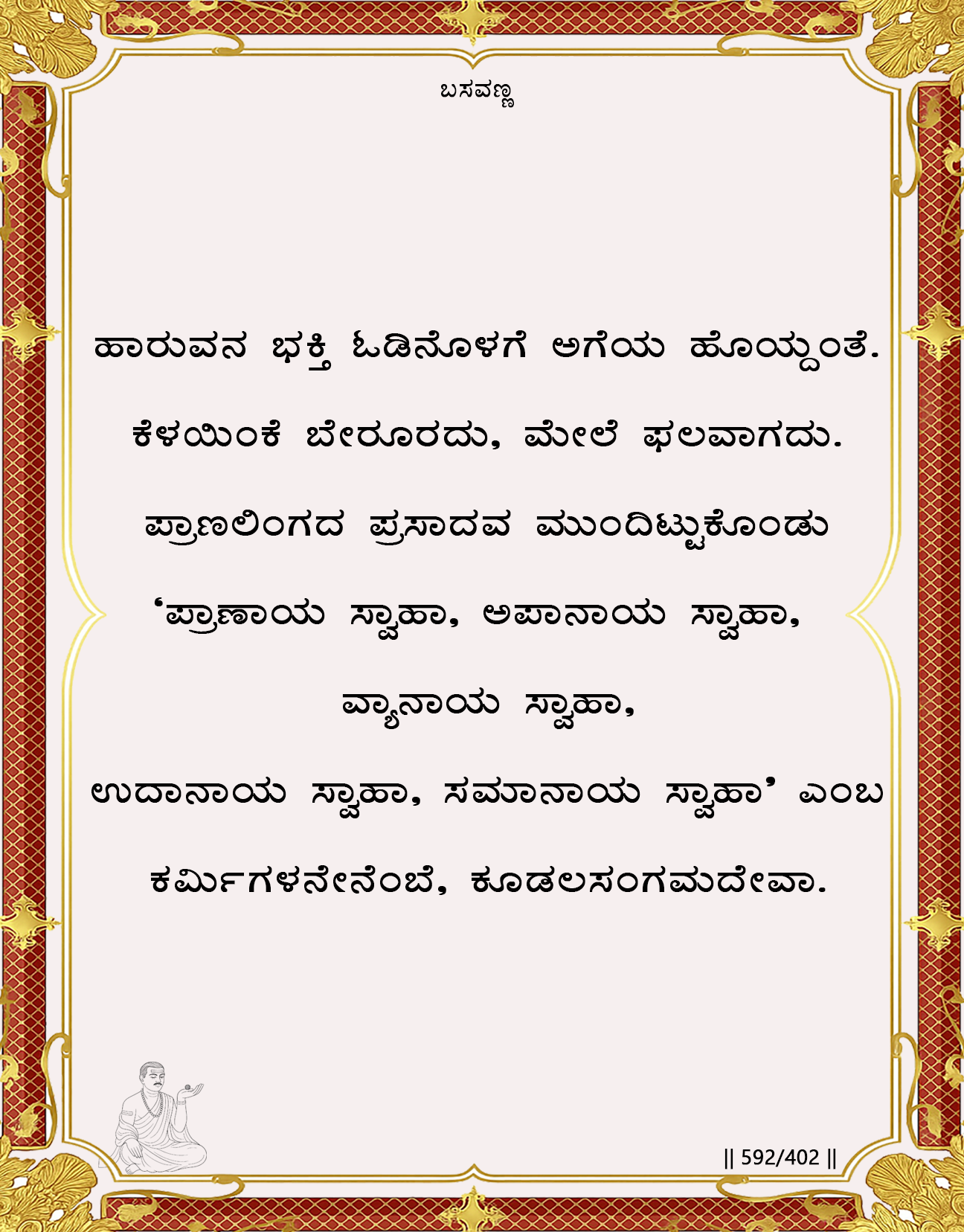
The devotion of those who cling to scriptures and rituals alone
their offering is like a shard of baked clay
buried in the soil.
How can such a seed take root?
How can it sprout or bear fruit?
For the true Prāṇa–Linga
the living Linga that breathes within this very body of flesh
stands here before my eyes,
closer than breath, nearer than heartbeat.
Yet they mutter:
“Prāṇāya svāhā, Apānāya svāhā, Vyānāya svāhā,
Upānāya svāhā, Samānāya svāhā, Udānāya svāhā,
Samanyāya svāhā …”
Empty utterances tossed into the air,
like seeds without life,
like offerings without fire.
Words alone cannot be trusted,
nor can rituals without inner awakening.
Only the seed of living awareness takes root,
says my Kudalasangama.
The Seed of Ritual and the Soil of Realization In this vachana, Basavanna draws a profound distinction between ritualistic religiosity and living spiritual experience. He compares those who rely solely on scriptures, chanting, or mechanical ritual—without inner transformation—to a person who takes a dry shard of clay and plants it in the soil expecting growth. Just as such a fragment can neither sprout nor bear fruit, rituals performed without inner realization cannot yield spiritual awakening.
The Living Source Is Within Basavanna reminds the seeker that the true Prāṇa-Linga—
the Divine present as life-force, breath, awareness— exists inside the living body. It is immediate, experiential, and self-revealing. To miss this living presence while performing external rites is to mistake the shell for the substance. The Futility of Mechanical Mantras Basavanna lists the traditional Vedic utterances associated with the five prānas and their ritual offerings:
• Prāṇa — life-breath
• Apāna — downward flow
• Vyāna — circulation
• Samāna — digestion
• Udāna — upward movement
• Upāna / Samanya — auxiliary or general offerings
He critiques not the mantras themselves but the emptiness with which they are often performed—uttered without insight, sincerity, or inner alignment. Such verbal offerings, like lifeless seeds, carry no potency.
Essential Teaching
True spiritual growth requires:
• Inner awareness, not outward show
• Living connection, not ritual habit
• Embodied experience, not borrowed knowledge
• The seed of realization, not the shell of tradition
Basavanna’s message is clear: Mechanical ritual is sterile. Only the living experience of the Divine within takes root and bears fruit.
Spiritual Context
Core Spiritual Principle: Spiritual practice is only potent when the practitioner (sadhaka) is the fertile ground for transformation. Ritual, mantra, and scripture are seeds. If the consciousness is hardened like baked clay identified with dogma, performing by rote, lacking humility and receptivity the seed cannot penetrate and transform. Realization is an organic event of germination, not an achievement of accumulation.
Cosmic Reality Perspective: In Shivayoga, Shiva is the seed (bija) of all creation, and Shakti is the fertile matrix. The individual is a microcosm of this. The “Prāṇa-Linga” is Shiva-Shakti as the animating life within. To chant about prana while ignoring the living reality of prana is to worship the map instead of entering the territory. It is a profound category error, mistaking the description for the described.
Historical Reality (Anubhava Mantapa Context): This vachana is a core doctrinal strike against the Brahminical ritual orthodoxy of 12th-century Kalyana. It specifically targets the pranagnihotrathe Vedic ritual of offering to the five pranas which was a complex, priestly monopoly. Basavanna democratizes and interiorizes it: the true offering is the conscious recognition of the prana as Linga, an offering every living being can perform without mediation. The Anubhava Mantapa shifted authority from ritual expertise to experiential validity (anubhava pramana).
Interpretation
1.”The devotion of those who cling to scriptures and rituals alonetheir offering is like a shard of baked clay buried in the soil.” “Baked clay” is earth that has undergone a chemical change via fire; it has lost its soft, receptive, life-giving quality. This represents a consciousness “fired” in the kiln of dogmatic certainty and rigid self-identity. It is dead, brittle matter. No life (true insight) can emerge from it.
2.”For the true Prāṇa-Linga… stands here before my eyes, closer than breath.” This is the pivot from externalized theology to imminent phenomenology. The Divine is not a conceptual conclusion but a perceptual factthe very fact of aware, embodied being. “Before my eyes” suggests it is the seer in the seeing, the awareness behind the visual field.
3.”Yet they mutter: ‘Prāṇāya svāhā…’ Empty utterances tossed into the air.” The mantra is not rejected; its empty application is. Svāhā means “I offer unto.” To offer to prana while not recognizing oneself as the prana-Linga is a performative contradiction. The “air” is the realm of empty concepts; the utterance doesn’t land in the fertile soil of the heart.
Practical Implications: One must constantly verify practice against inner aliveness. Before reciting a mantra or performing a ritual, ask: “Am I doing this to connect with a living reality within, or to fulfill a dead habit or social expectation?” Let the criterion be: does this practice soften and enliven my awareness (fertile soil), or does it make it more rigid and conceptual (baked clay)?
The Cosmic Reality
Anga (Human Dimension): The human as agricultural land. Spiritual practice is farming. The quality of the harvest depends entirely on the condition of the soil (consciousness). The farmer’s work (sadhana) is to plow (self-inquiry), fertilize (virtue), irrigate (devotion), and weed (remove impurities) to receive the seed.
Linga (Divine Principle): Koodalasangamadeva as the seed and the rain. The Linga is both the potential (seed) and the activating grace (rain). The Prāṇa-Linga is the seed already sown within every body; the rain is the constant, nourishing presence of consciousness.
Jangama (Dynamic Interaction): The germination process. It is the mysterious, vital movement where the dormant seed interacts with the prepared soil and springs to life. This is the moment of satori or sphurana (throbbing awareness)when ritual becomes realization, when the word prana blossoms into the experience of Prana-Linga.
Shata Sthala
Primary Sthala: PRANALINGI. This vachana defines the essence of the Pranalingi stage: the shift from knowing about prana to knowing as prana. The practitioner no longer offers to prana; they realize they are the offering, the priest, and the deityall as expressions of the Pranalinga. The “baked clay” is the state one transcends at this stage.
Supporting Sthala: BHAKTA. The Bhakta is given a crucial warning: devotion must not solidify into ritualistic fundamentalism. The Bhakta’s love must keep the heart-soft, making it fertile soil, not a hardened shard. The vachana urges the Bhakta to let devotion be a softening, receptive force.
Practical Integration
Arivu (Awareness Practices): Practice “Soil Testing” meditation. Sit quietly and feel the quality of your own consciousness. Is it hard, tight, repetitive (baked clay)? Or is it soft, open, receptive (fertile soil)? Don’t judge, just feel. Consciously invite softness. This is the primary preparation for any other practice.
Achara (Personal Discipline): Institute a “Germination Check” for all spiritual practices. After prayer, meditation, or study, ask: “Did this leave me more alive, open, and connected, or more rigid, certain, and separate?” Favor practices that pass the germination check.
Kayaka (Sacred Action): Let your work be an act of cultivating fertility in the world. Engage in labor that softens hardnesshealing, teaching, creating beauty, repairing broken systems. Avoid work that further bakes the clay of human consciousness (exploitation, manipulation, dogma-spreading).
Dasoha (Communal Offering): Share living water, not clay shards. Offer guidance, teaching, or help that comes from your own lived experience and opens possibilities for others. Avoid passing on second-hand doctrines or rigid rules you haven’t validated in the soil of your own life.
Modern Application
Spiritual Consumerism and Dogmatic Rigidity. The marketplace is full of “seeds” (techniques, courses, mantras) sold to people with “baked clay” consciousness stressed, conceptual, seeking quick fixes. People collect practices without tending their inner soil, leading to spiritual burnout or fundamentalism. Social media fosters performance (displaying the seed) over cultivation (tending the soil).
Commit to “Inner Permaculture.” Focus on regenerating your own inner eco system emotional health, mental flexibility, somatic awareness before adding more techniques. Choose one simple practice and deepen it until it germinates. In community, value shared vulnerability and experiential reports over doctrinal debates or ritual correctness. Be a gardener, not a collector.
Essence
Why plant a shard, a hardened thing,
When in your chest, a living seed does sing?
The breath that moves, the pulse that flows,
Is where the divine river rises and goes.
Chant not to prana from afar,
But know: You are the breath, the seed, the star.
Till your own soil, break the crust,
And let the Linga rise from trusting dust.
This vachana describes the difference between syntactic and semantic spiritual processing. Ritual recitation is syntacticit manipulates symbols (words, actions) according to rules. Realization is semanticit connects the symbol to the actual, lived referent (the experience of aliveness). The “shard of baked clay” is a symbol with no living referent in the practitioner’s consciousness. The brain processes the mantra syntactically, but it fails to trigger a semantic, transformative event because the neural pathways to the embodied experience (the prana) are blocked by the “hardness” of conceptual identity. Spiritual practice becomes fruitful only when it operates in a semantic mode, where every symbol is continually cross-referenced with direct experience.
Imagine you’re hungry. Reading a recipe aloud (ritual) is not eating. Memorizing the recipe (scripture) is not eating. Even buying perfect ingredients (external practice) is not eating. Eating happens when you put the food in your mouth, taste it, and digest it (direct experience). Basavanna says: your own alive body is the already-cooked, nourishing meal (Prāṇa-Linga). Don’t just read the menu (Prāṇāya svāhā…); eat! The person chanting the menu while starving, with a full plate in front of them, is the picture of absurdity.
We are often afraid of the raw, unmediated aliveness within. It is easier to deal with concepts, rules, and rituals the “baked clay” because they give us a sense of control and defined identity. This vachana confronts our avoidance of the vulnerable, uncontrollable reality of pure being. The liberation it offers is freedom from the exhausting project of building a spiritual identity, inviting us instead to simply be the living, breathing mystery that we already are. It replaces the anxiety of seeking with the profound relaxation of being found.

Views: 0