
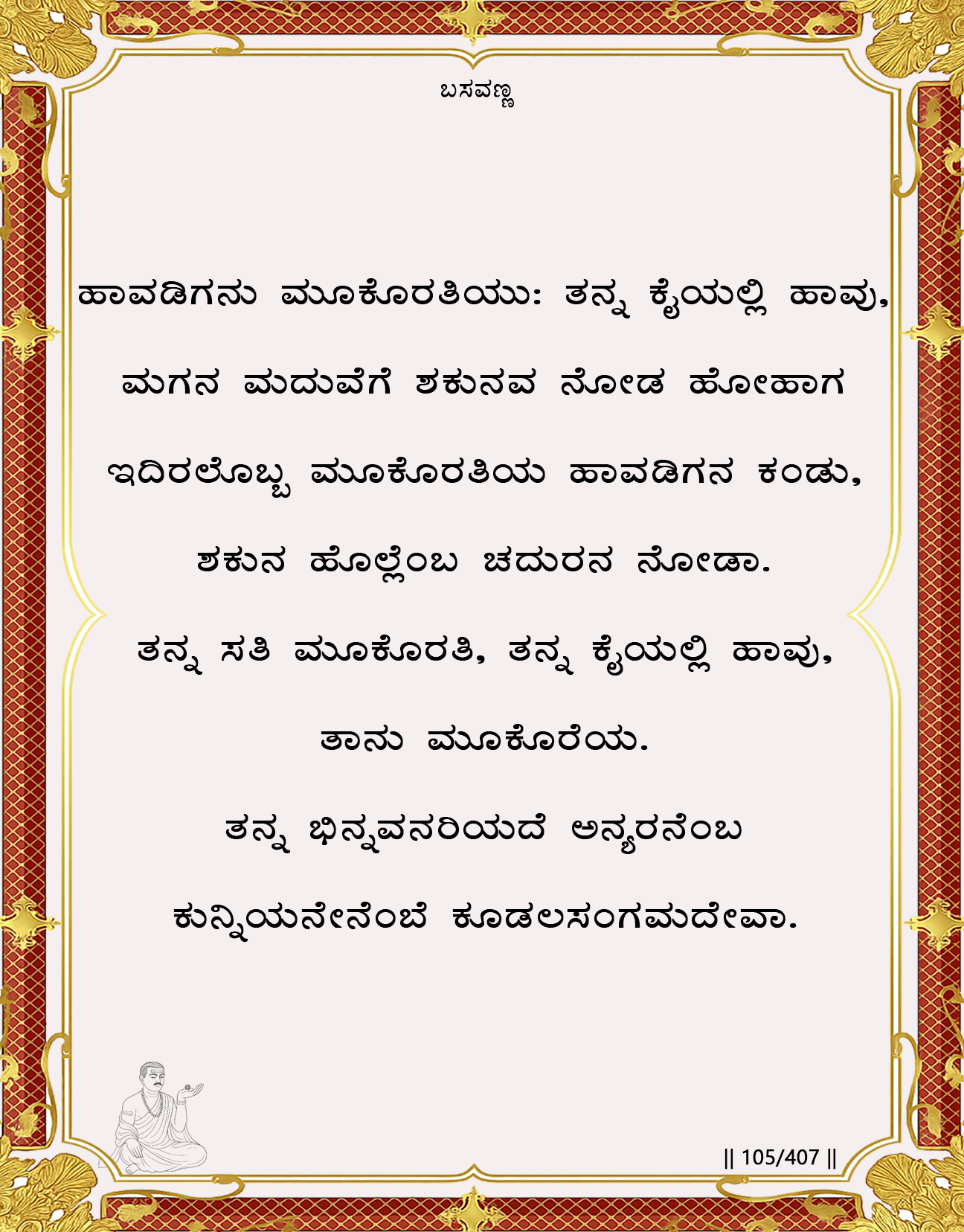
Poetic Rendering

The snake-charmer’s own noseless wife
holds the serpent daily in her hands
yet when seeking a bride for her son,
she runs to another charmer to read their fate!
Even as she stares at a woman
with the same disfigured face as hers,
she declares,
“I will never choose one like that!
Look how beautiful I am.”
The charmer is noseless,
his wife is noseless,
the serpent coiled in both their palms
yet they mock the deformities of others.
O Kudalasangamadeva,
when people blind to their own condition
call others flawed,
what shall I even call them?
Shall I call them dog-pups?
This vachana is Basavanna’s sharp satire on human hypocrisy. Through the vivid image of a snake-charmer’s nose less family—whose deformities come from handling venomous serpents—he exposes how people condemn in others exactly what they themselves carry. Core Teaching True spiritual vision begins with humility. The one who sees their own impurities clearly never finds time to condemn others. This vachana dismantles the ego’s favorite illusion: that I am whole, and others are flawed. The nose less charmer and his wife Their disfigurement is the natural result of their own profession. Yet:
• they hold serpents every day,
• are visibly marked by their choices,
• but still believe themselves superior.
The absurdity of judgment The charmer’s wife rejects a bride for her son who looks exactly like herself. Her self-image is distorted by ego, not reality. Basavanna uses this to highlight: We project our flaws onto others while remaining blind to them within ourselves. The spiritual message This vachana warns against:
• moral judgement,
• caste arrogance,
• ritualistic pride,
• the refusal to see one’s own impurities.
The more deeply one is entangled in ignorance, the more loudly one proclaims the faults of others. Basavanna’s piercing question At the end he turns to Kudalasangamadeva and asks: If people so lost in self-deception call others inferior, what name is left for them? The “dog-pup” metaphor is not insult but diagnosis: a person who barks at others without ever seeing their own shadow.
Spiritual Context
Core Spiritual Principle: Spiritual progress is impossible without self-awareness (atmavichara). Hypocrisy condemning in others what one harbors within is not just a moral failure but a metaphysical error that reinforces separation and blocks the light of consciousness. True vision (drishti) begins with seeing one’s own “nose lessness.”
Cosmic Reality Perspective: In the non-dual Shivayoga, all is a reflection of the one Linga. To see a “flaw” in another is to see a fragment of the whole out of context. To condemn it while ignoring its presence in oneself is to actively fracture the unity of perception. It is to handle the serpent of duality (the ego) and then deny being poisoned by it.
Historical Reality (Anubhava Mantapa Context): This vachana was a direct, public skewering of the social and religious hypocrisy of 12th-century Kalyana. It targeted caste elites who preached purity while being “noseless” from the “serpent” of greed and violence; ritualists obsessed with others’ impurity while blind to their own inner corruption. The Anubhava Mantapa insisted that community must begin with mutual accountability and self-scrutiny, not with projecting faults onto the marginalized.
Interpretation
1.“The snake-charmer’s own noseless wife holds the serpent daily in her hands…” The “serpent” is the poison of ego, hatred, and delusion (ahamkara, dvesha, moha). Handling it daily signifies habitual engagement with toxic mental patterns. The “noselessness” is the visible deformation of character the loss of discernment (viveka) and sensitivitythat results from this engagement.
2.“…yet when seeking a bride for her son, she runs to another charmer to read their fate!” This illustrates externalizing responsibility and seeking validation from equally flawed systems. She looks to another “noseless” authority (priest, astrologer, social norm) to certify her judgment, perpetuating the cycle of blindness.
3.“Even as she stares at a woman with the same disfigured face as hers, she declares, ‘I will never choose one like that! Look how beautiful I am.’” This is the peak of projective identification and narcissistic delusion. The ego, to protect its self-image, splits off its own unacceptable traits and projects them onto an external “other,” which it then rejects with disgust. The declaration of personal beauty is the ego’s lie to itself.
4.“What shall I even call them? Shall I call them dog-pups?” The “dog-pup” is not a mere insult. It signifies a being that barks instinctively at its own reflection, incapable of the self-recognition that defines mature humanity. It is a state of unconscious, reactive existence.
Practical Implications: One must institute a “Mirror Test.” When you feel a strong judgment or criticism toward another, immediately pause and ask: “Where does this same trait, perhaps in a different form, live within me?” The judgment is a mirror pointing back at the judge.
The Cosmic Reality
Anga (Human Dimension): The realm of projection and shadow. Here, the unconscious mind manages psychic pain by exporting it. The “noseless” face is the shadow self, disowned and made external. Society becomes a gallery of our own rejected deformities.
Linga (Divine Principle): Koodalasangamadeva as pure, unblemished awareness. The Linga is like a silent, clear lake that reflects every face exactly as it isnoseless or otherwisewithout distortion or aversion. It is the truth that accepts what is, enabling transformation.
Jangama (Dynamic Interaction): The healing confrontation. It is the moment grace arranges through a word, a sight, a crisis for the charmer to truly see the bride’s face and recognize it as his own. This shocking recognition is the Jangama force in action, initiating the possibility of integration and cure.
Shata Sthala
Primary Sthala: MAHESHWARA. This vachana is a central teaching for the Maheshwara stage. The tapas (austerity) of this stage is precisely to courageously look at one’s own “noselessness”one’s greed, anger, prideand burn it in the fire of awareness. The charmer’s wife exemplifies failing this tapas by turning the fire outward onto others.
Supporting Sthala: BHAKTA. The Bhakta must learn that devotion is not a credential for judging others. A Bhakta staring at the flaws of other devotees is spiritually noseless. The vachana demands that devotion include the humility to see one’s own endless need for grace.
Practical Integration
Arivu (Awareness Practices): Practice “Shadow Mindfulness.” In meditation, when a negative thought about someone arises, don’t push it away. Instead, investigate: “What does this reaction show me about a disowned part of myself? What fear or desire in me does this person mirror?”
Achara (Personal Discipline): Take a vow of conscious speech. Before speaking critically of anyone, complete this sentence silently: “I am aware that my criticism of X may reflect my own struggle with…” This creates a buffer of self-aware ness.
Kayaka (Sacred Action): Ensure your work integrates rather than projects. Are you in a profession that helps people face and heal their “noselessness” (therapy, art, coaching), or one that profits from judging and excluding others? Align with integrative action.
Dasoha (Communal Offering): Build communities of compassionate mirroring. Create circles where members have loving permission to hold up mirrors for one another with kindness, not judgment, understanding that each person’s “noselessness” is a shared human condition to be healed, not shamed.
Modern Application
The Digital Hall of Mirrors. Social media is the ultimate noseless-charmer’s fair. We curate perfect digital faces while projecting venom (cynicism, outrage, judgment) onto the faces of otherspolitical opponents, celebrities, commenters. “Cancel culture” is the mass ritual of rejecting the flawed bride while denying our own complicity in similar systems of harm. The algorithm is the “other charmer” we pay to validate our judgments.
Cultivate digital and psychological integration. Use your online engagement as a shadow-work tool. When you feel a strong negative trigger, write a private note exploring what it reflects in you. Follow people who challenge your views not to debate them, but to understand the “noselessness” they mirror in your own worldview. Choose communities focused on shared growth over shared judgment.
Essence
The face you scorn, the flaw you see,
Is your own reflection, plain to He
Who holds the glass of truth so clear.
The serpent’s kiss, the wound you bear,
You wield each day, yet never own
The mark it leaves upon the bone.
Till in that bride’s face, your features stare
And in that shock, begins the prayer.
This vachana describes the psychic immune disorder of consciousness. A healthy psyche metabolizes and integrates uncomfortable truths (toxins) into wisdom. Hypocrisy is an auto-immune response: the psyche’s defense mechanism mistakenly attacks externalized fragments of itself, causing systemic inflammation (social hatred, inner conflict). The “noselessness” is the scar tissue from this constant, misdirected attack. The Linga represents immune tolerancethe state of consciousness that can host all aspects of itself without triggering a destructive defense.
Imagine your mind is a house with a cracked mirror in the attic (your flaws). Instead of fixing the mirror, you cover it with a sheet and run through the town pointing at every cracked window, shouting “How awful! How broken!” Basavanna says: you are running around town with a piece of that cracked mirror in your hand, blaming others for the cracks you see. Go home. Look in your own attic. The repair begins there.
We are biologically and psychologically wired to detect threats in our environment. This vachana reveals that the most persistent threat is the disowned self. Our judgment of others is a misplaced survival instinct, a frantic attempt to locate and expel the danger that actually resides within. The liberation it offers is the immense relief of laying down this exhausting, futile project. When we finally see our own noseless face, we stop the charade. In that raw, unflinching self-acceptance lies the beginning of true compassion for all other fractured faces. The “dog-pup” becomes a human when it stops barking at shadows and recognizes its own tail.

Views: 1