Poetic Rendering

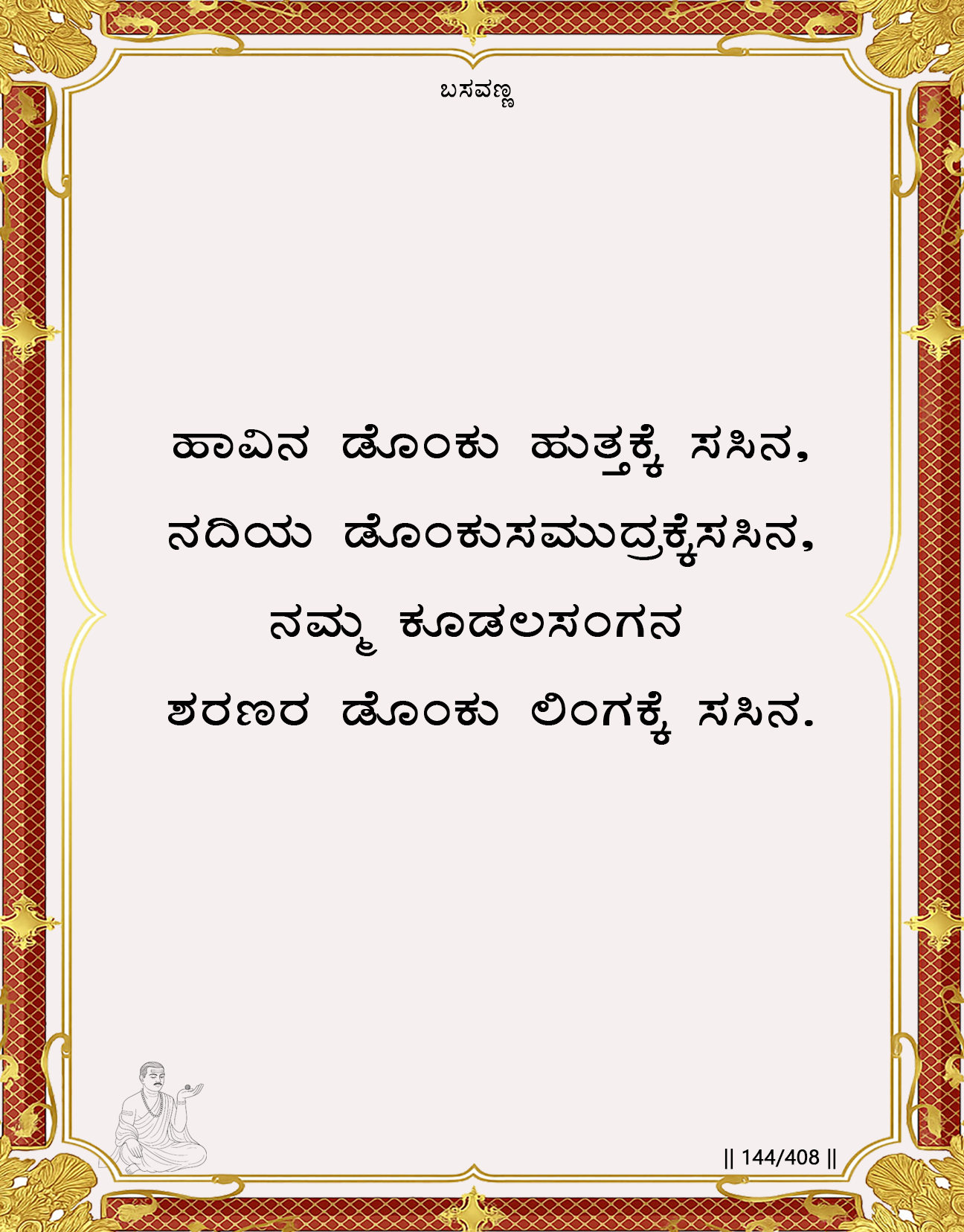
The serpent, coiled like a curving script,
always slips back into its waiting hole.
The winding river restless, shimmering
finds its way at last
to the ocean’s boundless heart.
So too, O Kudalasangamadeva,
no matter how many turns the Sharana takes,
every wanderer returns only to You
the Source, the Rest, the Home.
In this brief yet profound vachana, Basavanna unveils a universal spiritual law: everything in existence returns to its source. The Serpent’s Homecoming The serpent’s twisting, S-shaped body finds perfect harmony with the S-shaped curve of its burrow. This is not escape it is belonging. Its movement is not random but guided by its very nature. The River’s Journey The river may meander through forests, mountains, plains, and villages, but its destiny is unwavering: the ocean. It may twist, turn, or wander, but the pull of its source is irresistible. The Sharana’s Inevitability Basavanna applies these natural metaphors to the inner world: Just as serpent and river instinctively return to their origin, the Sharana—no matter how many detours life brings cannot help but return to Kudalasangama, the Divine Source at the heart of all existence.
This “return” is not a forced discipline but a gravitational movement of the soul, a spiritual homing instinct. Return as the Law of Consciousness Basavanna reveals a mystical insight:
• The Linga is the origin.
• Manifestation (creation) is the journey outward.
• The Sharana is the conscious point in creation that awakens to its longing for home.
• The return to the Linga is the completion of the cosmic cycle.
Just as the ocean is not separate from the river, and the hole is not separate from the serpent, the devotee and the Divine were never separate they only appeared so during the journey. The Essence of the Teaching
The end of all wandering is the Source.
The end of all seeking is the Self.
The end of all becoming is Being.
The end of the Sharana is the Linga.
Basavanna shows that spiritual realization is not something attained it is something remembered.
Spiritual Context
Core Spiritual Principle: All of creation is governed by the law of return (pratiprasava). Separation is a temporary curvature in consciousness; unity is the equilibrium to which it inevitably returns. The spiritual path is not about achieving union but about recognizing and cooperating with this inherent gravitational pull of the soul toward its source.
Cosmic Reality Perspective: In Shivayoga, Shiva is the absolute, unmoved center. Shakti is the centrifugal force of manifestation that expands into diversity, and the centripetal force of dissolution that contracts back into unity. The serpent’s coil and the river’s bend are expressions of Shakti’s playful meandering, but their vector always points home to Shiva. The Sharana is that point in the play where consciousness becomes aware of this vector and joyfully cooperates.
Historical Reality (Anubhava Mantapa Context): In the turbulent social and spiritual landscape of 12th-century Kalyana, this vachana provided profound reassurance to the Sharanas. Their revolutionary path rejecting caste, redefining worship, facing persecution was a radical “winding.” This teaching affirmed that their journey was not a chaotic rebellion but part of a cosmic law of return to an essential truth. It validated their experimentalism, assuring that all sincere seeking, however unorthodox, converges at the same divine source.
Interpretation
1.“The serpent, coiled like a curving script, always slips back into its waiting hole.” The serpent’s coil represents the kundalini energy and the convolutions of the ego-mind. The hole is the sushumna or the heart-cave (hridaya guha). The serpent’s nature is to return to darkness, stillness, and secrecya symbol of consciousness withdrawing from objectification to its subjective source.
2.“The winding river restless, shimmering finds its way at last to the ocean’s boundless heart.” The river’s winding is the necessary process of erosion, nourishment, and experience. It cannot flow straight to the ocean; its meanders are what define its journey and its service to the landscape. The ocean is the dissolution of the limited identity into the boundless.
3.“So too, O Kudalasangamadeva, no matter how many turns the Sharana takes, every wanderer returns only to You.” This is the teleological guarantee. The “turns” are not mistakes: they are lessons, purifications, and the gathering of wisdom. The verb “returns” (pratiprasava) implies a reversal of the process of becoming, an unwinding back to the original state. The Sharana is the one who consciously experiences this return as grace.
Practical Implications: One must trust the winding. In periods of confusion, doubt, or apparent regression, remember: the river does not fret at its bend; it flows. The practice is to surrender personal navigation and feel the gravitational pull of the Linga within. The goal is not to avoid the turns but to recognize they are part of the path home.
The Cosmic Reality
Anga (Human Dimension): The experiencer of the journey. The Anga is the river-bed and the serpent’s bodythe specific, unique form through which the journey of return is personalized. Its winding is its biography.
Linga (Divine Principle): Koodalasangamadeva as the alpha and omega. The Linga is both the source of the emanation (the spring, the egg) and the attractor at the end (the ocean, the hole). It is the still silence before and after all movement.
Jangama (Dynamic Interaction): The flow and the return. Jangama is the intelligent force within the windingthe current that knows how to find the ocean, the instinct that guides the serpent home. It is the divine activity (kriya) within the seeker’s journey.
Shata Sthala
Primary Sthala: AIKYA. This vachana speaks from the perspective of Aikya, where the journey is seen in its entirety as a closed loop. From this vantage point, the wandering was never truly a leaving; it was the Linga exploring its own potential. The return is the recognition of having never left.
Supporting Sthala: SHARANA. The Sharana is the one on the path, experiencing the winding. This vachana gives them the faith to continue. It teaches that their longing for the Linga is not their own but the Linga’s pull within them. Their surrender is to that pull.
Practical Integration
Arivu (Awareness Practices): Practice “Homecoming Meditation.” Sit quietly and feel the body as the serpent’s coil or the river’s course. Sense an inner, silent point (the heart) as the burrow or the ocean. With each exhale, feel consciousness flowing back toward that point. Recognize all thoughts and sensations as temporary bends in the river, all flowing home.
Achara (Personal Discipline): Cultivate trust in the process. When faced with a difficult “turn” (failure, loss, confusion), refrain from self-judgment. Instead, affirm: “This too is part of the winding path home to Koodalasangama.” Let this stabilize equanimity.
Kayaka (Sacred Action): See your work as part of the river’s meander. Your labor is not a distraction from the path; it is the path. It is the necessary winding that nourishes the landscape (community) on your way to the ocean. Perform it as an offering to the journey itself.
Dasoha (Communal Offering): Support others on their winding paths. Do not judge another’s detours. Provide rest and nourishment at the bends. Remember, all rivers lead to the same ocean; companionship on the journey is part of the homecoming.
Modern Application
The cult of the straight line. Modern life valorizes efficiency, linear progress, and clear goals. This creates spiritual anxiety when the inner life inevitably winds, loops, and seems to regress. We pathologize depression, confusion, and life changes as “failures” rather than necessary meanders.
Embrace the non-linear journey. In career, relationships, and inner growth, release the pressure for a straight line. See life as a serpentine river. Use journaling to look back and see how past “detours” were essential to your current understanding. In spirituality, honor your unique winding path; do not compare it to another’s. Trust that your specific journey is perfectly designed for your homecoming.
Essence
The coil must wind, the river bend,
All seeking finds the self-same end.
Not one true turn is made in vain,
Through joy, through loss, through ease, through pain.
The Source that sent the journey’s start
Draws all its wandering back, O heart,
To where the serpent and the sea
Are one in still identity.
This vachana describes the fractal geometry of consciousness. The winding path is not random but follows a spiritual fractala pattern that repeats at different scales (serpent’s coil, river’s meander, life’s journey). This fractal is generated by a simple attractor equation: the Linga. No matter where you start within the fractal’s domain (the manifest world), iterative application of the equation (the pull of consciousness back to its source) will always lead to the same strange attractorthe Linga. The winding is the beautiful, infinite complexity generated by the iteration; the homecoming is the mathematical certainty.
Imagine a marble rolling in a large, beautifully crafted bowl. No matter where you drop it on the rim, it will spiral inward, making many turns, sometimes looping back near where it started, but always moving inexorably toward the bottom. The marble is the soul. The bowl is the structure of reality. The bottom is Koodalasangama. Basavanna says: don’t fret about the spiraling. It’s the design of the bowl. Just keep rolling. You can’t not reach the center.
We fear losing our way. We fear that our mistakes, our oddities, our circuitous routes have doomed us. This vachana speaks to that primal fear of eternal lostness. It offers the ultimate comfort: you are built to find home. Your very longing is the homing device. The liberation is not from the journey, but from the anxiety about the journey. It is the deep, somatic trust that you are always, already, coming home. Every breath is a beat of that return. In that trust, the winding path ceases to be suffering and becomes a sacred pilgrimage, where every step, even the backward ones, is a step into the arms of the Beloved who sent you out to play.

Views: 0