Poetic Rendering

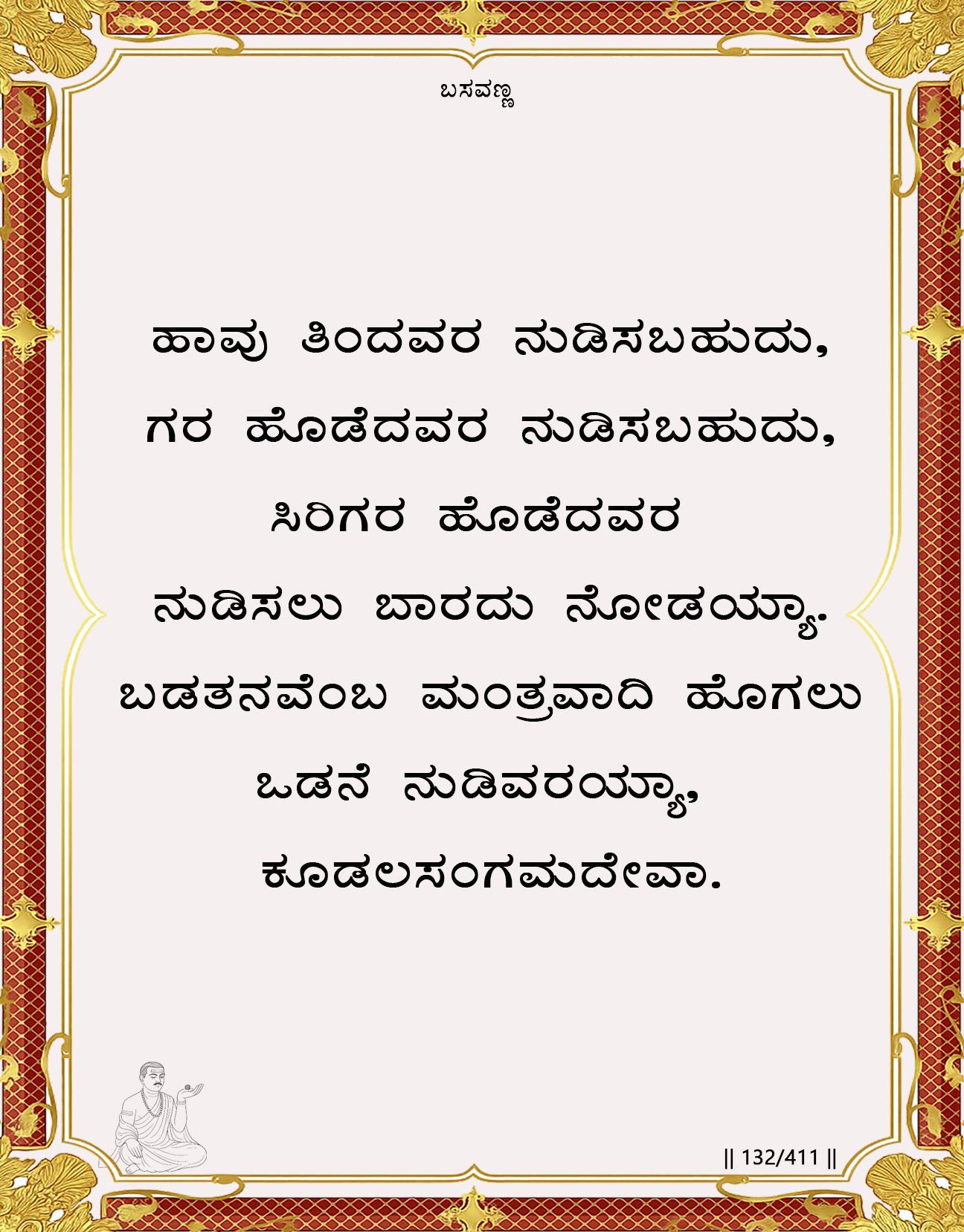
One bitten by a serpent
can still be coaxed to speak.
One seized by frenzy or possession
can yet be brought to utter words.
But the one whose mouth is filled
with the dust of hoarded wealth
whose breath is chained to gold
such a one cannot be made to speak at all.
Only when touched by the trembling cry
of true poverty
a poverty born not of lack,
but of surrender
only then does his sealed tongue open,
and his voice break forth,
O Kudalasangamadeva.
This vachana overturns all conventional ideas of poverty and wealth. Basavanna reveals that spiritual speech authentic expression, truth-telling, the outpouring of the inner Linga is impossible for a person imprisoned by greed.
The Paradox of Speech Basavanna lists two extreme conditions snakebite and possession states in which human consciousness is compromised and the body is overwhelmed. Yet even in these states, a person can still be made to speak.But the one gripped by greed, the one dissolved into the pursuit of wealth and consumption, becomes spiritually mute. His tongue is not held by physical paralysis but by the weight of self-obsession, fear of loss, and identification with possessions. Greed silences because it destroys the very center from which truth arises.
Poverty as a Mantra True poverty in this vachana is not deprivation, but detachment. It is a sacred state of openness, simplicity, and inner freedom. This “poverty” becomes a mantra a vibration that awakens the conscience of the greedy one, breaking through his hardened silence. Here, poverty reveals itself as strength, not weakness; as illumination, not lack. The Inner Dynamics of Wealth and Silence According to Basavanna’s vision of spiritual psychology:
• Wealth binds consciousness outward.
• Greed contracts awareness into isolation.
• Possession creates fear, and fear kills truthful speech.
Thus, the wealthy man cannot speak not because he lacks words, but because he has lost authenticity. Speech as the Voice of the Linga In the Liṅgāyata Darśana, truthful speech is a vehicle of the Divine. It flows naturally from a heart aligned with the Linga. But when the heart is clogged with attachments and self-importance, the Divine cannot speak through it. The poor man’s cry—not his poverty, but his purity becomes the catalyst that restores the wealthy man’s humanity.
The Ultimate Insight Basavanna is not condemning wealth; he is exposing the inner greed that imprisons the soul. The real poverty is ego emptying itself, and the real wealth is truth flowing freely. Thus, spiritual poverty becomes the ground in which the voice of the Divine is heard again, awakening even the most hardened heart.
Spiritual Context
Core Spiritual Principle: Authentic expressiontruthful speech, prayer, wisdomis a function of inner freedom. Greed, as the psychic contraction around “mine,” seizes the faculty of speech (vak shakti) and turns it inward to serve the ego’s narrative, rendering it incapable of expressing transcendent truth. Only the emptiness of non-possession allows the Divine to speak through the human.
Cosmic Reality Perspective: In the non-dual Shivayoga, Shiva is pure consciousness and Shakti is its expressive power (vagbhava Shakti). Greed is Shakti trapped in a recursive, self-referential loopenergy circulating around a concept of “I” and “mine.” This creates a standing wave that blocks the free flow of Shakti as communication. Poverty (detachment) collapses this loop, allowing Shakti to flow unimpeded as an offering to Shiva, manifesting as liberated speech.
Historical Reality (Anubhava Mantapa Context): In 12th-century Kalyana, a merchant and treasury-based economy, this vachana directly challenged the link between wealth and social voice. It declared that the wealthy who hoarded were, in fact, the most silenced caught in a muteness of conscience. Conversely, the Sharanas, who embraced voluntary simplicity (aparigraha), found a powerful, prophetic voice. This justified the community’s emphasis on Dasoha (sharing) as essential to spiritual discourse.
Interpretation
1.”One bitten by a serpent… One seized by frenzy…” These represent acute, exogenous crises. They disrupt the body-mind system from the outside but do not fundamentally corrupt the soul’s orientation. Speech remains possible because the core consciousness, though distressed, is not identified with the disturbance.
2.”But the one whose mouth is filled with the dust of hoarded wealth… cannot be made to speak at all.” This is a chronic, endogenous pathology. The “dust” is the fine particulate of countless attachments and fears. Greed is not an event that happens to consciousness; it is a state consciousness inhabits. The individual becomes the hoard; their identity is the accumulation. Thus, any speech would threaten the identity structure, resulting in profound existential muteness.
3.”Only when touched by the trembling cry of true poverty… does his sealed tongue open.” “True poverty” (atyanta daridrya) is the zero-point of egoic claim. It is not deprivation but the positive state of having nothing to defend. The “cry” is the spontaneous vibration of this emptiness. This cry resonates at the frequency of ultimate reality, shattering the stagnant, self-referential silence of greed. The opened tongue now speaks from need, not from accumulation; from connection, not from separation.
Practical Implications: To preserve or recover one’s authentic voice, one must conduct a “wealth audit” not just of possessions, but of mental and emotional holdings: What opinions, identities, or resentments are you “hoarding” that silence your truth? Practice speaking from a place of vulnerability (poverty) rather than from a fortress of position (wealth).
The Cosmic Reality
Anga (Human Dimension): The human as a sound chamber. Greed stuffs the chamber with insulating material (possessions, status, narratives), damping all resonance. Poverty empties the chamber, allowing it to amplify the fundamental note of the Linga.
Linga (Divine Principle): Koodalasangamadeva as the primordial Sound (Nada Brahman), the Logos. The Linga is the truth that seeks to be uttered. It cannot be spoken about by the greedy; it can only be spoken as by the poor in spirit.
Jangama (Dynamic Interaction): The cry of poverty as the shockwave that cleanses the sound chamber. It is also the community of the poor (Sharanas) whose collective cry creates a field of resonance that can trigger awakening in those trapped in silent greed.
Shata Sthala
Primary Sthala: MAHESHWARA. The Maheshwara’s task is the destruction of lobha (greed). This vachana provides the key insight: the success of this purification is measured by the return of authentic, fearless speech. If one is still crafting words to protect image or wealth, the impurity remains.
Supporting Sthala: PRASADI. The Prasadi is the one who receives and shares. They understand that speech is a form of prasadaa grace to be received in emptiness and offered in generosity. Their “poverty” ensures the channel is clear, making them a conduit for wisdom.
Practical Integration
Arivu (Awareness Practices): Practice “Silence of the Hoard” meditation. Sit quietly and inventory what you are mentally clinging toplans, resentments, self-images. Then practice “Cry of the Empty” meditation. Breathe out completely, and in the emptiness at the bottom of the exhale, let a sound or word arise spontaneously from a place of no claim.
Achara (Personal Discipline): Observe a “Truthful Utterance” vow. For a period, speak only what is essential and true, avoiding speech designed to impress, protect assets, or manipulate. Notice how greed for social capital influences speech.
Kayaka (Sacred Action): Let your work be an expression of generative, not accumulative, energy. Choose tasks that create flow, connection, and nourishment rather than just stockpiling. Ensure your profession allows you to speak truth without fear of financial loss.
Dasoha (Communal Offering): Use your voice and resources to amplify the silenced. Share platforms with those whose poverty (of status, access) has purified their message. Create spaces where speech is free from the need to curry favor or protect privilege.
Modern Application
The Performance of Wealth and the Silence of Complicity. Social media fosters a curated “wealth” of experience, likes, and opinions that silences authentic vulnerability. Corporate and political speech is often rendered mute by greed (shareholder value, partisan advantage), leading to empty, managed communication. Individuals are silenced by fear of losing economic or social standing.
Cultivate “impoverished” platforms and spaces. Engage in and create forums where status is checked at the door circle practices, anonymous sharing, direct storytelling. In personal life, practice “financial transparency” and “vulnerable communication” to break the silence that wealth often imposes. Support voices that speak from the margins, the modern “cry of poverty.”
Essence
The serpent’s victim still can cry,
The madman’s voice still hits the sky.
But wealth’s fine dust, a gag profound,
Stifles all but its own sound.
Till poverty’s keen, trembling prayer
Cuts the silence, sharp and bare
And from the heart that owns no thing,
The Linga’s voice begins to sing.
This vachana describes the information theory of consciousness. Consciousness is a system for processing and transmitting signals (truth). Greed creates signal-dependent noisethe system’s output becomes corrupted by the desire to preserve and amplify the “self” signal. This creates a high noise-to-signal ratio, rendering meaningful communication impossible (silence). Poverty (detachment) is system reset to factory settings: it eliminates the signal-dependent noise by removing the “self” as the primary reference. The system now acts as a clean channel, allowing the base signal of the Linga (pure awareness) to be transmitted with perfect fidelity. The “cry of poverty” is the initial burst of pure signal that recalibrates the entire system.
Imagine a microphone (your voice) placed inside a safe full of money (greed). No matter how loudly you speak, the sound is muffled, trapped, and distorted by the surrounding mass. Now imagine the safe is emptied and opened (poverty). The microphone is exposed to the open air. Even a whisper is clear and carries. Basavanna says: your soul’s voice is trapped in the safe of your possessions. Only the act of emptying itthe cry that comes from having nothing left to losebreaks it open.
We fear poverty because we believe it will diminish us. This vachana reveals the opposite: it is wealth, in the sense of psychic hoarding, that diminishes us into silence. Our deepest longing is to be seen, heard, and known authentically. Yet we build walls of achievement and possession that make true encounter impossible. The liberation offered is the realization that your voice your true identity is not only heard but becomes clarion when you stop using it to describe your walls. In the emptiness of surrender, you don’t just find your voice; you become the voice of something eternal.

Views: 0