Poetic Rendering

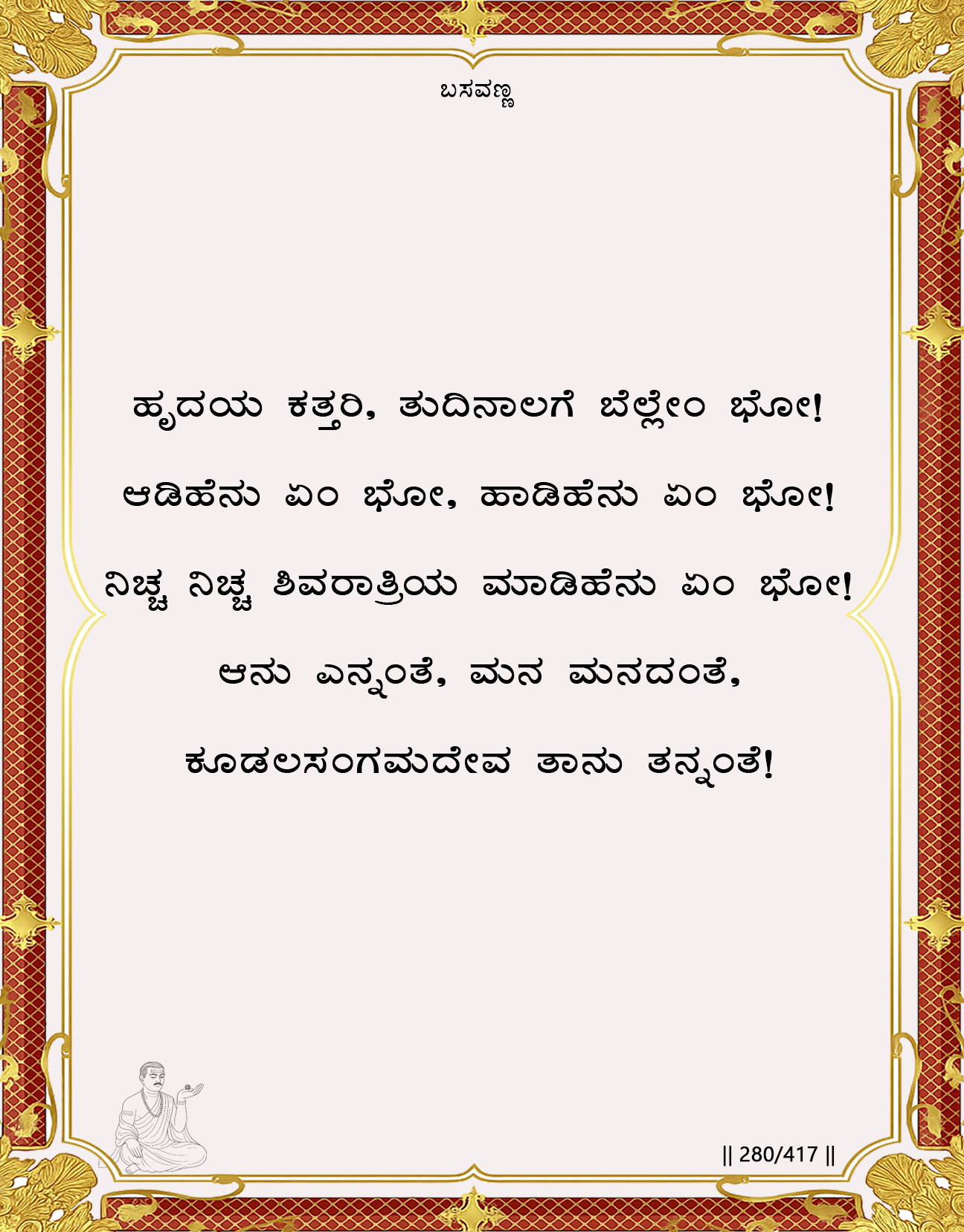
A scissor’s edge in the heart,
and nectar on the tongue
see the contradiction!
“I sing for Śiva!
I dance for Śiva!
I fast and keep every vigil!”
so declares the restless mind.
Yet I remain just as I am,
unchanged;
and You, O Kudalasangamadeva,
remain ever as You are.
Basavanna exposes the self-deception of spiritual theatrics. Sweet words on the tongue conceal a sharp, divided heart. Singing, dancing, fasting when performed as displays do not transform the inner being. The Divine is not swayed by outward performance. God remains what God is;
the devotee remains what he truly is. Transformation requires inner honesty, not external show. This vachana is Basavanna’s call to strip away pretension and cultivate a heart that is unified, transparent, and sincere an unadorned heart worthy of Kudalasangamadeva.
Spiritual Context
Core Spiritual Principle: Kriya-Bahiranga, Antahkarana-Satya – The Principle that Action is Superficial, the Inner Instrument is Truth. The efficacy of any practice (kriya) is nullified by the falsity (asatya) of the heart-mind (antahkarana). God-realization is a state of being, not a catalog of acts.
Cosmic Reality Perspective: This addresses the non-dual misunderstanding. Non-duality (Shiva-Shakti as one) is not achieved by the Shakti of action (kriya-shakti) alone while the core consciousness remains dualistic. The outward of oneness (singing, dancing) while internally fractured is the ultimate contradiction to the cosmic reality.
Historical Reality (Anubhava Mantapa Context): In the ferment of spiritual debate, this vachana served as a quality control mechanism. It challenged those who might join the Basavayoga movement for social prestige or intellectual thrill without inner commitment. It defined the Anubhava Mantapa not as a theater for performance, but as a forge for authentic being.
Interpretation
The “scissor’s edge in the heart” is the cutting power of unresolved duality (like/shame, truth/falsehood) that severs the seeker from their own essence. “Nectar on the tongue” is the intoxicating self-delusion created by holy rhetoric. The list of boasts (“I sing, I dance, I fast”) maps the ego’s attempt to claim the Jangama rolethe dynamic, visible devoteewhile the Anga remains stubbornly unreformed. The final declaration (“I remain just as I am… You remain ever as You are”) states the stark, unbridgeable gap created by inauthenticity.
Practical Implications: Spiritual practice must begin with and continually return to self-auditing honesty. Before singing, check for the scissors in the heart. The most sacred action is to dissolve inner contradiction. Performance without being is spiritual fraud, most damningly against oneself.
The Cosmic Reality
Anga (Human Dimension): The “restless mind” engaged in spiritual theatrics. It is a fabricated identity, a “devotee costume” worn over a conflicted, unchanged self. It is activity without essence.
Linga (Divine Principle): Koodalasangamadeva as pure, unchanging Is-ness (Sat). It is the unwavering reference point against which all falsity becomes visible. It does not play the role of an audience to be impressed.
Jangama (Dynamic Interaction): Here, the Jangama is paralyzed, represented by a one-way monologue. The devotee’s actions generate no reciprocal flow, no transforming communion. It is the drama of movement that goes nowhere, highlighting that real Jangama is the movement of grace into a heart made open and congruent.
Shata Sthala
Primary Sthala: Prasadi. The vachana defines the central obstacle to receiving grace: inauthenticity. Prasada (grace) is the flow of truth; it cannot settle in a vessel coated with the falsehood of performance. One must be prasanna (clear, serene) within to be a receptacle for Prasadi.
Supporting Sthala: Bhakta. This is a direct critique of a corrupted Bhakta stage, where devotion has become a persona rather than a purifying fire. True Bhakta is the burning away of the divided heart, not its cosmetic decoration with holy acts.
Practical Integration
Arivu (Awareness Practices): Practice “the pause before the performance.” Before any spiritual act, pause to sense the inner state. Is there a need to be seen? Is there inner unity? Cultivate the awareness that sees the “scissor’s edge” without judgment but with fierce clarity.
Achara (Personal Discipline): Let your primary discipline be satya (truthfulness) of the heart. This may mean doing fewer external practices with total inner consent rather than many with divided intention. Simplify your spiritual life to what feels authentically yours.
Kayaka (Sacred Action): Infuse your daily labor with this authenticity. Let your work be an expression of your actual, integrated self, not a performance for others’ approval. The purity of a simple, honest task outweighs the showiest ritual.
Dasoha (Communal Offering): Offer the gift of honest fellowship. In community, create space where personas can be dropped and the “unadorned heart” can be spoken without fear. Be a mirror for others, not an audience for their performance.
Modern Application
The “scissor’s edge and nectar” define the age of social media spiritualitycarefully curated posts about mindfulness, yoga, and sacred quotes masking a heart riddled with anxiety, comparison, and fragmentation. The “restless mind” is the personal brand builder in the realm of the spirit.
This vachana liberates by dismantling the exhausting project of spiritual image-management. It grants permission to stop performing. The path to the Divine begins with the courageous, humble admission: “I remain just as I am.” From that raw, honest starting point not from a pretense of attained holiness true transformation can begin. Your ordinary, conflicted self is the only valid raw material.
Essence
The stage is set, the lines well known,
A convincing act in a holy tone.
But in the silence when the play is done,
Two solitudes: the seeker, and the Sun.
The bridge is not a song or dance,
But the fearless, naked, inward glance.
This vachana describes a failed quantum entanglement. For the Linga (pure consciousness) and the Anga (individual consciousness) to become entangled (non-dual), their quantum states must be compatible. The devotee’s performative actions create a decoherent “classical” maska definite, false state (“I am a great devotee”) that is incompatible with the Linga’s superposition of pure potentiality. Until the mask is observed and collapsed through honesty, no entanglement (union) can occur.
You can’t connect a genuine power source to a prop made of cardboard and paint. It won’t light up; it will just expose the materials. Stop building the prop. Become a real socket. We all fear that our authentic self is not enough, so we adorn it with achievements, virtues, and spiritual accomplishments. This vachana reveals that those very adornments are the barrier to the connection we seek. The Divine only meets what is real. The liberation is in the laying down of the costume.

Views: 0