Poetic Rendering

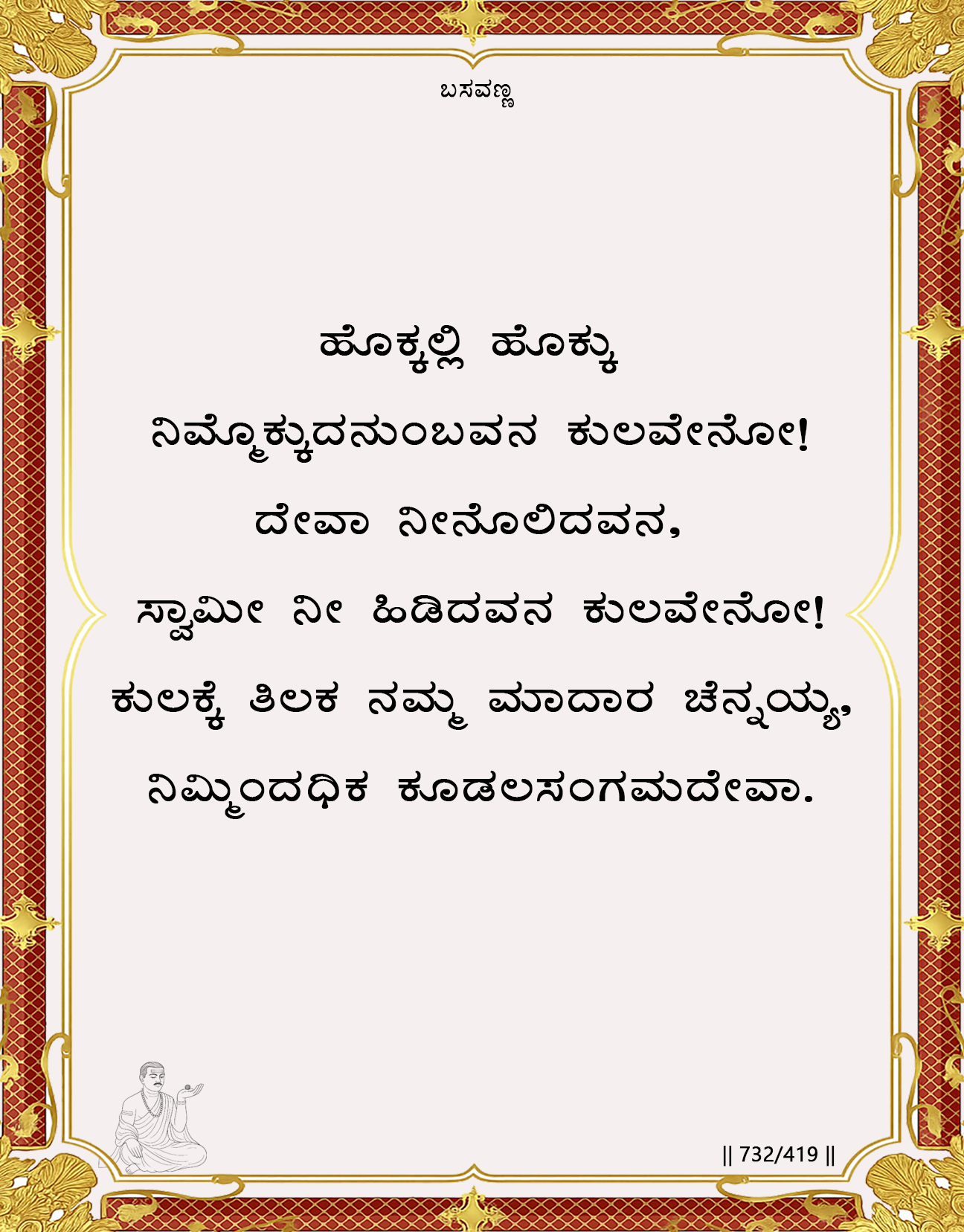
What worth is one’s lineage
if it is not rooted in You?
What pride in birth or family
if Your hold is absent?
The true ornament of any clan
is one like Māḍara Chennayya
made radiant only
by Your grace,
Kudalasangamadeva.
This vachana overturns all notions of worldly prestige. Basavanna declares that neither ancestry, caste, nor inherited status has any meaning without inner devotion and divine alignment. True nobility is not something one is born into it is something one becomes through surrender, integrity, and union with the Divine. Māḍara Chennayya, born outside the structures of “high birth,” becomes the shining example of this truth: grace, not lineage, determines spiritual greatness.
Spiritual Context
Core Spiritual Principle: Linga-Kula – The Principle of the Divine Lineage. One’s true family, clan (kula), and heritage are defined by connection to the Linga, not by blood or social caste. Spiritual merit (adhikara) overwrites and nullifies hereditary status.
Cosmic Reality Perspective: From the non-dual view, Shiva-Shakti is the only true progenitor, the source of all manifestation. To claim a separate, superior worldly lineage is a denial of this fundamental unitya form of spiritual arrogance that reinforces illusion (maya) of separation. Realizing the Self as Linga is entering the only noble lineage.
Historical Reality (Anubhava Mantapa Context): This is the theological bedrock of Basavanna’s social revolution. By citing Māḍara Chennayya (a legendary Sharana from the Madiga community), Basavanna doesn’t just argue for equality he demonstrates a new hierarchy where spiritual realization, accessible to all, is the sole measure of greatness. The Anubhava Mantapa was thus a new “family” based on Linga-Kula.
Interpretation
The rhetorical questions (“What worth…? What pride…?”) perform a surgical negation of the ego’s most cherished social anchors. To be “rooted in You” or to have “Your hold” means one’s consciousness is sourced in and shaped by the Divine, not by societal narratives. Māḍara Chennayya as the “true ornament” is a supreme metaphor: an ornament is an added glory that reveals the inherent beauty of the wearer (the Linga). His realized life is the adornment that glorifies the Divine, proving the Divine’s power to transform any human vessel into a jewel.
Practical Implications: One must actively dis-identify from pride or shame based on birth, nationality, or social standing. Spiritual practice involves consciously transferring the sense of belonging from the biological/social family to the community of seekers (Sharanas) and the source (Linga). Your worth is to be actively created through devotion, not passively received from ancestry.
The Cosmic Reality
Anga (Human Dimension): The socially constructed self, burdened or elevated by the accident of birth. This is a borrowed, contingent identity, full of pride or shame but empty of inherent spiritual substance.
Linga (Divine Principle): Koodalasangamadeva as the sole ground of being and the only true inheritance. It is the primordial “root” and the absolute “holder” of all that exists. To be aligned with it is to possess the only lineage that matters.
Jangama (Dynamic Interaction): The Jangama here is embodied in the living example of Māḍara Chennayya. He is the walking, talking testament to the transformative power of the Linga-Anga relationship. His existence is not just inspiration but proof; he is the dynamic interaction made flesh, silencing all doctrinal objections about birth-based eligibility.
Shata Sthala
Primary Sthala: Aikya. This vachana describes the consciousness of Aikya (Union), where the sense of separate self, including its most entrenched social identity, has dissolved. One recognizes oneself solely as a manifestation of the Divine (Linga), part of its divine lineage. The question of worldly lineage becomes irrelevant.
Supporting Sthala: Bhakta. The Bhakta stage is where this dis-identification is fiercely practiced. The devotee must continually offer their pride of lineage and shame of birth at the feet of the Linga, cultivating the only identity that counts: Lingada Ashrita (one surrendered to the Linga).
Practical Integration
Arivu (Awareness Practices): Notice moments of pride or defensiveness related to your background, education, or social status. Observe them as attachments to a false, contingent self. Consciously replace that thought with: “My only lineage is my connection to the Divine within.”
Achara (Personal Discipline): Let your discipline be the conscious honoring of spiritual merit over social status. Listen deeply to the wisdom of those regardless of their worldly station. In your own practice, seek to become an “ornament” to the principle of grace, not to your own name or family.
Kayaka (Sacred Action): Perform your work in a way that severs its value from your social identity. Let the work itself, done with integrity and dedication, be your true signature, your “Chennayya-like” ornament, rather than the title or prestige attached to it.
Dasoha (Communal Offering): Build and nurture communities that actively embody Linga-Kula. Create spaces where introductions are based on one’s spiritual aspiration or service, not their resume or pedigree. Honor the Māḍara Chennayyas among you.
Modern Application
We live in an age of curated personal brandsprofessional lineages, academic pedigrees, social media influencer status. Even in spiritual circles, gurus are often valued by the size of their lineage rather than the depth of their realization. Identity is still fiercely tied to external markers, leading to existential emptiness when those markers are stripped away.
This vachana liberates by offering an identity that cannot be taken away by job loss, social change, or familial rejection. It empowers you to write your own spiritual lineage through your choices and your surrender. You are not trapped by the past of your bloodline; you are authored by the present of your devotion. In a world obsessed with origins, it points you to the Origin itself.
Essence
The tree that boasts the oldest ground
Is by the storm most easily found.
But graft your shoot to the Sun and Sky,
A deeper root no wind can deny.
Your name is not what you were first called,
But how you answer when the Divine has called.
This vachana describes a metaphysical override of inherited quantum state. The human at birth is placed in a societal “superposition” of potential identities (high/low caste). Social conditioning collapses this into a definite, classical state (e.g., “shudra”). Lingayoga introduces a stronger, conscious observerthe Linga-anchored awarenesswhich re-collapses the identity wave function into a new, fundamental state: “child of the Divine.” Māḍara Chennayya’s life is the historical record of this state-change.
You can inherit a rusty, old title deed to a small plot of land (worldly lineage), or you can claim citizenship in the entire cosmos by aligning with its source. The latter makes the former laughably insignificant. Basavanna says: take the citizenship.
We all crave belonging and a sense of noble origin to counter our deep-seated feelings of inadequacy. This vachana redirects that ancient longing from the horizontal plane of human history to the vertical axis of direct spiritual connection. Your most profound belonging is not behind you in your ancestry, but above and within you, in your capacity to reflect the Divine.

Views: 0