Poetic Rendering

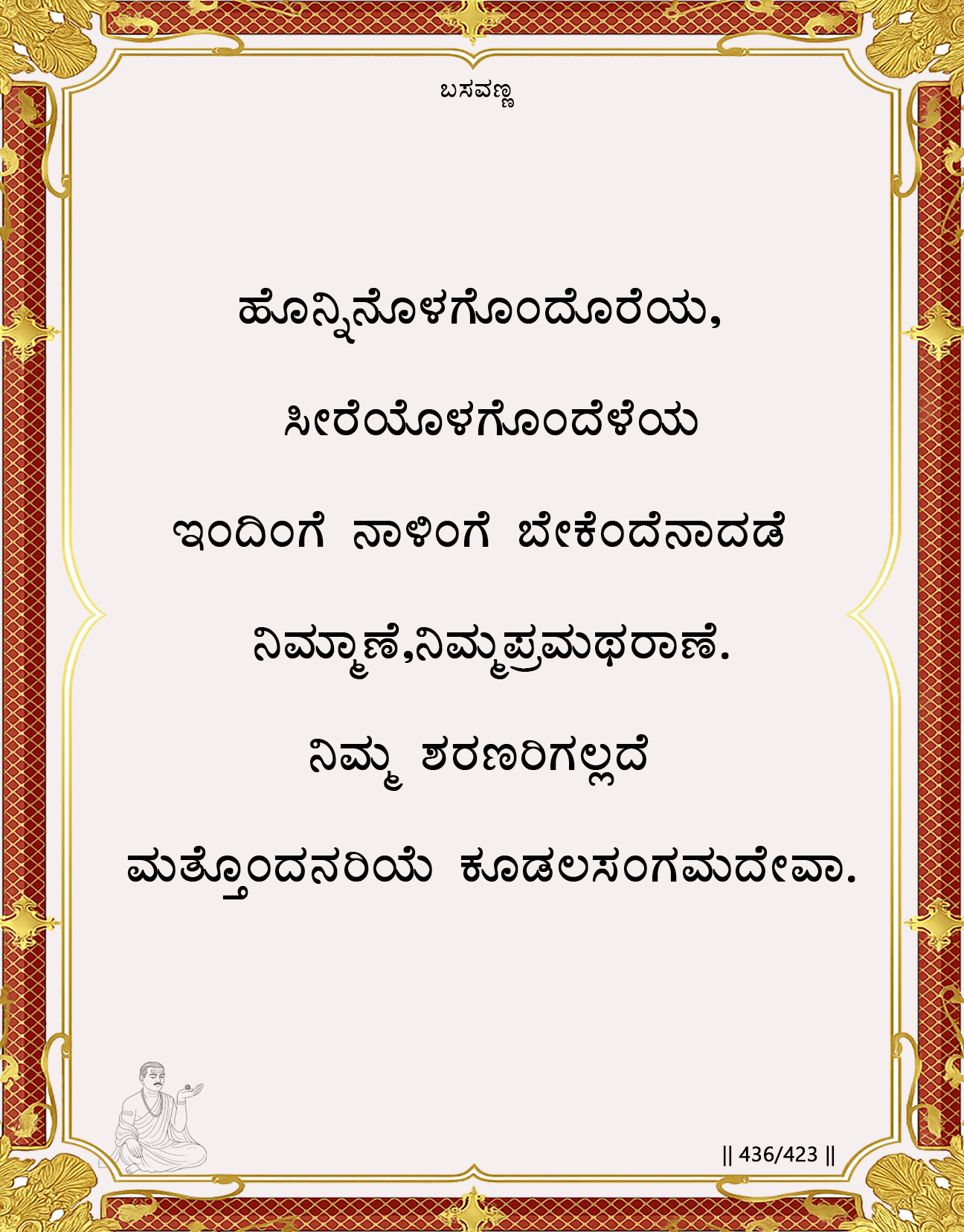
No gold shall I hold within,
Nor worldly riches, not even a thread thin,
Today, tomorrow, my vow I begin,
Seeking only your grace, O divine kin.
This Vachana expresses the devotee’s deep commitment to renounce all material possessions and desires. The seeker promises not to hold onto any form of wealth, not even a thread while weaving, signifying a complete detachment from worldly attachments. The vow is taken to seek only the divine’s grace, recognizing that true richness lies in spiritual abundance rather than material wealth. By dedicating everything to the divine and promising to use whatever comes their way for the benefit of fellow seekers on the spiritual path, the seeker embodies selflessness and devotion.
Spiritual Context
Core Spiritual Principle: Vyavasaya-Dasoha – The Principle of Livelihood as Offering. One’s profession and its fruits are not personal property but a sacred trust (vyavasaya) from the Divine, to be managed for communal offering (dasoha). Renunciation (tyaga) is not of the object, but of the claim of ownership; it is the transformation of possession into stewardship.
Cosmic Reality Perspective: This reflects the non-dual dynamics of Shiva (the owner) and Shakti (the owned, the energy of wealth and creation). The ego’s claim “this is mine” (mamakara) is the primal contraction that creates duality. By vowing “I shall not hold,” the individual consciousness aligns with Shiva’s stance of non-possession, allowing Shakti (wealth, resources) to flow through it as a natural, unattached expression of the whole.
Historical Reality (Anubhava Mantapa Context): This was the economic manifesto of the Basavayoga revolution. It dismantled the capitalist-ego and the hoarding instinct, creating a practical model for a sanctified economy. The community’s survival was based on this vow where each member’s labor (kayaka) generated resources that were offered (dasoha) to sustain the entire spiritual commune, breaking the bonds of both poverty and greed.
Interpretation
“Gold” represents condensed worldly value and security. The “thread thin” is even more profound it is the basic unit of weaving, symbolizing the very means of one’s livelihood and daily sustenance. Renouncing claim to even this signifies surrendering the anxiety of personal survival to the Divine. “My vow I begin” frames this not as a one-time act but as a continuous, moment-to-moment practice of non-attachment. “Seeking only your grace” is the positive counterpart; the vacuum created by renouncing worldly desire is filled with the active pursuit of divine consciousness, which then manifests as provision for the community.
Practical Implications: One must examine their relationship with money, possessions, and skills. The practice is to hold every asset with an open hand, asking: “How can this serve the highest good (the Linga in the community)?” It transforms budgeting and giving into a spiritual discipline of flow management.
The Cosmic Reality
Anga (Human Dimension): The individual as a clear channel, a “hollow bamboo.” Its identity is not as an owner (“I have”) but as a trustee (“I serve”). Its need is not eliminated but sanctified, becoming the very reason for receiving divine flow.
Linga (Divine Principle): Koodalasangamadeva as the sole proprietor (swami) of all wealth (sampada), material and spiritual. Grace (prasada) is the currency of this divine economy.
Jangama (Dynamic Interaction): The Jangama is the circulatory system of this economy. It is the act of receiving “gold” or “thread” as prasada, and the immediate, unattached offering of it as dasoha. The individual becomes a living junction where divine provision meets human need, without blockage.
Shata Sthala
Primary Sthala: Sharana. This is the definitive action of a Sharana. Taking refuge means surrendering all personal security systems especially material onesto the Linga. One’s survival is entrusted to the Divine, expressed through the community. This creates fearless dependence on grace.
Supporting Sthala: Prasadi. This vow operationalizes the stage of Prasadi. One becomes a conscious participant in the flow of grace, not a passive recipient. By vowing to hold nothing for oneself, one ensures that all that comes is recognized as grace and all that goes is distributed as grace.
Practical Integration
Arivu (Awareness Practices): Cultivate the awareness of being a trustee. Upon receiving income or any resource, pause to acknowledge it as prasada from the Divine. Observe the inner contractions of greed and fear of lack as signs of forgetting the vow.
Achara (Personal Discipline): Fix a proportion of your income or resources for unconditional giving (dasoha). Simplify your needs to reduce the “gold” you feel you must hold. Practice skill-sharing (offering your “thread”) as readily as sharing material wealth.
Kayaka (Sacred Action): Perform your work as an act of generating offerings for the world, not just wealth for yourself. See your profession as the loom where the “thread” of your skill is woven into the fabric of community well-being.
Dasoha (Communal Offering): Institutionalize giving within your community. Create systems a common fund, skill banks, resource sharing that embody this vow, ensuring no member is in dire need and all surplus is recycled into service and spiritual growth.
Modern Application
We live in an economy of accumulation, where self-worth is tied to net worth, and anxiety about future lack drives endless hoarding and competitive consumption. Spiritual practice itself can become commodified. We are terrified of being the channel, insisting on being the reservoir.
This vachana liberates from the soul-crushing burden of ownership and the anxiety of scarcity. It reframes you from a consumer to a distributor of divine abundance. It solves financial stress by shifting the question from “Do I have enough for me?” to “How can what I have serve?” This creates a profound sense of security rooted in being part of a flowing, grace-filled system, not a isolated stockpile.
Essence
Not to own the river, but to let it run through,
Not to stash the light, but to be the pane it shines unto.
The hand that clutches cannot receive the new,
The heart that’s empty finds its work to do:
To pass the gift along, and keep the view true.
This vachana describes the metaphysics of a superconducting circuit. Personal desire and ownership are resistances that generate heat (anxiety, greed) and slow down the flow of spiritual energy (grace). The vow of non-possession is the act of cooling the system to a critical temperature where resistance drops to zero. The individual becomes a superconductor for divine Shakti, allowing energy (wealth, resources, love) to flow perpetually without loss, powering the entire community network.
You are a pipe. If you clog it with “my gold, my thread” (personal attachments), nothing flows. The vow is the act of declogging. Once clear, the water of grace can flow freely to all the gardens downstream. Your purpose is not to be a full pipe, but to be a clean pipe.
We believe possession equals security and identity. This vachana reveals that possession is actually the cause of insecurity (fear of loss) and a false identity. Our deepest security lies in being a trusted, integral part of a flowing, benevolent whole. Our true identity is not “owner” but “loving conduit.” The alchemy turns the leaden fear of lack into the gold of shared abundance.

Views: 0