Poetic Rendering

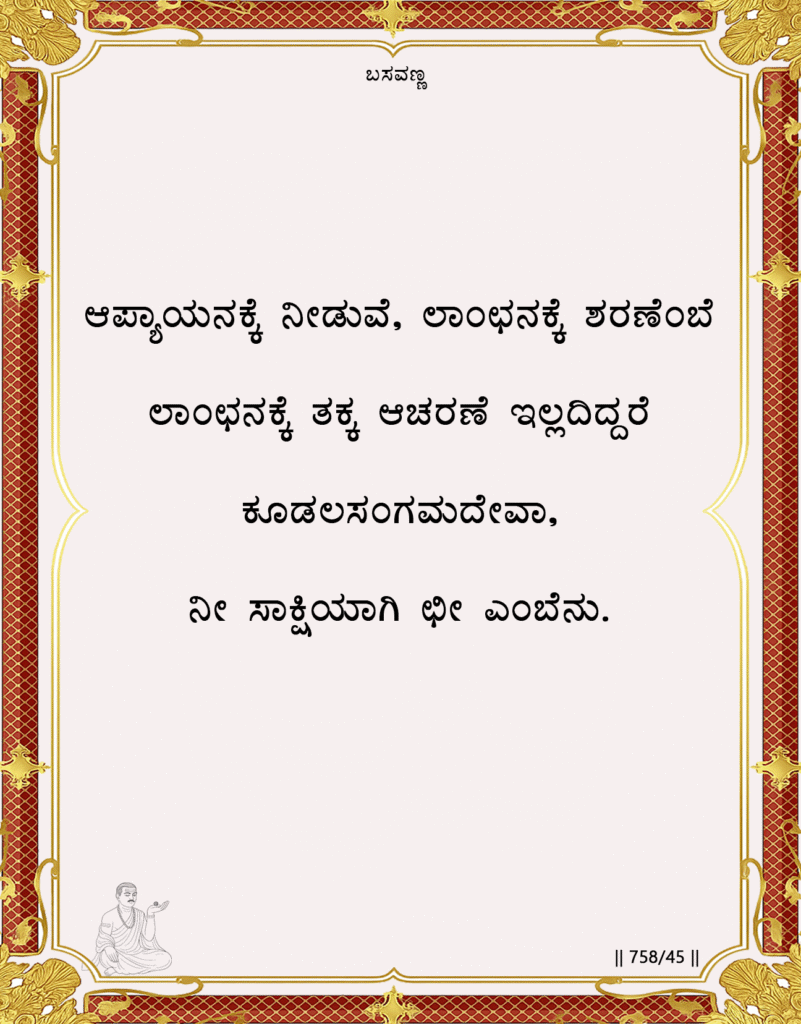
For my own inner fulfilment I offer dāsoha;
seeing the universal Liṅga shining in another,
I bow my head in reverence.
But if one who wears the Liṅga
stands apart from its truth,
then, with You as my witness, O Kudalasangamadeva,
I shall name such a one a pretender
without fear or hesitation.
Basavanna affirms that true devotion begins with sincere service and reverence for the Liṅga in all beings. Yet he also insists on moral clarity: anyone who outwardly wears the Liṅga but lives contrary to its truth must be called out. With the Divine as witness, he refuses to legitimize hypocrisy, distinguishing genuine seekers from mere pretenders.
Spiritual Context
Core Spiritual Principle: Spirituality requires both inner sincerity and communal integrity. While one’s personal practice should be humble and focused on inner growth, it must be coupled with the moral courage to uphold truth within the community. Tolerance of hypocrisy for the sake of false harmony betrays the path itself.
Cosmic Reality Perspective: The Linga is absolute truth (Sat). Hypocrisy is a living falsehood (Asat) that actively obscures this truth. To remain silent in the face of a known pretender is to be complicit in the propagation of Asat. Naming it is an act of alignment with Sat.
Historical Reality (Anubhava Mantapa context): This vachana serves as the community’s immune system. It empowers every member to be a guardian of the path’s integrity, ensuring that the revolutionary symbol of the Linga is not diluted into a meaningless social ornament. It prevents the formation of a corrupt clergy or a privileged class that is above scrutiny.
Interpretation
1. The Foundation of Personal Sincerity: “For my own inner fulfilment I offer…” : Basavanna begins by establishing his own motive as pure. His practice of Dasoha (service) and reverence is for his own spiritual cleansing (Antahkarana Shuddhi), not for public approval. This personal integrity gives him the moral authority to judge.
2. The Vision of Unity: “seeing the universal Liṅga shining in another, I bow…” : This describes his default state seeing the Divine in all. His first impulse is reverence, not judgment. This clarifies that his subsequent stance is not born of cynicism but of a higher responsibility to truth.
3. The Condition for Confrontation: “if one who wears the Liṅga stands apart from its truth…” : The key criterion is duality a disconnect between the outer symbol and the inner reality. The “pretender” is not one who struggles, but one who uses the symbol for ego, power, or social gain while living in opposition to its principles.
4. The Act of Truth-Telling: “I shall name such a one a pretender…” : This is the courageous culmination. The word “name” (cÃ) is powerful. It is an act of clear discernment (Viveka) and fearless speech (Satyavachana). He does this “with You as my witness,” indicating it is a sacred duty performed in alignment with God, not a personal vendetta.
Practical Implications: A seeker must first ensure their own practice is sincere. Then, they must develop the discernment to see the difference between a struggling seeker (who deserves compassion) and a wilful hypocrite (who must be confronted for the health of the community). The practice is to speak truth with courage but without malice, always for the sake of upholding the sanctity of the path.
The Cosmic Reality
Anga (Human Dimension): The individual as both a practitioner of sincere devotion and a guardian of communal truth. The Anga must balance humility with courage.
Linga (Divine Principle): Kudalasangama Deva as the ultimate truth and the witness before whom all hypocrisy is laid bare. The Linga is the standard against which all conduct is measured.
Jangama (Dynamic Interaction): The Jangama is the active principle of upholding integrity. It is the dynamic process of holding the community accountable to the truth it professes, ensuring that the collective movement (Jangama) towards God is not hijacked by ego.
Shata Sthala
Primary Sthala: Maheshwara. This vachana exemplifies the Maheshwara’s role as a spiritual warrior possessing the fierce courage and unwavering resolve to cut through illusion and defend the truth, even when it is socially difficult.
Supporting Sthala: Bhakta. The sincere personal practice of Dasoha and reverence is the foundational work of the Bhakta, which must precede any act of discernment.
Practical Integration
Arivu (Awareness): Cultivate the awareness to discern the spirit behind actions. Can you feel the difference between genuine striving and spiritual posturing in yourself and others?
Achara (Personal Discipline): Let your primary discipline be the alignment of your own inner and outer life. Ensure that your actions match your professed beliefs. This integrity is your license to speak.
Kayaka (Sacred Action): In your professional and communal life, have the courage to call out unethical behavior, especially when it is cloaked in virtuous language. Uphold standards of excellence and integrity.
Dasoha (Communal Offering): The highest Dasoha to your community is to help protect its purity. This may involve having difficult conversations, setting boundaries, or refusing to enable dysfunctional behavior, all done with the intention of healing, not harming.
Modern Application
We live in a culture where “tolerance” is often misinterpreted as moral relativism and a refusal to make judgments. This allows hypocrisy, corruption, and “spiritual bypassing” to flourish unchecked in our institutions, communities, and even in our own spiritual circles, because no one dares to “name” the problem for what it is.
This vachana liberates by giving us permission and a moral imperative to uphold truth. It teaches that love for the community sometimes requires courageous truth-telling. It frees us from the passive aggression and silent resentment that grows when falsehood is tolerated. It is a call to build communities of authentic accountability, where we support each other not by ignoring our flaws, but by lovingly helping each other overcome them.
Essence
I’ll serve in secret, bow to the true,
But when I see a lie wrapped in the hue,
Of sacred robes, I’ll name the deceit,
And stand for truth, firm and complete.
Metaphysically, this vachana enacts the principle of Dharma Rakshana (protection of righteousness). The pretender creates Adharma (unrighteousness) by creating a dissonance between Nama (name/symbol) and Rupa (form/reality). Basavanna’s act of naming is an application of Viveka (discernment) to restore harmony. It is a Sattvic action, as it is performed without personal malice, for the sake of cosmic order (Rta). The vachana beautifully balances the Saguna (with form) aspect of seeing God in all, with the Nirguna (formless) aspect of upholding absolute truth, even when it means confronting a form that bears a sacred name.
True integrity requires both personal sincerity and social courage. Do not use tolerance as an excuse for cowardice. A healthy family, community, or society is one where its members love each other enough to tell the truth, and are committed enough to their shared values to hold each other accountable. Silence in the face of wrongdoing is a form of consent.

Views: 0