Poetic Rendering

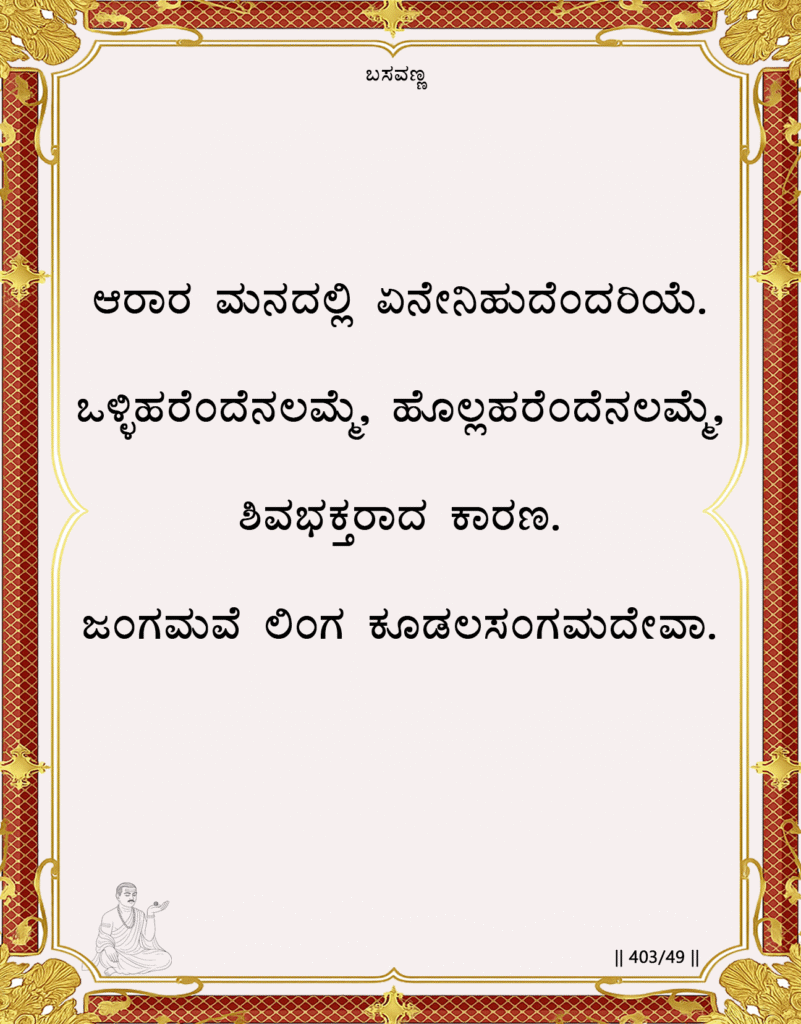
Who can truly know
the secret chambers of another’s heart?
One may be hailed as virtuous,
another scorned as sinful
yet if their inner self rests in Shiva,
they stand sanctified.
For the one who carries the living Linga within,
O Kudalasangamadeva,
is none other than Your own jangama.
Basavanna warns that human judgment is blind to the inner truth of a person’s heart. Reputation good or badmeans nothing before God. What alone matters is the soul’s hidden union with Shiva. Thus, one who embodies this inner Linga, the jangama, must be revered regardless of outward appearance or public opinion.
Spiritual Context
Core Spiritual Principle: Spiritual reality is interior and invisible. External judgments are inherently flawed and irrelevant, for the only true criterion of sanctity is the soul’s hidden, conscious union with the Divine.
Cosmic Reality Perspective: The non-dual truth (Shivadvaita) is that Consciousness (Shiva) is the sole substratum of all beings. This inner reality is veiled by the external world of names, forms, and reputations (nama-rupa). To be deluded by these externals is to live in maya; to perceive the inner Linga is to perceive reality (satya).
Historical Reality (Anubhava Mantapa Context): This Vachana is a radical assault on the caste-based, ritualistic society of 12th-century Karnataka, where a person’s worth was determined by birth and external conduct. Basavanna declares this entire system null and void. He establishes an entirely new, interiorized spiritual aristocracy based not on birth or behavior, but solely on the direct, mystical connection with Shiva, which is accessible to all.
Interpretation
1. “Who can truly know the secret chambers of another’s heart?” The Vachana begins with a profound epistemological humility. It establishes a fundamental limit of human knowledge: we cannot access the inner landscape (antahkarana) of another. This immediately invalidates all social and religious judgment.
2. “One may be hailed as virtuous, another scorned as sinfulyet if their inner self rests in Shiva, they stand sanctified.” Here, Basavanna severs the link between public reputation and spiritual truth. “Virtuous” and “sinful” are labels applied by a blind society. The only thing that matters is the invisible, internal state of “resting in Shiva”a state of unwavering consciousness and surrender to the divine will. This inner state is what confers true sanctification, regardless of external opinion.
3. “For the one who carries the living Linga within… is none other than Your own jangama.” This is the revolutionary conclusion. The “living Linga within” is the realized state of the Pranalingi. The person who has achieved this inner union becomes the Jangamathe moving, human manifestation of God. Therefore, to judge such a one based on externals is not just a social error, but a spiritual blindness, a failure to recognize the Divine itself.
Practical Implications: The seeker is guided to: Relentlessly scrutinize and suspend their own judgments of others. Cultivate the “inner eye” to look beyond appearances and sense the divine presence in all. Understand that their own spiritual practice is an inward journey to make the “hidden truth” of their union with Shiva the unwavering reality of their being.
The Cosmic Reality
Anga (Human Dimension): The Anga is the individual mind that is prone to labeling and judging based on superficial appearances. The purified Anga is one that has heeded this teaching, turning its gaze inward to cultivate its own connection with the Linga and withdrawing its projections onto others.
Linga (Divine Principle): The Linga is “Shiva” as the innermost core of every beingthe “secret chamber of the heart.” It is the static, eternal presence that is the true Self (Atman) of all.
Jangama (Dynamic Interaction): The Jangama is the human being in whom the inner Linga is fully awakened and alive. This person is a “living Linga.” The dynamic interaction is the sacred recognition between one who has the inner Linga and another who has the eyes to see it. It is the manifestation of the formless in form.
Shata Sthala
Primary Sthala: Pranalingi Sthala. This Vachana is the definitive description of this stage. The Pranalingi is precisely the one for whom the Linga is no longer an external symbol but a living reality within the core of their consciousness (prana). Their sanctity is independent of all external validation or condemnation.
Supporting Sthala: Sharana Sthala. The one who has become the “living Linga” (Pranalingi) naturally manifests as the Jangama, the walking embodiment of the divine. This is the state of the true Sharana, who lives and acts as a transparent vehicle for the divine will, irrespective of how they are perceived by the world.
Practical Integration
Arivu (Awareness Practices): Judgment Watch: Maintain a constant mindfulness of your thoughts about others. When a label (“good,” “bad,” “virtuous,” “sinful”) arises, note it and let it go, reminding yourself: “I do not know the secret chambers of their heart.”
Inner Sanctuary Meditation: Daily, turn your awareness inward to the “secret chamber” of your own heart. Rest there in silent communion with the inner Linga, cultivating the state that alone matters.
Achara (Personal Discipline): Make a vow to refrain from gossip and categorical judgments. Speak of others only with necessity and compassion.
Kayaka (Sacred Action): Perform your duties without concern for praise or blame, offering the work to the inner Linga. Interact with colleagues and clients without labeling them, serving the divine presence within them.
Dasoha (Communal Offering): Offer the gift of non-judgmental acceptance to your community. Create a safe space where people are valued for their inner spiritual potential, not their external status or mistakes.
Modern Application
The “Culture of Judgment.” In the age of social media, cancel culture, and 24/7 news cycles, we are constantly encouraged to perform public judgments on others. We reduce complex human beings to their worst mistake or their most popular achievement. This creates a society of anxiety, hypocrisy, and profound loneliness, where people fear being truly seen.
This Vachana offers liberation from the exhausting and toxic game of judgment. It grants the freedom to be authentic, knowing that our worth is not determined by the fickle court of public opinion. It also frees us from the burden of judging others, allowing us to meet people with curiosity and compassion rather than labels. It is the foundation for building communities based on genuine spiritual connection, not superficial performance.
Essence
The world sees the mask, the painted show,
and dares to label saint or sinner.
But You, O Lord, see the silent altar
glowing in the heart’s deep crypt.
The one in whom that flame burns steady,
though the world may scorn or praise,
is Your own breath made human,
is the walking God I must embrace.
This Vachana establishes a radical epistemology for spiritual life. It declares the realm of external perception (drishti) as fundamentally unreliable for knowing truth (satya), which can only be accessed through inner realization (anubhava). Its multidimensional impact is to create a spiritual democracy that is utterly impervious to social hierarchies. It completes the theological arc by internalizing the Linga, which then naturally expresses itself as the Jangama, making every realized individual a sacred center of the universe, independent of location or reputation.
Never confuse a person’s reputation with their soul. The most holy person might be disguised in rags and scorn, while the most lost might be draped in honor. True wisdom lies in looking past all appearances to honor the silent, sacred presence that dwells within every human breast. Your own task is not to manage your reputation, but to tend the divine flame within your own heart.

Views: 0