
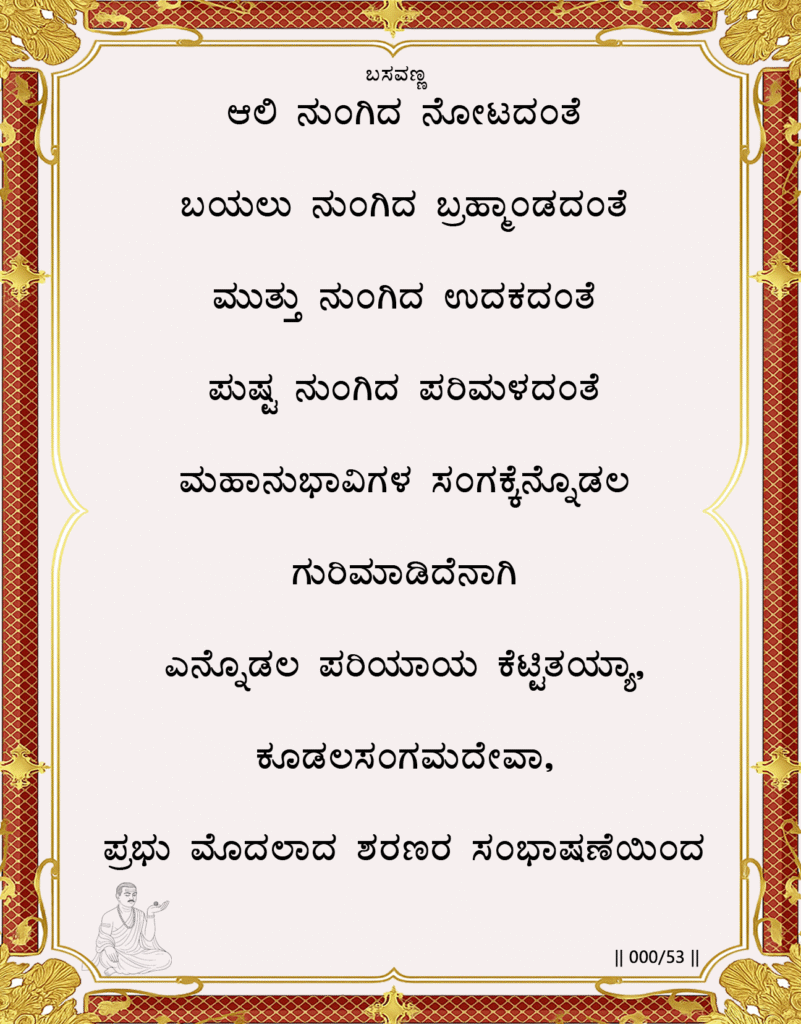
Poetic Rendering

As the eye takes in form
and calls that taking “sight,”
as the vast sky holds all space
yet is never burdened,
as the pearl drinks water
and hides the miracle within,
as the flower conceals
its sweetest fragrance
so too does my small self
disappear without trace
in the company of the true ones.
Sitting near the great sharana,
one like Prabhu himself,
this hard stone of “I”
crumbles into dust,
O Kudalasangamadeva
not by my striving,
but by the quiet alchemy
of holy companionship.
Basavanna shows how subtle, transformative processes like sight, fragrance, or a pearl’s hidden absorption mirror the inner change that occurs in the presence of true sharanas. Near realized souls, the ego dissolves naturally, effortlessly. Spiritual companionship itself becomes the purifier, turning the rigid “I” into humility before Kudalasangamadeva.
Spiritual Context
Core Spiritual Principle: The most profound spiritual transformations occur not through forceful effort, but through receptive exposure to a higher consciousness. The presence of a realized being (Jangama/Sharana) creates a catalytic field that effortlessly erodes the ego.
Cosmic Reality Perspective: The non dual reality operates through laws of subtle influence and resonance. Just as the sky effortlessly contains clouds without being altered, and a flower naturally perfumes its surroundings, the consciousness of a Sharana radiates a transformative influence that purifies receptive minds by the law of spiritual osmosis, not by active intervention.
Historical Reality (Anubhava Mantapa Context): This Vachana reinforces the core social structure of the Lingayat path: the indispensable role of the Sangha (community) and the Guru (exemplified by “Prabhu,” likely Allama Prabhu). It democratizes grace, making it accessible through the simple, egalitarian act of sitting in the company of the enlightened, bypassing the need for complex rituals controlled by a priestly class.
Interpretation
1. “As the eye takes in form and calls that taking ‘sight’…” This metaphor illustrates a process so natural it is unconscious. The eye doesn’t “do” seeing; it is the instrument through which sight happens. Similarly, in Satsang, transformation is not an act of will but a spontaneous occurrence of perception.
2. “…as the vast sky holds all space yet is never burdened…” The sky represents the Jangama’s consciousness spacious, unattached, and unburdened by the forms (seekers) that appear within it. This quality of spaciousness alone creates a liberating environment for the ego.
3. “…as the pearl drinks water and hides the miracle within…” This is a metaphor for subtle, invisible absorption. The pearl undergoes a change by simply being in water. Likewise, the seeker absorbs the qualities of the Sharana subtly and invisibly, with the transformation hidden deep within the soul.
4. “…as the flower conceals its sweetest fragrance ” Fragrance is an emanation of the flower’s very being, not something it actively dispenses. The transformative power of the Sharana is not a taught doctrine but a natural emanation of their realized state.
5. “So too does my small self disappear without trace… this hard stone of ‘I’ crumbles into dust…” The culmination: the ego, which seemed as solid as a stone, is revealed to be as transient as a form in the sky or a scent in the air. Its dissolution is a natural consequence of proximity to the real, just as shadow vanishes in direct sunlight.
Practical Implications: The seeker is guided to: Value the silent, receptive presence in the company of the wise over intellectual debate. Understand that effort (sadhana) is for making oneself receptive; the transformation itself is a gift of grace transmitted through Satsang. Cultivate humility, as the crumbling of the “I” is the desired outcome.
The Cosmic Reality
Anga (Human Dimension): The Anga is the “hard stone of I” and the receptive entity (the “eye,” the “pearl”). Its role is to be present, open, and allowing, to let the process of dissolution occur without resistance.
Linga (Divine Principle): The Linga is the fundamental, spaceless Reality that the Jangama embodies. It is the principle of pure consciousness that remains unmoved and unattached, like the sky.
Jangama (Dynamic Interaction): The Jangama is the Sharana, the “flower” and the “sky.” They are the living conduit. The dynamic interaction is the field of Satsang itself the silent, energetic space where the Linga’s transformative power is transmitted to the Anga, causing the ego to crumble effortlessly.
Shata Sthala
Primary Sthala: Prasadi Sthala. The entire process is an act of grace. The “quiet alchemy” is not self willed; it is the spontaneous action of divine power (shakti) flowing through the Jangama to the receptive devotee.
Supporting Sthala: Maheshwara. This Vachana perfectly illustrates the mechanism of Sacred Company (Satsang), which is the supporting environment for all stages, particularly for the Bhakta to receive grace and for the Maheshwara to have their renunciation deepened.
Practical Integration
Arivu (Awareness Practices): Receptive Meditation: Sit in meditation not to achieve a state, but to receive the silent presence of the Divine. Imagine yourself as the sky, holding thoughts without being them, or as a pearl, absorbing grace.
Contemplation of Natural Law: Reflect on the natural metaphors in the Vachana throughout the day, noticing how transformation in nature is effortless, and aligning your spiritual attitude accordingly.
Achara (Personal Discipline): Prioritize spending time in environments and with people who inspire peace and selflessness. Make Satsang a non negotiable part of your discipline.
Kayaka (Sacred Action): Perform your duties in the spirit of the sky fully engaged yet internally undisturbed. Let your work be an offering that happens through you, not from your ego.
Dasoha (Communal Offering): The highest Dasoha is to become a source of peace and stability for others. As your own “I” softens, your mere presence can become a subtle, fragrant offering to your community.
Modern Application
The “Cult of Forced Transformation.” Modern self help and wellness cultures often promote aggressive goal setting, constant self improvement, and the relentless pursuit of peak performance, which can reinforce the very ego that is the problem. This leads to burnout and spiritual exhaustion.
The Liberative Application: This Vachana offers a liberating counter paradigm: transformation through receptive allowing, not forceful striving. It validates the power of simply being in a healing environment whether a meditation hall, a natural setting, or the company of a wise teacher or community. It relieves the pressure to “fix” oneself and points toward a path of grace, ease, and profound inner change through subtle exposure and resonance.
Essence
The eye receives the world, the sky the cloud,
the pearl the sea, the flower its scent.
No effort made, yet all is changed.
So in the presence of the True,
this noisy “I,” this striving stone,
is worn to silence, smooth and plain,
by the quiet rain of what is Real.
This Vachana presents a metaphysics of spiritual osmosis, where the fundamental substance of the seeker’s consciousness is reconfigured through exposure to a higher energy state of being. It maps a process where the subject object relationship is transcended not by analysis, but by the object (the Sharana) dissolving the subject (the ego) through its mere, immutable presence. Its multidimensional impact is to frame enlightenment not as an acquisition but as a shedding, catalyzed by the most subtle and powerful force in the spiritual universe: sacred companionship.
Do not underestimate the transformative power of your environment and your associations. The greatest changes within you will likely occur not when you are striving alone, but when you are quietly, receptively present in the company of what is true, loving, and wise. Place yourself in the current of grace, and it will carry you home.

Views: 0