Poetic Rendering

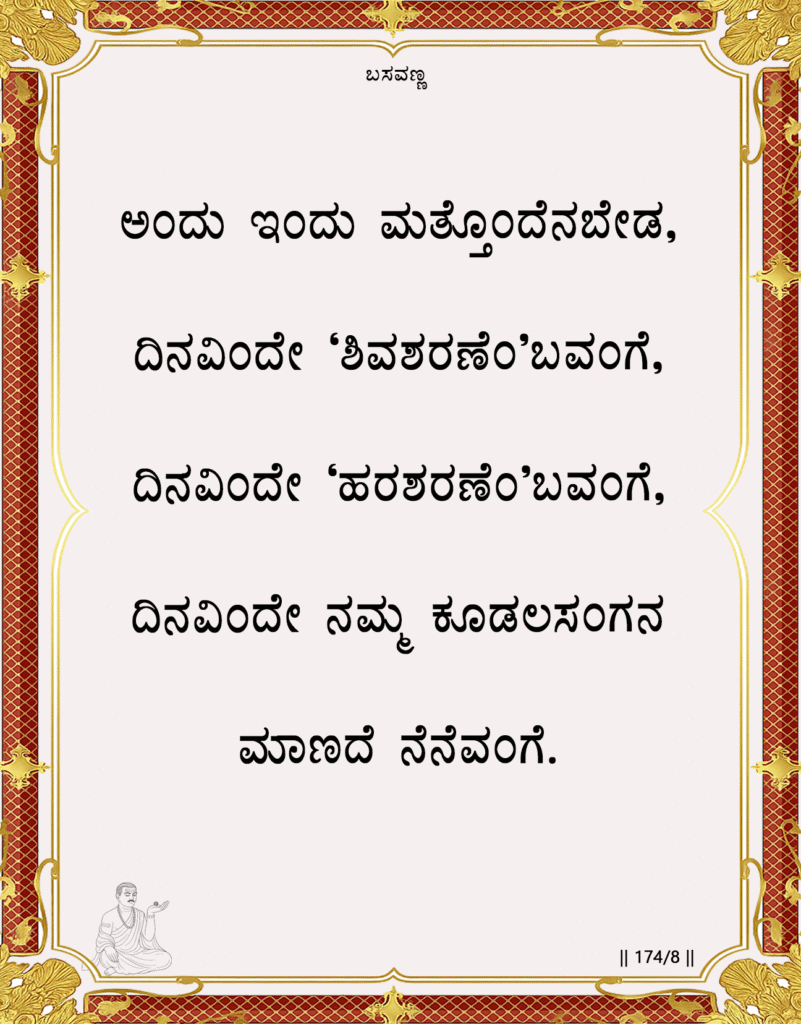
Do not speak of yesterday or tomorrow.
Each day let me live as “Shiva’s sharana,”
each day let me live as “Hara’s sharana,”
each day let me remember our Koodalasangama,
without faltering.
The poet commands to stop speaking of yesterday or tomorrow. He resolves to live each day, in the present moment, as a “Sharana of Shiva” and a “Sharana of Hara,” remembering his Lord Kudalasangama continually and without fail.
Spiritual Context
Core Spiritual Principle: Liberation is not a temporal event but a qualitative shift in consciousness that can only occur in the eternal present (Nitya, the Now). Attachment to past identity or future attainment is the primary obstacle to realizing this ever-present truth.
Cosmic Reality Perspective: The Divine (Shiva/Hara) is timeless, existing in an eternal present. The world of past and future (Kāla) is a construct of the mind (Maya). To align with the Cosmic Reality is to step out of the stream of psychological time and abide in the “now.”
Historical Reality (Anubhava Mantapa context): This vachana cuts through spiritual procrastination and doctrinal debates about past lives or future heavens. It grounds the Lingayat path in radical immediacy and personal responsibility, making spirituality a matter of present-moment integrity and awareness, not philosophical speculation.
Interpretation
1. “Do not speak of yesterday or tomorrow.”: This is a radical injunction to cease the mind’s primary activity. “Yesterday” represents regret, attachment to past glories, and the burden of identity. “Tomorrow” represents anxiety, desire, and the spiritual procrastination of thinking realization will happen later.
2. “Each day let me live as ‘Shiva’s sharana’…”: The repetition of “each day” (¢£À«AzÉÃ) emphasizes the daily, moment-to-moment nature of the commitment. “Sharana” is not a permanent badge but a role to be consciously assumed anew each day, like getting dressed.
3. “…each day let me live as ‘Hara’s sharana'”: The use of different names for the Divine (Shiva, Hara) signifies that the specific form or name is less important than the continuous act of surrender (Sharanagati) itself.
4. “…each day let me remember our Koodalasangama, without faltering.”: This is the essence of the practice: uninterrupted remembrance (Smarana). “Our Kudalasangama” adds a note of intimate, personal relationship. “Without faltering” does not imply perfection, but a continuous, gentle effort to return to the present-moment awareness of the Divine.
Practical Implications: The seeker must vigilantly catch the mind when it wanders into the past or future and gently return it to the question, “What is my state of surrender right now?” Spiritual practice becomes the continuous, gentle effort of abidance in the present, reaffirming one’s identity as a Sharana in this moment alone.
The Cosmic Reality
Anga (Human Dimension): The human as a time-bound entity, the mind constantly oscillating between memory and anticipation. Its purification involves stilling this oscillation to experience the timeless self.
Linga (Divine Principle): Kudalasangama Deva as the eternal, unchanging “Now,” the ever-present ground of being upon which the illusion of time plays out.
Jangama (Dynamic Interaction): The dynamic is the practice of Smarana (remembrance). The Jangama is the active, present-moment choice to remember the Linga, which serves as an anchor that pulls the Anga out of the river of time and into the ocean of the eternal present.
Shata Sthala
Primary Sthala: Sharana. This vachana is the living expression of the Sharana stage. It is the conscious, willful, and continuous act of surrendering one’s temporal identity to live fully in the divine will, moment by moment.
Supporting Sthala: Aikya. The state of “Aikya” or union is not described as a future reward but as the very substance of the present-moment commitment. By being a perfect Sharana now, one is already in union, for the two are not separate.
Practical Integration
Arivu (Awareness): Practice mindfulness of the present moment. Use the breath or a mantra as an anchor. Whenever you notice the mind in the past or future, gently note “this is not now” and return to the awareness of the Linga in the present.
Achara (Personal Discipline): Let your personal vow be: “I will not postpone my spiritual practice.” Refuse to say, “I will be better tomorrow.” Make the commitment to right action, truthful speech, and conscious remembrance in this very moment.
Kayaka (Sacred Action): Immerse yourself fully in the task at hand. Do not work for a future result, but perform the work as an offering in the eternal now. Let the work itself be the meditation.
Dasoha (Communal Offering): Encourage and remind fellow seekers of the power of the present moment. Build a community that supports immediate, authentic living over stories of past achievements or future plans.
Modern Application
Our minds are almost entirely lost in time obsessively curating a digital “yesterday” and anxiously planning for a secure “tomorrow.” This creates chronic stress, a lack of presence in our relationships, and a feeling that life is passing us by. We are constantly becoming, never being.
This vachana is an urgent wake-up call. It liberates by revealing that peace and freedom are always available now, not after the next achievement or when our problems are solved. It teaches us to drop the burden of the past and the anxiety of the future, and to find our true identity and purpose not in time, but in the timeless presence of the Divine within.
Essence
Cut the thread of yesterday’s story,
Sever the cord of tomorrow’s worry.
In this breath, be Shiva’s own,
In this moment, be Hara’s alone.
Metaphysically, this vachana addresses the illusion of linear time (Kāla). The true Self (Atman) is timeless (Kūṭastha). The practice of present-moment remembrance is the means to shift identification from the time-bound psycho-physical apparatus (Anga) to the eternal witness (Linga), realizing their inherent non-duality (Jangama).
The only time we ever have to live, love, or be free is now. All psychological suffering is rooted in being absent from the present moment. The highest wisdom and the most profound peace are found not in the accumulation of time, but in the depth of our attention to the eternal now.

Views: 17