Poetic Rendering

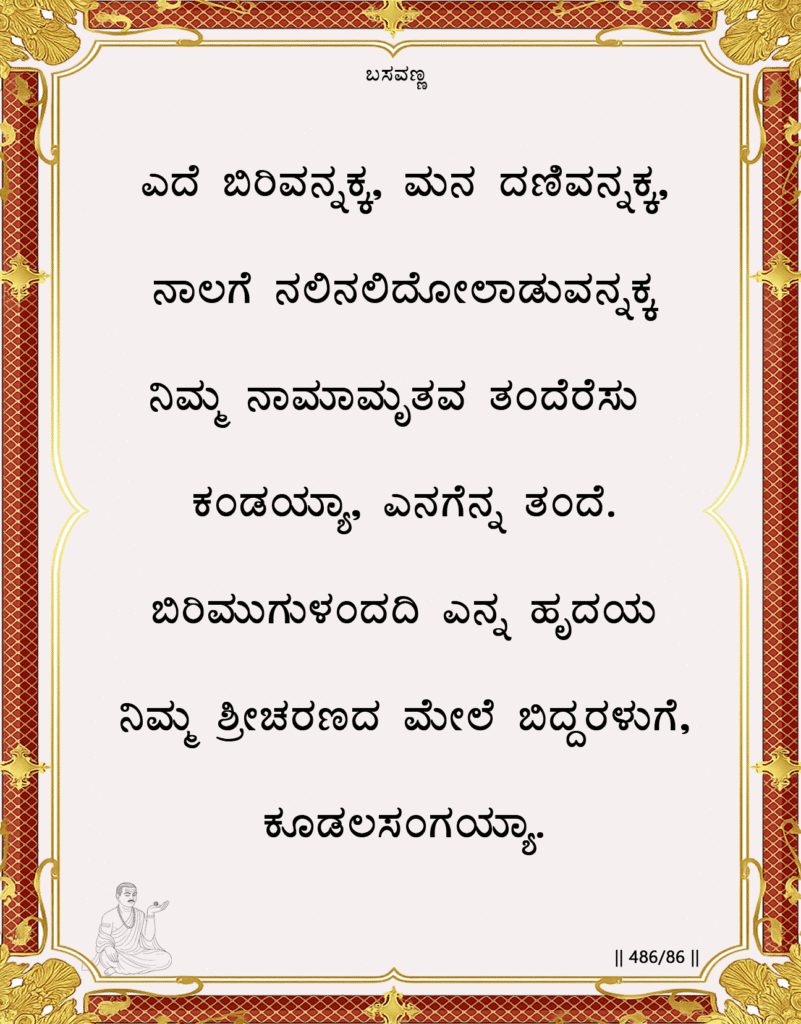
When my heart is full,
when my mind is clear,
when my tongue ripens in Your song
then, Father, pour into me
the nectar of Your name.
Let this blooming heart
soften, fall,
and become dust
at Your sacred feet,
O Koodalasangayya.
In this vachana, Basavanna expresses the final stage of devotion: the wish not for powers, blessings, or liberation, but simply to dissolve at the Lord’s feet. Fulfillment of heart, mind, and speech leads to a deeper longing the desire to surrender completely. The image of a blossoming heart turning to dust symbolizes the ego’s final offering, a peaceful falling away into divine love.
Spiritual Context
Core Spiritual Principle: The ultimate fulfillment of the spiritual path is not an enhanced state of individual being, but the blissful dissolution of the individual into the Divine. The final prayer is for the cessation of the separate self.
Cosmic Reality Perspective: The wave of individual consciousness (Anga) has journeyed through the ocean and now longs not to be a magnificent wave, but to merge back into the silent, depths of the ocean (Linga). This is not annihilation but a return to source, the end of the illusion of separation. The “dust” at the sacred feet symbolizes the most humble, formless state, where the ego has completely yielded and become one with the ground of all being.
Historical Reality (Anubhava Mantapa Context): This Vachana reveals the ultimate goal of the Sharana path. It moves beyond the social revolution and ethical frameworks to the core mystical conclusion. It assures the seeker that the path does not end in a state of glorious individuality but in a peaceful, loving self offering. This was the inner destination that gave meaning to the external struggles and reforms of the Anubhava Mantapa.
Interpretation
1. “When my heart is full, when my mind is clear, when my tongue ripens in Your song ” Basavanna first describes a state of spiritual maturity. The heart is full of love (bhakti), the mind is clear of distractions (shuddha manas), and the speech is perfected in divine praise. This represents the culmination of the Sadhana (spiritual practice).
2. “then, Father, pour into me the nectar of Your name.” At this peak of personal attainment, the seeker does not ask for more power or vision, but for the final transformative agent: the “nectar of Your name.” This represents the direct, grace bestowed experience of the Divine Essence (Rasa), which has the power to dissolve the one who tastes it.
3. “Let this blooming heart soften, fall, and become dust at Your sacred feet…” This is the core of the final surrender. The “blooming heart” is the ego at its most beautiful and successful full of love and spiritual attainment. Yet, the prayer is for this very achievement to “soften, fall,” and become “dust.” Dust is what is trod upon, what is humble, what has no identity of its own. This is the ultimate vairagya (renunciation), the letting go of even the spiritual ego.
4. “O Koodalasangayya.” The use of the intimate, affectionate “Koodalasangayya” (a diminutive, loving form of Kudalasangamadeva) underscores the personal, loving nature of this final surrender. It is not a cold merger but a loving return to the source, addressed as a beloved parent.
Practical Implications: The seeker is guided to: Understand that even spiritual achievements and feelings of devotion are ultimately part of the ego and must be offered up. Cultivate the desire for self dissolution in divine love as the highest goal. See humility and self effacement not as weaknesses but as the final, most profound spiritual virtues.
The Cosmic Reality
Anga (Human Dimension): The Anga is the “blooming heart” that consciously seeks its own end, its transformation into “dust” at the divine feet.
Linga (Divine Principle): The Linga is the “sacred feet” the ultimate refuge, the base and foundation of all existence, the final destination.
Jangama (Dynamic Interaction): The Jangama is the process of “softening and falling” the dynamic, grace filled act of self offering that completes the journey of the soul.
Shata Sthala
Primary Sthala: Aikya Sthala. This Vachana describes the final movement of this stage, where the last vestige of individual identity is willingly offered, resulting in complete union.
Supporting Sthala: Bhakta Sthala is the beginning of the love that culminates in this self offering. Maheshwara Sthala is the renunciation that prepares the seeker for this final letting go.
Practical Integration
Arivu (Awareness Practices): Meditation on Dissolution: Meditate on the image of your “blooming heart” your achievements, your love, your very sense of self softening, falling, and becoming silent, humble dust at the feet of the Divine. Feel the peace of this non being.
Prayer of Self Offering: Use this Vachana as a daily prayer, especially after successful spiritual practice, to ensure that even your successes are offered up and do not become new ego attachments.
Achara (Personal Discipline): Practice humility in all aspects of life. Actively efface the ego by taking the lowest seat, accepting blame, and serving without recognition.
Kayaka (Sacred Action): Perform all actions as an offering that leads to your own “dissolution.” Work without any desire for a result that aggrandizes the self.
Dasoha (Communal Offering): Serve the community in a spirit of self effacement. Become the “dust” that supports the feet of the Sangha, working humbly for the collective good without any need for personal acknowledgment.
Modern Application
“The Spiritual Ego and the Pursuit of Peak Experiences.” The modern wellness and spiritual landscape often glorifies peak experiences, special powers (siddhis), and a “high vibration” identity. This can create a strong spiritual ego, which is a subtler and more stubborn obstacle than the worldly ego.
The Liberative Application: This Vachana is the ultimate cure for spiritual materialism. It liberates the seeker from the need to be a “spiritual somebody.” It validates the longing for quietude, simplicity, and humble anonymity as the highest aspiration. It offers a path that ends not in a grandiose state, but in the peaceful, joyful cessation of the separate self.
Essence
I have polished the mirror until it shines.
Now, I pray for the hand that shatters it.
I have nurtured this flower to its perfect bloom.
Now, I beg for the wind that scatters its petals.
Let not my beauty be my final prison, Lord.
Take this last offering of what I have become,
and leave only the scent of where I have gone.
This Vachana presents the metaphysics of completion. It describes the final phase of the soul’s journey where the very instrument of seeking the individuated consciousness is willingly deconstructed. Its multidimensional impact is to resolve the path into a perfect circle: the soul emanates from the Divine, journeys through the drama of separation and seeking, and ultimately longs for and achieves reabsorption. It positions the Jangama as the final, graceful act of disappearance the loving movement of the soul back into its source, where the triad of Anga, Linga, and Jangama collapses into the silent, non dual Absolute.
The end of your search is not to find yourself, but to lose yourself. The greatest victory is surrender. Do not cling to your spiritual achievements, your loving feelings, or your hard won peace. Offer them all. The most profound peace lies not in being a magnificent someone, but in being no one, dissolved in the love that created you. This is not death; it is the final homecoming.

Views: 0