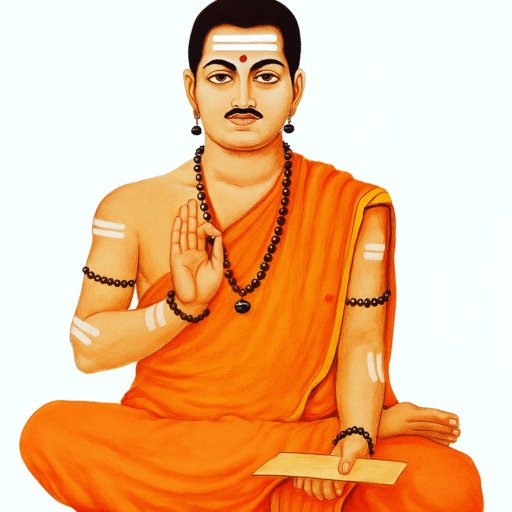

Poetic Rendering

Let me see myself as foe or friend
whichever truth You show me.
If I stand against Your sharanas,
let that be my undoing;
if old, stubborn thoughts cling to me,
burn them in Your awakening flame.
How else shall I know
what to renounce
and whom to embrace?
Keep my head bowed low,
my hands folded in surrender,
O Koodalasangamadeva.
This vachana teaches the deepest form of self honesty and surrender. Basavanna prays to see himself clearly whether as helper or obstacle on the spiritual path. Opposition to the sharanas is recognized as spiritual death, while clinging to old patterns is seen as a barrier that only divine grace can dissolve. By asking the Lord to reveal both his faults and his strengths, Basavanna expresses the essence of inner alchemy: transformation through truthful self awareness and humble surrender. The vachana ends with the devotee bowing completely to the Lord, seeking guidance in every step.
Spiritual Context
Core Spiritual Principle: The most difficult obstacle on the spiritual path is one’s own hidden ego, which can disguise itself as virtue or manifest as resistance to truth. The highest spiritual practice is to actively seek out these hidden faults through divine grace and surrender them for purification.
Cosmic Reality Perspective: The Divine (Linga) is the ultimate Truth and the purifying Fire (tapas). The ego is the primary source of illusion (maya) and separation. For the seeker to align with cosmic reality, this ego must be willingly offered into the divine fire. The process requires the grace of the Linga to act as a mirror, revealing what the ego itself cannot see.
Historical Reality (Anubhava Mantapa Context): This Vachana addresses a critical danger within any spiritual community: spiritual pride and internal hypocrisy. Basavanna, as a leader, models the ultimate humility by publicly praying for his own flaws to be exposed and burned away. This sets a standard for every Sharana, ensuring that the community remains a crucible for authentic transformation rather than a platform for ego. It institutionalizes self scrutiny and surrender as core disciplines.
Interpretation
1. “Let me see myself as foe or friend whichever truth You show me.” The prayer begins with a radical openness to truth, no matter how uncomfortable. The seeker asks for the divine perspective on their own being, willing to be shown that they are their own worst enemy if that is the case.
2. “If I stand against Your sharanas, let that be my undoing…” This identifies the most serious spiritual fault: opposition to the enlightened community and the truth they embody. Basavanna recognizes that such opposition is a form of spiritual suicide and prays for it to be revealed and for its consequences to be swift, so that he may correct course.
3. “…if old, stubborn thoughts cling to me, burn them in Your awakening flame.” This addresses the subtler, persistent residues of the ego: ingrained habits, conditioned thinking, and latent tendencies (vasanas). These cannot be removed by willpower alone; they require the “awakening flame” of divine grace (shakti pat) to be incinerated.
4. “How else shall I know what to renounce and whom to embrace?” This is a confession of the inherent blindness of the ego. Left to its own devices, the ego clings to what is harmful and rejects what is beneficial. True discernment (viveka) is a gift of grace.
5. “Keep my head bowed low, my hands folded in surrender…” The culmination of the prayer is a posture of perpetual humility and receptivity. The “bowed head” symbolizes the end of egoic arrogance, and the “folded hands” symbolize the offering of one’s entire capacity for action to the Divine. This is the stance that allows the alchemy to occur.
Practical Implications: The seeker is guided to: Regularly pray for the revelation of their hidden faults and blind spots. Cultivate a non defensive attitude towards criticism, seeing it as a potential mirror from God. Understand that the destruction of negative patterns is an act of grace, and prepare oneself for it through surrender.
The Cosmic Reality
Anga (Human Dimension): The Anga is the seeker in a state of active, willing self inquiry and surrender, offering their ego to be dismantled.
Linga (Divine Principle): The Linga is the purifying Fire and the revealing Light that shows the Anga its true condition.
Jangama (Dynamic Interaction): The Jangama is the process of revelation and purification. It is the dynamic interplay where the Linga’s grace exposes a fault, and the Anga’s surrender offers it up to be burned away.
Shata Sthala
Primary Sthala: Maheshwara Sthala. This Vachana is a textbook expression of this stage, which is defined by intense inner purification (virakti), the burning away of attachments, and the renunciation of the ego.
Supporting Sthala: Bhakta Sthala provides the devotion and trust necessary to make this terrifying prayer. Prasadi Sthala is the stage where this grace filled purification bears fruit in a transformed consciousness.
Practical Integration
Arivu (Awareness Practices): Prayer for Self Knowledge: Use this Vachana as a daily prayer. Sit in silence and ask, “Show me where I am a foe to my own awakening. Show me what needs to be burned.”
Mindfulness of Reaction: Pay close attention to moments of irritation, defensiveness, or pride, especially in spiritual settings. See these as the “old, stubborn thoughts” that need to be offered to the “awakening flame.”
Achara (Personal Discipline): Make humility and surrender your primary disciplines. Practice accepting feedback and admitting mistakes readily.
Kayaka (Sacred Action): In your work, be willing to have your methods and assumptions challenged. Let your professional life also be a field for burning away stubbornness and embracing higher efficiency and truth.
Dasoha (Communal Offering): Help create a community where loving, truthful feedback is given and received as a form of grace. Support others in their own process of self purification.
Modern Application
“Spiritual Bypassing and Fragile Ego.” In modern spirituality, there is a tendency to use positive affirmations to cover up deep seated flaws (bypassing). Furthermore, the modern ego is often fragile, unable to tolerate any criticism, leading to a culture of blame and defensiveness.
The Liberative Application: This Vachana is the ultimate antidote to spiritual bypassing. It is a call for ruthless, grace supported self honesty. It liberates the seeker from the exhausting project of maintaining a perfect self image and allows for genuine, transformative growth through the conscious embrace of one’s shadows. It builds resilience and authentic strength.
Essence
Do not let me hide from my own darkness, Lord.
Drag it into Your light.
If my shadow falls across the path of the saints,
cut me down to size.
I would rather be Your humble, smoldering ember
than a towering, rotten tree.
My only safety lies in this perpetual bow,
this endless offering of my unworthy self.
This Vachana outlines the metaphysics of transformative purification. It recognizes that the ego is a complex structure that cannot be simply wished away; it must be seen and dismantled by a power greater than itself. The process is one of divine surgery, where the Linga’s light acts as the diagnostic tool and its fiery grace as the surgical instrument. Its multidimensional impact is to ensure that the spiritual path remains a genuine death and rebirth process, not a mere accumulation of knowledge or experiences. It positions the Jangama as the catalytic environment the Sangha and the Guru that often serves as the mirror and the context where these egoic patterns are most vividly revealed and offered up.
The path to growth is not about building a better, more spiritual ego. It is about the courageous and humble work of taking that ego apart. You must be willing to see the worst in yourself to find the best in yourself. Do not fear your flaws; fear the blindness that hides them from you. Invite a higher truth to show you who you really are, and have the courage to surrender what you see. This is the alchemy that turns the lead of your personality into the gold of your spirit.

Views: 0