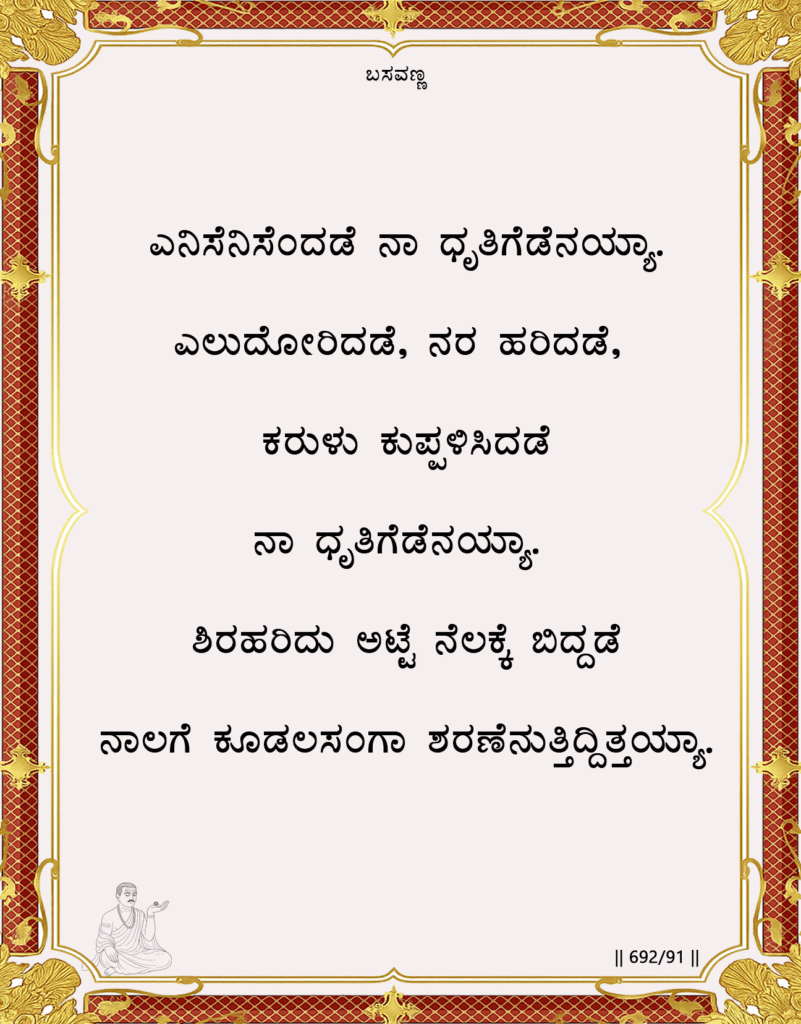
Poetic Rendering

Let troubles come as they will
I shall not fear.
Let my bones tremble,
let my nerves quiver,
let my breath falter
I shall not fear.
Even if this head
is severed and falls to the earth,
this tongue will still cry out
Your holy name,
O Koodalasangamadeva.
Basavanna declares absolute, unshakable devotion. No physical suffering, no fear, not even death itself can break his remembrance of the Divine. Even if his body collapses or his head falls, his last breath, his final movement, will be the chanting of God’s name. This vachana expresses the highest form of surrender devotion that outlives the body.
Spiritual Context
Core Spiritual Principle: The culmination of the spiritual path is a surrender so total that the distinction between the devotee and the Divine dissolves. True devotion is not conditional upon well-being but is an unwavering state of consciousness that persists through all states of existence, including death.
Cosmic Reality Perspective: This Vachana expresses the non-dual realization that the individual self (Anga) is a transient manifestation, while the essential consciousness (Linga) is eternal. The declaration is not from the ego but from that realized consciousness itself, which knows itself to be indestructible and one with the Divine. The body is a temporary vessel; the divine name is the eternal reality.
Historical Reality (Anubhava Mantapa Context): In an era of intense social and religious conflict, this Vachana is a powerful testament to the fearlessness cultivated by the Sharanas. It represents the ultimate defiance against worldly and religious authority that could threaten the body but never touch the spirit. It is the voice of a soul that has achieved absolute inner freedom.
Interpretation
1. “Let troubles come as they will I shall not fear.”: This establishes a state of unconditional equanimity (Sthitaprajna). The seeker has moved beyond a transactional relationship with the Divine, where devotion is offered in exchange for peace or prosperity.
2. “Let my bones tremble, let my nerves quiver, let my breath falter…”: This represents the transcendence of the Annamaya and Pranamaya Koshas (the physical and vital energy sheaths). The devotee witnesses the potential disintegration of the body and its energies without identifying with them. The “I” that declares “I shall not fear” is distinct from the trembling physical form.
3. “Even if this head is severed and falls to the earth…”: This is the ultimate testthe dissolution of the very seat of the individual mind and identity (Manomaya and Vijnanamaya Koshas). The imagery is one of finality and absolute sacrifice.
4. “…this tongue will still cry out Your holy name…”: This is the climax, revealing that the core of his being is the divine name. The remembrance is not an action performed by the body, but the very nature of the consciousness that animates it. It is a declaration that the Jangama relationship has become his eternal, fundamental state (Sahaja).
Practical Implications: For the seeker, this sets the highest standard of devotion. It challenges one to practice remembrance not only in comfort but especially in discomfort, fear, and pain, gradually cultivating a consciousness that is rooted deeper than the body’s frailties.
The Cosmic Reality
Anga (Human Dimension): The Anga is presented in its most fragile and transient aspect: a body subject to decay, terror, and death. However, the true Anga here is the witnessing consciousness that can observe this dissolution without being destroyed by it. It is the self that is ready to be offered completely.
Linga (Divine Principle): The Linga, Koodalasangamadeva, is the sole anchor, the ultimate reality and identity. The Linga is not an external deity but the innermost essence of the devotee’s being, which is why its remembrance can outlast the physical form. It is the ground of being itself.
Jangama (Dynamic Interaction): The Jangama is the spontaneous, unstoppable flow of the divine name. It is no longer a practice but a state of being. This dynamic union is so complete that it becomes the final and only action of consciousness, even at the moment of the body’s demise. The Jangama has become one with the Anga’s very life-force.
Shata Sthala
Primary Sthala: Aikya Sthala. This Vachana is a pure expression of the Stage of Union. The devotee has moved beyond the need for formal worship (Bhakta), internal purification (Maheshwara), or even the reception of grace (Prasadi). The union is so seamless that the devotee’s consciousness and the Divine are functionally identical, even before physical death.
Supporting Sthala: Sharana Sthala. This Vachana exemplifies the ultimate meaning of being a Sharana one who has taken absolute refuge. The quality of fearless, total surrender described here is the very definition of this stage, now perfected and made permanent in Aikya.
Practical Integration
Arivu (Awareness Practices): Practice mindfulness of death (Marana Vichara). Contemplate: “If this were my final moment, what would my mind be holding onto?” Cultivate the practice of returning to the divine name or a sacred symbol as an anchor during moments of fear or anxiety, training the mind to seek refuge there instinctively.
Achara (Personal Discipline): Develop a disciplined commitment to your core spiritual practice (Sadhana) regardless of your physical or emotional state. Do not skip practice because you are tired, upset, or unwell. This builds the resilience of devotion.
Kayaka (Sacred Action): Perform your daily work with the attitude that it is your final offering. Let the quality of your action be such that if you were to die immediately after, it would have been a perfect offering. This infuses every moment with ultimate significance.
Dasoha (Communal Offering): The fearlessness expressed here is a gift to the community. By embodying such unwavering faith, one becomes a pillar of strength and inspiration for others, showing that it is possible to live and die in a state of grace and surrender.
Modern Application
Existential Anxiety and Thanatophobia. Modern society is deeply marked by the fear of death, decay, and meaninglessness. This terror often manifests as a frantic pursuit of security, youth, and distraction. The inability to face mortality leads to a superficial engagement with life and a fragile, fear-based identity.
This Vachana offers the ultimate antidote to existential fear. It presents a vision of an identity that is not contingent upon the body’s survival. By rooting one’s sense of self in a consciousness that transcends the physical (the “divine name”), one can face mortality with equanimity. This liberates immense energy previously spent on resisting the inevitable, allowing one to live with profound courage, passion, and freedom.
Essence
Poetic Summation:
Let the vessel of flesh shatter.
Let the storm of fear pass.
The song within the singer
is untouched by breaking glass.
This final breath is not an end,
but Your name’s first, and last.
1. The Inversion of Ontological Dependence: Common View: The individual self (the “I”) is a product of the body. The body generates life, the life-force supports the mind, the mind engages in thought, and within thought, concepts like “God” or “the Divine Name” arise. In this model, the body is primary, and God is a secondary, abstract concept. The death of the body means the annihilation of the self and the end of its God-idea. Basavanna’s Realized View: This Vachana completely inverts this. Here, Koodalasangamadeva (the Linga) is the primary, uncaused reality. The individual consciousness (the true “I” that speaks the Vachana) is a direct expression of that reality. This consciousness temporarily animates a body-mind complex (the Anga). The “tongue” that cries out is not ultimately the physical organ but the fundamental, expressive power (Vak) of the Divine itself, using the human apparatus as its instrument. Therefore, when the body dies, the source of the Divine Namewhich is the Divine itselfis utterly unaffected. The death of the body is like a wave collapsing back into the ocean; the ocean of Divine Consciousness remains.
2. Transcendence of the Koshas (Sheaths of Being): The Vachana’s progression mirrors the sequential transcendence of the five sheaths that veil the true Self: “Let my bones tremble…” = Annamaya Kosha (The Food Sheath): This is the physical body. Basavanna witnesses its potential destruction without identifying with it.”let my nerves quiver, let my breath falter…” = Pranamaya Kosha (The Vital Energy Sheath): This is the level of life-force, sensation, and instinctual fear. He remains as the awareness watching these energies become destabilized.”Even if this head is severed…” = Manomaya & Vijnanamaya Koshas (The Mental & ntellectual Sheaths): The head is the seat of the thinking mind and the ego-sense (“I am this individual”). Its severance represents the final dissolution of the individual, separate self.”…this tongue will still cry out Your holy name.” = Anandamaya Kosha (The Bliss Sheath) and Beyond: What remains after the other sheaths are stripped away is not nothingness, but the core reality: the eternal, blissful consciousness whose very nature is the vibration of the Divine Name. This is the state of the Self (Atman), one with the Absolute (Linga).
3. The Name as Non-Dual Reality, Not a Concept: Metaphysically, the “holy name” is not a word Basavanna remembers intellectually. It is the Nada-Brahmanthe reality of the Divine as transcendent, immanent sound-vibration. In the highest state of realization, the seeker’s consciousness becomes one with this vibration. Therefore, the “crying out” is not an action he performs; it is the spontaneous, autonomic expression of his realized state, much like a star shines or a river flows. It is the Sahaja Sthitithe natural state.
4. The Jangama as the Unbroken Circuit of Grace: In this ultimate state, the Triad does not collapse into a static oneness but reveals its true nature as a dynamic, self-sustaining circuit.Anga: The total psycho-physical apparatus in a state of final offering.Linga: The absolute, foundational Reality (Koodalasangamadeva).Jangama: The perpetual flow where the Anga’s dissolution is its final, perfect offering to the Linga, and the Linga’s response is the continuous emanation of its Name as the very consciousness of the Anga. The relationship is so complete that it outlives the mechanism that once seemed to facilitate it.
This Vachana addresses the most fundamental human anxiety: the fear of annihilation. It proclaims that our true identity is not the fragile, temporary collection of body and mind, but an indestructible consciousness that is one with the Eternal. The path to conquering all fear, therefore, is not to fortify the temporary self, but to discover through direct experience that which never dies. This is the birthright of every human being: to realize that our essence is divine, and that this essence cannot be touched by birth, life, or death. It is a call to shift our allegiance from the mortal to the immortal within.

Views: 0